Not every away game is created equal, and some trips are significantly more difficult than the betting board makes them look.
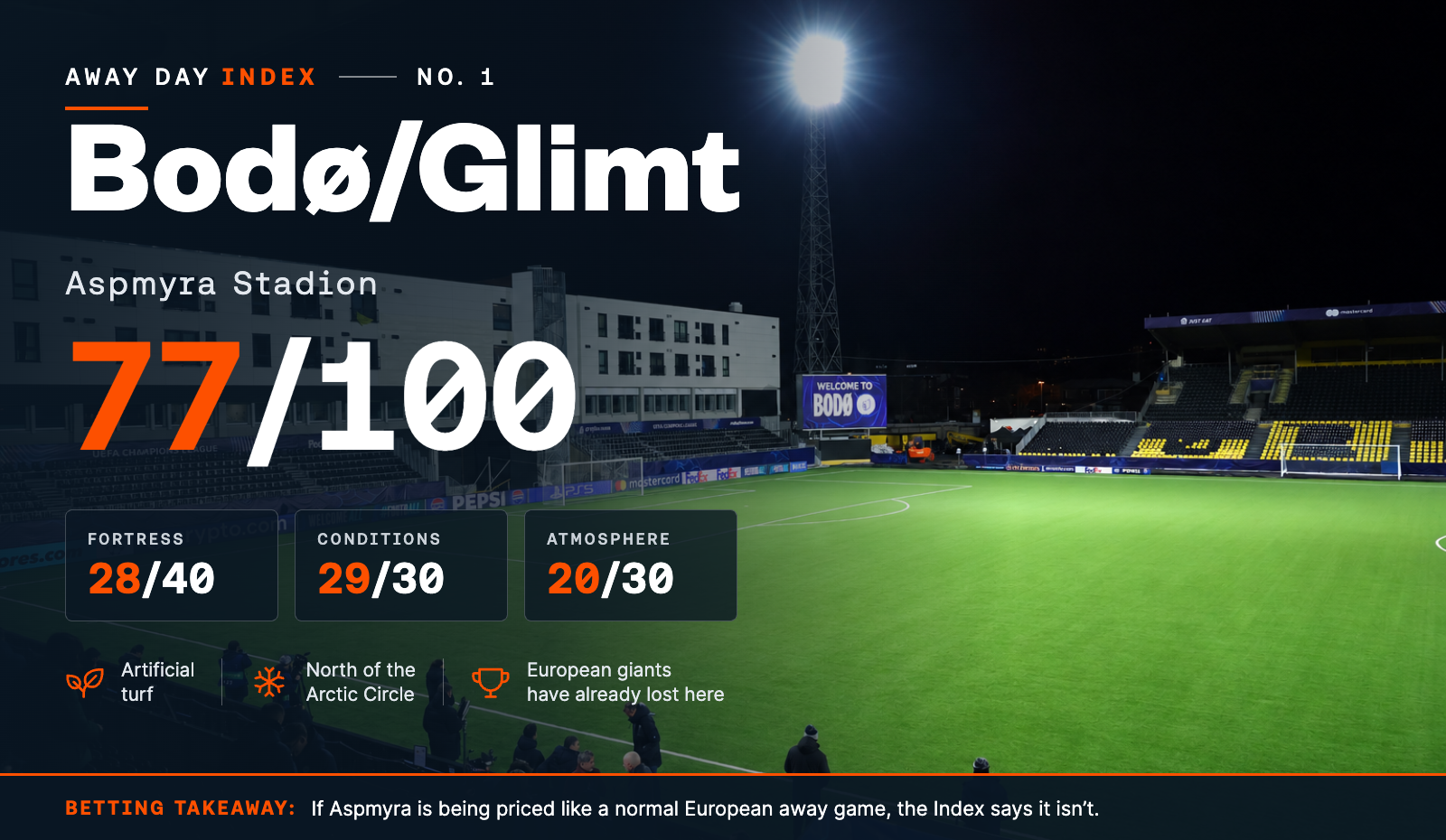
Playing Bodo/Glimt at Aspmyra, for example, is basically like going to Costco on the Friday of a long weekend — except the Costco is beyond the Wall, north of the Arctic Circle, and somebody replaced the floor with artificial turf.
That's the idea behind the Covers Away Day Index. Using five seasons of home-vs-away results, European performance, conditions, travel, playing surface, and atmosphere, I've ranked the stadiums that make life toughest on visiting teams — and identified where that added difficulty could matter to bettors.
The goal isn't to find Europe's best home teams. It's to measure how much harder a match becomes because of where it's being played.

- 🥶 Bodo/Glimt rank No. 1 because Aspmyra combines proven European home success with artificial turf, Arctic weather, and one of the most unusual road trips in European soccer.
- 🏠 Atletico Madrid own the strongest five-year domestic home effect in the study, gaining nearly a full point per game at home compared with away.
- 🔊 Atmosphere matters, but it isn't everything. Liverpool, Dortmund, Galatasaray, PAOK, Marseille, and Celtic all score at or near the crowd ceiling, but none rank No. 1.
- 👀 Reputation does not guarantee a spot. Bayern Munich, PSG, Fenerbahce, Feyenoord, and Red Star all miss the Top 20 once team quality is separated from venue impact.
- 💰 This is not a system for blindly betting home teams. The Index is designed to identify away assignments where the market may be treating an abnormal road trip like a normal one.
How the Away Day Index works
The Index is built around three questions: Does the team become better here? Is the trip unusually difficult? And how much does the stadium itself add?
| Category | Max | What it measures |
|---|---|---|
| Fortress | 40 | How much better the club performs at home, domestically and against European opposition. |
| Conditions | 30 | Surface, weather, altitude, travel, geography, time zones, and other physical adjustments. |
| Atmosphere | 30 | Attendance, supporter culture, noise, stadium design, proximity, and opponent testimony. |
Total: 100
Underneath that simple score is five years of research designed to separate great teams from great home environments. This isn't a power ranking of European clubs; a team can be dominant everywhere and still have a relatively small venue-specific advantage.
One quick note on the numbers: when I refer to a team's "home lift," I'm talking about the difference between its weighted home and away points per game across the five-season sample. A +0.50 lift means the club earns about half a point more per home league match.
Enjoying Covers content? Add us as a preferred source on your Google account
Away Day Index: Europe's 20 toughest stadiums
| Rank | Club / Stadium | Index |
|---|---|---|
| 1 | Bodo/Glimt Aspmyra Stadion |
77 |
| 2 | Atletico Madrid Riyadh Air Metropolitano |
72 |
| 3 | Liverpool Anfield |
72 |
| 4 | Borussia Dortmund Signal Iduna Park |
68 |
| 5 | Real Madrid Santiago Bernabeu |
67 |
| 6 | Galatasaray Rams Park |
67 |
| 7 | PAOK Toumba Stadium |
67 |
| 8 | Newcastle United St James' Park |
66 |
| 9 | Roma Stadio Olimpico |
66 |
| 10 | Marseille Stade Velodrome |
66 |
| 11 | AEK Athens ALLWYN Arena |
66 |
| 12 | Slavia Prague Fortuna Arena |
65 |
| 13 | Athletic Club San Mames |
65 |
| 14 | Rangers Ibrox Stadium |
65 |
| 15 | Celtic Celtic Park |
65 |
| 16 | Olympiacos Georgios Karaiskakis Stadium |
63 |
| 17 | Club Brugge Jan Breydel Stadium |
62 |
| 18 | Inter San Siro |
60 |
| 19 | Arsenal Emirates Stadium |
59 |
| 20 | Porto Estadio do Dragao |
59 |
Why Bodo/Glimt rank No. 1
Bodo/Glimt don't have Europe's biggest stadium, loudest crowd, or strongest domestic home-vs-away split. What they do have is a combination almost nobody else can match: artificial turf, Arctic conditions, unusual travel, and a European home record that shows those factors aren't just background noise.
Visiting teams have to change more than their hotel reservation. They're travelling north of the Arctic Circle, preparing for a synthetic surface, and potentially dealing with cold, wind, or snow in an environment that looks nothing like a normal road game in England, Spain, Italy, or Germany.
And some of Europe's biggest clubs have already found out the hard way. Bodo have beaten Roma 6-1, Porto 3-2, Lazio 2-0, Manchester City 3-1, Inter Milan 3-1, and Sporting CP 3-0 at Aspmyra across their recent European runs. Roma's loss was the first time a Jose Mourinho-coached team had ever conceded six goals, while the Manchester City win came against a former Champions League winner.
That's why Aspmyra scores 77/100 despite earning only 20/30 for Atmosphere. Bodo aren't No. 1 because they're the loudest or most famous — they're No. 1 because the conditions are unusual, the trip is difficult, and the results prove those advantages travel up in class.
Only three stadiums cracked 70
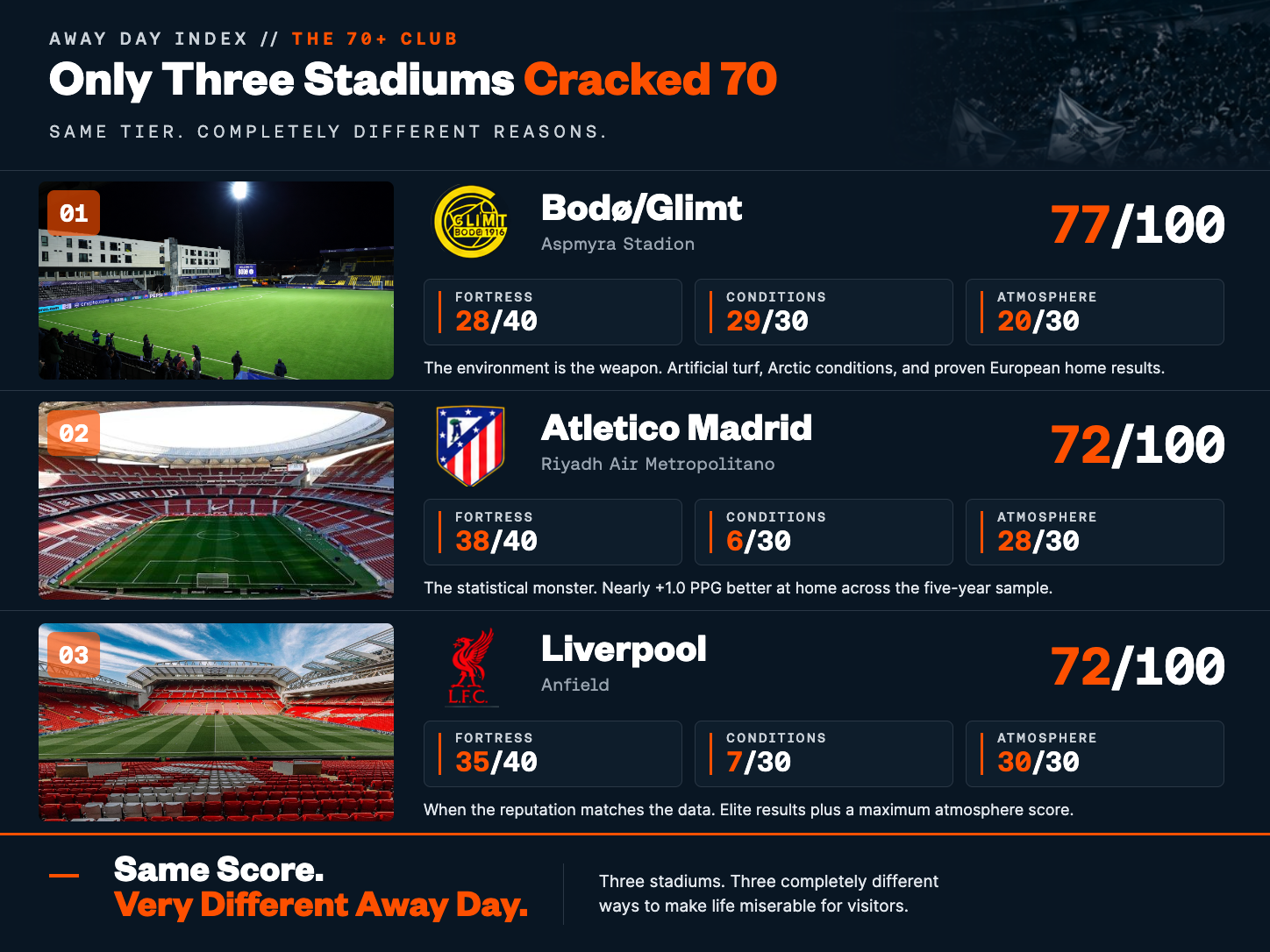
Aspmyra stands alone at 77, but two of Europe's most famous clubs aren't far behind. Atletico Madrid and Liverpool both score 72/100, although they get there in almost completely different ways.
Atletico's case is built around one of the strongest measurable home advantages in the study. Liverpool combine elite home results with the only thing Anfield has never struggled to sell: atmosphere.
Atletico Madrid: The ultimate statistical fortress
Atletico don't need artificial turf, Arctic weather, or a brutal travel itinerary to make an away team uncomfortable. Across the five-year weighted sample, they improve by roughly 0.96 points per game at home compared with away — the largest domestic home effect in the entire field.
In plain English, Atletico's results improve by nearly a full league point per match when they're playing in Madrid. There's no trick here: playing Atletico at the Metropolitano is less "survive the elements" and more "walk into a vice and see how long you last."
The Metropolitano adds a huge crowd and strong European evidence, but the foundation of its 72/100 score is simple: Atletico become a materially better team when the match is played at home.
Betting takeaway: Don't judge Atletico solely by their overall form. Their home and away performances have been different enough over five seasons that location should be one of the first things bettors account for.
Liverpool: When the reputation matches the data
Anfield almost feels too obvious for a list like this. The difference is that Liverpool's reputation survives the numbers, with a positive home lift in all five seasons studied and a weighted advantage of roughly 0.63 points per game.
There also isn't much physically unusual about the trip. Liverpool score just 7/30 for Conditions, but make up for it with a 35/40 Fortress score and the maximum 30/30 for Atmosphere.
Anfield is basically the horror movie where everybody knows what's behind the door, opens it anyway, and still gets wrecked. Visiting teams know exactly what's coming, and five years of results suggest that hasn't made dealing with it much easier.
Betting takeaway: Anfield becomes most important when the teams are otherwise closely matched. Liverpool don't need a weird surface or extreme weather for the venue itself to help tilt the matchup.
When the crowd becomes part of the matchup
Bodo can make an away team uncomfortable before it even lands. The next group does most of its damage after the turnstiles start moving.
These stadiums aren't ranked because somebody found a loud YouTube clip. The atmosphere has to sit alongside a measurable home effect, European evidence, or both.
4. Borussia Dortmund — Signal Iduna Park: 68/100
Everybody knows the Yellow Wall, which almost works against Dortmund in an exercise like this — the reputation is so enormous that the numbers have to prove it isn't just a postcard. They do: Dortmund averaged a weighted 2.26 points per game at home compared with 1.65 away across the five-year sample, a roughly +0.60 lift, and finished with a positive home advantage in every season studied.
The European receipts are even better. During their run to the 2024 Champions League final, Dortmund beat Atletico Madrid 4-2 at Signal Iduna Park in the quarterfinals before beating PSG 1-0 there in the semifinal. The trip to Dortmund is ordinary; then the Yellow Wall fills up, and the numbers start looking a lot less ordinary.
6. Galatasaray — Rams Park: 67/100
Galatasaray's weighted home lift of +0.36 points per game doesn't jump off the page like Atletico's, largely because Gala have also been excellent away. The raw home record tells the story better: over the three most recent seasons in the sample, Galatasaray went a ridiculous 46-7-1 in domestic league matches at Rams Park.
European visitors haven't been immune either. Gala beat Marseille 4-2 there in 2021 and Tottenham 3-2 in the 2024-25 Europa League, helping justify both a 14/15 European score and the maximum 30/30 for Atmosphere. There is nothing particularly strange about getting to Rams Park. Playing there is the strange part.
7. PAOK — Toumba Stadium: 67/100
Toumba looks like the kind of stadium where the visiting locker room should come with a waiver form, but PAOK have numbers behind the intimidation. Their five-year weighted home lift is +0.49 points per game, and in 2025-26 they went 12-4-0 at home while averaging 2.50 points per game, compared with just 1.50 away.
The European evidence gives the 30/30 Atmosphere score even more credibility. PAOK overturned a two-goal first-leg deficit by smashing Dinamo Zagreb 5-1 at Toumba in 2024, then followed with home wins of 5-0 over Ferencvaros and 2-0 over Slavia Prague the next season. Toumba doesn't just look hostile. The results say visiting teams feel it too.
10. Marseille — Stade Velodrome: 66/100
If you've never watched Marseille at home, imagine putting 60,000-plus people inside a giant concrete mixing bowl and giving almost all of them the same emotional problem. The interesting part is that the data shows when the Velodrome really started becoming a weapon: Marseille were actually better away in the two oldest seasons of the sample before their home advantage exploded.
In 2023-24 alone, Marseille went 10-6-1 at home compared with 3-5-9 away, a massive +1.29 PPG gap. That same season, the Velodrome produced European wins of 4-3 over Ajax, 4-0 over Villarreal, and 1-0 over Benfica before Marseille advanced on penalties. The Velodrome has always looked insane. More recently, Marseille have started playing like it too.
14. Rangers — Ibrox Stadium: 65/100
Ibrox sits just below the atmosphere ceiling at 29/30, but this isn't simply an Old Firm reputation score. Rangers produced a positive home lift in all five seasons studied, including a +0.68 PPG advantage in 2024-25 when they went 14-2-3 at Ibrox compared with 8-7-4 away.
The best proof came on their run to the 2022 Europa League final. Rangers overturned knockout ties at Ibrox with 3-1 wins over Braga and RB Leipzig, the latter sending them to their first European final in 14 years. Ibrox is at its best when a European tie stops feeling like a soccer match and starts feeling like a public referendum.
15. Celtic — Celtic Park: 65/100
Celtic Park gets the full 30/30 for Atmosphere, but the Index doesn't let the mythology do all the work. Celtic posted a positive home-vs-away lift in all five seasons of the study, producing a weighted advantage of roughly +0.40 points per game.
The European proof isn't as deep as Dortmund or Galatasaray, which is why Celtic receive only 9/15 in that category, but the recent highs matter. In the 2024-25 Champions League, Celtic beat Slovan Bratislava 5-1, RB Leipzig 3-1, and Young Boys 1-0 at Celtic Park. The noise is real; the model just refuses to let it write the entire story.
16. Olympiacos — Georgios Karaiskakis Stadium: 63/100
Olympiacos don't have one overwhelming statistical hammer, but the home effect keeps showing up. They finished with a positive home lift in all five seasons studied, including a 12-4-0 domestic home record in 2024-25, while their five-year weighted advantage sits around +0.29 points per game.
Then there are the European nights. Olympiacos beat reigning Conference League champion West Ham 2-1 in Piraeus in 2023, then knocked off Fenerbahce 3-2 and Aston Villa 2-0 at home during their run to the 2024 Conference League title. No single factor makes Karaiskakis terrifying; it's the pile-up of results, crowd pressure, and little inconveniences that make the trip miserable.
The teams that change when they get home
The next group is less about smoke, tifos, and intimidation videos. Their warning sign is sitting directly in the home-vs-away numbers.
For bettors, these may actually be some of the most useful venues in the Index because the badge doesn't always scream "fortress" before the data does.
8. Newcastle United — St James' Park: 66/100
There is nothing exotic about travelling to Newcastle. There is something extremely inconvenient about playing Newcastle once you arrive: across the five-year sample, the Magpies averaged a weighted 1.88 points per game at home compared with just 1.17 away, a +0.71 lift that ranks among the strongest in the entire study.
The split became ridiculous in 2023-24, when Newcastle went 12-4-3 at St James' Park compared with 6-2-11 away. Then came the European receipt: Paris Saint-Germain walked into Newcastle for the club's first Champions League home match in more than 20 years and got hammered 4-1. Newcastle on the road and Newcastle at St James' Park can look like two different teams wearing the same shirt.
9. Roma — Stadio Olimpico: 66/100
Roma might be one of the biggest beneficiaries of actually doing the homework. They posted a positive home lift in all five seasons studied, with a weighted average of 2.11 PPG at the Olimpico compared with 1.47 away — approximately +0.65 difference in Serie A.
The European results fit the profile. Roma demolished Brighton 4-0 at home in the 2024 Europa League Round of 16 and beat AC Milan 2-1 there in the quarterfinals, while their 2024-25 run included home wins over Braga and Eintracht Frankfurt. Rome wasn't built in a day, and apparently neither was this home advantage.
11. AEK Athens — ALLWYN Arena: 66/100
AEK are a useful reminder that a stadium doesn't need 100 years of ghosts to become difficult quickly. ALLWYN Arena only opened in September 2022, so the Index throws out the club's old-stadium results and uses only the relevant current-ground sample — which still produces a weighted +0.56 PPG home lift.
The first full season at the new ground made the point pretty quickly: AEK went 14-4-0 at home in 2023-24, compared with 9-5-4 away. They followed that with a 13-2-1 home record in 2025-26, and while the European evidence is more mixed than the teams above them — reflected in a 10/15 European score — the domestic venue effect is already undeniable. New stadium, old-school problem for the away team.
12. Slavia Prague — Fortuna Arena: 65/100
Slavia may be the quietest monster in the Top 20. Their weighted five-year home average is an absurd 2.70 points per game compared with 2.08 away, and twice in the sample they came frighteningly close to domestic perfection.
In 2022-23, Slavia went 17-1-0 at home. Two seasons later, they removed the draw and went a perfect 18-0-0. Europe has supplied receipts too: during the 2023-24 Europa League campaign, Slavia won their first four home matches, including qualifying, by a combined 13-0, with a 2-0 win over Roma as the headline result. If you're waiting for the badge to tell you this trip is dangerous, you're already late.
13. Athletic Club — San Mames: 65/100
San Mames doesn't need a gimmick. Athletic produced a positive home lift in all five seasons studied, averaging a weighted 1.82 PPG at home compared with 1.20 away — a +0.62 gap while playing every week in La Liga.
The 2024-25 Europa League turned that domestic trend into European proof. Athletic beat AZ Alkmaar, Slavia Prague and Viktoria Plzen at San Mames before overturning Roma 3-1 in the Round of 16 and beating Rangers 2-0 in the quarterfinals. Sometimes the scary condition is simply having to play Athletic in Bilbao.
17. Club Brugge — Jan Breydel Stadium: 62/100
Club Brugge don't dominate any one category, which is almost what makes them dangerous. Their weighted domestic home lift sits at a solid +0.42 PPG, and in 2025-26 they went 16-2-2 at home compared with 12-2-6 away.
The European resume is what pushes Jan Breydel higher. During the 2024-25 Champions League alone, Club Brugge beat Aston Villa 1-0, Sporting CP 2-1, and Atalanta 2-1 at home; entering the Villa knockout tie, UEFA noted they had lost just once in their previous 13 home European matches. The name on the visitor's shirt can be bigger. That doesn't mean the trip is easier.
Great team doesn't always mean great home-field advantage
This is where the Index starts picking fights with reputation. A club can be terrifying and still not have one of Europe's biggest venue effects if most of that dominance follows them onto the road.
That distinction is why Real Madrid can rank fifth while Inter sit 18th, and why Bayern Munich miss the Top 20 altogether. The question isn't simply "How good is this team?" It's "How much more difficult do they become because this game is being played here?"
5. Real Madrid — Santiago Bernabeu: 67/100
The Bernabeu is the control case for the entire project. Madrid averaged a weighted 2.55 points per game at home compared with 2.00 away across the five seasons, including a 16-3-0 home league record in 2023-24 and back-to-back 16-win home seasons after that.
Then there's the 15/15 European score. Bayern Munich led Madrid in the 2024 Champions League semifinal until the 88th minute, only for Joselu to score twice — in the 88th and 90+1 — and send Real to another final. There is no gimmick at the Bernabeu. Sometimes 87 good minutes still buy you absolutely nothing.
18. Inter — San Siro: 60/100
San Siro ranking 18th will probably annoy somebody, which is precisely why the Index is useful. Inter averaged 2.33 weighted PPG at home and 2.13 away, giving them a relatively modest +0.20 venue lift; in their dominant 2023-24 Serie A season, they were actually slightly better away.
That's not the same as saying San Siro doesn't matter. Inter earn 14/15 for European performance, reached Champions League finals in 2023 and 2025, and beat Barcelona 4-3 after extra time at San Siro in one of the wildest semifinals in recent memory. Great team. Great stadium. Much smaller domestic venue effect than the mythology might suggest.
19. Arsenal — Emirates Stadium: 59/100
The Emirates probably isn't anyone's first answer to "Where do away teams go to die?", and that's what makes Arsenal's inclusion interesting. The Gunners produced a positive home lift in all five seasons studied, averaging 2.33 weighted PPG at home compared with 1.97 away.
The European evidence has caught up with the domestic numbers too. Arsenal beat PSG 2-0 at the Emirates during the 2024-25 Champions League league phase, then dismantled defending champion Real Madrid 3-0 there in the quarterfinals. Not every fortress needs smoke, flares, and a moat. Sometimes it just needs Declan Rice bending two free kicks past Real Madrid.
20. Porto — Estadio do Dragao: 59/100
Porto don't have one cartoonishly difficult feature, but they have produced a positive domestic home lift in all five seasons studied. Their weighted gap sits at +0.31 PPG, with the biggest recent split coming in 2024-25 when Porto went 13-3-1 at home compared with 9-2-6 away.
The Dragao has also produced the kind of European result that makes a favorite check the fine print. Arsenal visited in the 2024 Champions League Round of 16 and left without a shot on target or a point after Galeno scored a 90+3 winner in Porto's 1-0 victory. Porto are the index-card version of annoying: nothing outrageous, just consistently difficult — right up until somebody scores in stoppage time.
Who just missed the Top 20?
Some of the omissions may be more surprising than the inclusions, which is part of the point. Famous stadiums don't receive automatic credit if the team's success travels almost as well as it performs at home.
Bayern Munich are one of Europe's best teams, but their dominance travels too well for the Allianz Arena to generate the kind of venue-specific lift required for the Top 20.
Paris Saint-Germain tell a similar story. PSG have often been almost as dangerous away from Paris, limiting how much of their success can honestly be assigned specifically to Parc des Princes.
Fenerbahce have an atmosphere worthy of the Top 20, but their weighted five-year domestic home lift is only around +0.13 PPG. That wasn't enough to overcome the stronger performance profiles immediately above the cut line.
Feyenoord grade brilliantly for atmosphere at De Kuip, but the broader five-year home-vs-away evidence isn't strong enough to keep them inside the final 20.
Red Star Belgrade remain one of Europe's most intimidating trips by reputation, but their domestic dominance travels extremely well, and recent elite-European results are mixed.
PSG: same problem — too little venue-specific lift.
Fenerbahce: elite atmosphere, weaker five-year home lift.
Feyenoord: atmosphere grades better than the broader home-away split.
Red Star Belgrade: intimidating reputation, mixed recent elite-European evidence.
How bettors should use the Away Day Index
The easiest mistake would be treating the Top 20 like a list of automatic home bets. That's not what the Index is: a bad price is still a bad price, and a poor matchup doesn't suddenly become attractive because the home stadium ranks highly.
Instead, use the Index as an adjustment to the handicap. Separate the home team's home and away performance, identify anything unusual the visitor has to prepare for, and then ask whether those disadvantages are already reflected in the market.
Take Newcastle as an example. If you're building an opinion from their full-season numbers without accounting for a five-year home lift of roughly +0.71 PPG, you're blending two very different performance profiles together. The same applies in a different way at Bodo, where the question is less about a huge domestic split and more about whether the price fully accounts for artificial turf, Arctic conditions, travel, and proven European home success.
The most interesting spots may come when name recognition points in the opposite direction. If a Champions League heavyweight is taking public money at Slavia Prague, PAOK, Club Brugge, or Bodo because casual bettors recognize the badge more than the venue, that's exactly the type of matchup the Index is designed to flag.
The bet isn't "home team good." The bet is whether the market has properly priced the away team's problem.
What about rivalry games?
The permanent Away Day Index measures the stadium itself, but not every opponent receives the same welcome. A North American fan probably doesn't need an explanation for Yankees-Red Sox or Maple Leafs-Canadiens; Marseille-PSG or Inter-Juventus may require a little more context.
That's why rivalry stays outside the permanent /100 score. It can instead be added as a match-specific Rivalry Heat layer when history, supporter hostility, cultural significance, competitive stakes, or recent bad blood turns a difficult stadium into something even nastier.
Think Celtic hosting Rangers or Marseille hosting PSG. The stadium's permanent Away Day Index score doesn't change, but the specific opponent can make that particular away assignment meaningfully more hostile than an ordinary league visit.
Away Day Index methodology
The front-facing Index is intentionally simple: Fortress /40, Conditions /30, Atmosphere /30. Underneath that score is a five-year model designed to separate great teams from environments that actually make life harder on away teams.
Fortress — 40 points
Domestic Fortress accounts for 25 points and uses the five most recently completed league seasons, weighted 35% / 25% / 20% / 12% / 8% from newest to oldest. The model considers home-vs-away performance, points-per-game lift, consistency, and league strength so one great season can't hijack the entire score.
The remaining 15 points come from European or elite competition, with recent performances and opponent quality carrying more weight. Beating a Champions League contender at home matters more than beating a qualifying minnow.
Conditions — 30 points
Conditions measure the physical problems facing the visitor: playing surface, weather, altitude, travel, geographic isolation, time-zone changes, and unusual preparation requirements. This is where a venue such as Aspmyra can separate itself from a famous stadium in London, Madrid, or Milan.
Atmosphere — 30 points
Atmosphere includes attendance, occupancy, organized support, noise, stadium geometry, proximity to the pitch, and documented player or manager testimony. Reputation helps point the research in the right direction, but reputation by itself doesn't score points.
The stadium matters, not the badge
Only results relevant to the club's current ground count. If a team changed stadiums during the five-year window, the old venue doesn't get smuggled into the new one's resume.
That's also why the No. 1 stadium doesn't automatically score 100. A perfect Away Day Index score would require elite home performance, elite European proof, brutal conditions, and one of the best atmospheres in soccer all at once.
The bottom line
Home-field advantage isn't one thing. At Atletico Madrid it's a five-year statistical pattern, at Liverpool it's elite performance backed by Anfield, and at Bodo/Glimt it's basically Costco on the Friday of a long weekend — except the Costco is north of the Wall.
The stadiums create problems in completely different ways, but the betting question stays the same: has the market properly priced how difficult this trip actually is for the away team?
The Index estimates venue-specific difficulty using five years of domestic and European results alongside travel, conditions, and atmosphere. It is a comparative research tool, not a prediction model or a guarantee of betting value.