Legal In USA
 Verified on Nov. 5, 2026
 Last used 44 mins ago
 2 min avg claim time


Enter Underdog promo code COVERS to claim a 'Play $10, Get $50 in Bonus Entries' welcome offer. The $50 is distributed as one $10 bonus entry each day for five days, rather than arriving as a single upfront credit.
Below, I explain how to claim the offer, find the daily entries, and where you can use them across Underdog’s sports products. I also compare the separate 50% deposit match up to $1,000 for users considering that alternative.
What is the latest Underdog promo code in November 2026?
| Operator | Underdog promo code | Welcome bonus | Key terms | Eligibility | Available states | Last verified |
|---|---|---|---|---|---|---|
|
Underdog |
COVERS |
$10 minimum deposit, $10 qualifying play, five (5) $10 bonus entries issued daily over five days |
New users only |
Eligible U.S. locations; product and promotional restrictions apply |
Nov. 5, 2026 |
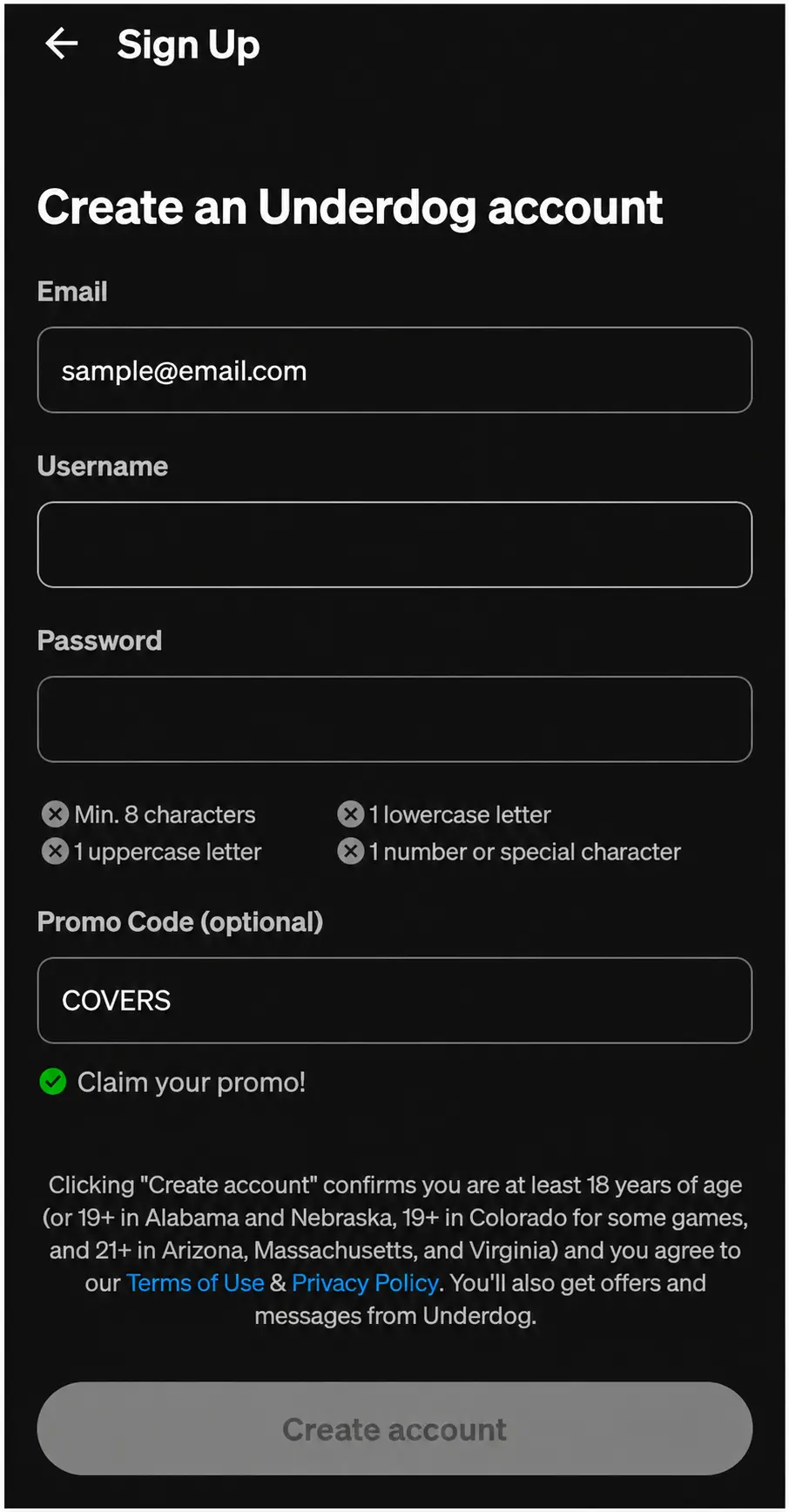
Underdog signup screenshot showing where to enter promo code COVERS. Confirm the offer during registration.
My Underdog offer experience: When I tested Underdog's earlier 50% deposit match, I deposited $100 and received $50 in bonus funds. What stood out was the playthrough requirement: I needed $150 in qualifying entry volume within 14 days, not just $50. That made me look beyond the headline bonus amount when comparing offers. The current COVERS promotion has a much smaller starting commitment, requiring a $10 qualifying play to unlock $50 in bonus entries. However, those rewards arrive as five separate $10 entries over five days, rather than one immediately available $50 balance. I prefer the lower upfront commitment, but the daily distribution makes it important to keep track of each reward instead of assuming the full $50 is available immediately.
Best Underdog promo code: Play $10, Get $50

The best Underdog promo code is COVERS, for the featured 'Play $10, Get $50 in Bonus Entries' Underdog welcome offer. Eligible users receive five $10 bonus entries, distributed over five days.
I've previously tested Underdog's 50% deposit-match promotion, depositing $100 and receiving $50 in bonus funds. The credit appeared within approximately 30 minutes, which was encouraging, but I quickly realized the more important detail was the playthrough requirement. My $100 deposit and $50 match meant I needed $150 in qualifying entry volume within 14 days, not simply $50 in play.
That experience is why I prefer the smaller starting commitment of the current $50 offer for most newcomers. A qualifying $10 play unlocks the full advertised promotional value without requiring a large first deposit. The trade-off is that the rewards arrive as five separate $10 entries, not a $50 balance I can immediately put toward one selection. It's a meaningful distinction when comparing the top prediction market promos, especially because Underdog's bonus entries are intended for eligible fantasy activity rather than standalone Prediction Picks.

How are the five $10 bonus entries issued?
The promotion distributes one $10 bonus entry per day for five days, totaling $50 in promotional entries. You only need to complete the initial qualifying $10 play to activate the advertised offer; you don't need to make another $10 qualifying play every day.
The biggest difference from the deposit match I tested is how I would manage the rewards. With the earlier promotion, I could see the credited bonus amount together and calculate the required playthrough. With the current offer, I would treat each $10 entry as a separate reward with its own availability and usage conditions. Receiving one entry daily makes the promotion approachable, but it also means checking the account regularly instead of assuming the full $50 is available immediately.
Where do I find my Underdog bonus entries?
Open the Underdog mobile app and select the Promos tab, identified by the gift icon near the account balance. Available bonus entries can be selected there and applied to eligible fantasy entries. Promotional options may also appear while building an entry. Underdog's help guidance specifies that bonus entries are redeemed through the mobile app rather than a web browser.
One detail worth paying attention to is the final entry slip. A $10 bonus entry isn't identical to $10 in cash: the promotional stake is not returned with a winning payout, so the displayed return can differ from an otherwise identical cash-funded entry. I would confirm that the bonus is actually selected, review the final payout, and check the entry's expiration before submitting. Under the Play and Get rules, bonus entries also have product and minimum-payout restrictions, so an available reward isn't necessarily usable on every selection.
How much is the Underdog deposit match worth?
Underdog's alternative welcome offer provides a 50% first-deposit match up to $1,000 for eligible users. The calculation is straightforward:
Underdog secondary bonus = 50% of the first deposit, up to a maximum of $1,000
That means a $2,000 qualifying first deposit earns the maximum $1,000 match. Depositing more than $2,000 doesn't increase the bonus beyond that cap. The actual offer and maximum available can vary by eligibility and location.
| First deposit | 50% bonus | Deposit plus bonus | Required 1x playthrough |
|---|---|---|---|
| $10 | $5 | $15 |
$15 |
| $50 | $25 | $75 |
$75 |
| $100 | $50 | $150 |
$150 |
| $500 | $250 | $750 |
$750 |
| $1,000 | $500 | $1,500 |
$1,500 |
| $2,000 | $1,000 | $3,000 |
$3,000 |
My own $100 deposit and $50 match correspond to the third row of this table. What surprised me wasn't the bonus calculation, but the amount of qualifying play required before clearing it. A 1x playthrough applies to the deposit and bonus combined, not just the promotional $50. In my case, that meant $150 in qualifying entry volume. A $500 deposit would create a $750 requirement, while maximizing the offer with a $2,000 deposit would mean $3,000 in qualifying play.
The playthrough must be completed within 14 days under the applicable deposit-match terms. That deadline is why I wouldn't increase my deposit merely to chase the larger advertised bonus. I'd choose a deposit amount based on what I already planned to play, not the maximum available promotion.
Today's Underdog promo code check
The current COVERS promotion advertises Play $10, Get $50 in Bonus Entries, with five $10 bonus entries distributed over five days. The most important check happens during registration: make sure the selected welcome offer matches the promotion you intend to claim. Underdog can present alternative welcome offers, and the deposit match and Play $10, Get $50 promotion have different qualifying requirements.
I'd also distinguish between seeing a promotion advertised, completing the qualifying $10 fantasy entry, and having a bonus entry available for use. Those are separate stages. Once the reward appears in the app, its displayed eligibility, payout conditions, and expiration determine how it can actually be used.
My verdict on the Underdog welcome offer
After testing Underdog's earlier deposit match, I think the current Play $10, Get $50 promotion is the better starting point for most casual users. My $100 deposit earned a $50 match, but clearing that promotion required $150 in qualifying play. The current offer unlocks the same $50 headline value with a smaller qualifying commitment, although it arrives as five daily bonus entries instead of one balance.
There are two catches I'd emphasize. First, those entries aren't withdrawable cash, and the promotional stake isn't returned with a winning payout. Second, the bonus is tied to eligible fantasy activity, so someone joining primarily to trade standalone Prediction Picks shouldn't assume the welcome entries will work on those contracts.
I'd recommend Play $10, Get $50 to newcomers comfortable with eligible fantasy entries who prefer a smaller upfront commitment. The 50% deposit match is more appealing when someone already intends to make a larger qualifying deposit and can realistically meet the playthrough requirement. For me, understanding those conditions matters more than choosing whichever offer has the biggest headline number.
How to claim the Underdog promo code COVERS
I've been through Underdog's registration, identity verification, and funding process firsthand. During my earlier test of its 50% deposit match, I deposited $100 and received $50 in bonus funds. What that experience taught me is that claiming a promotion is only half the job; understanding how the reward is credited and what you need to do with it matters just as much.
The current Play $10, Get $50 in Bonus Entries offer follows the same general account setup, but the qualifying play and reward structure are different. Here's how to claim it and what I'd pay attention to at each step.
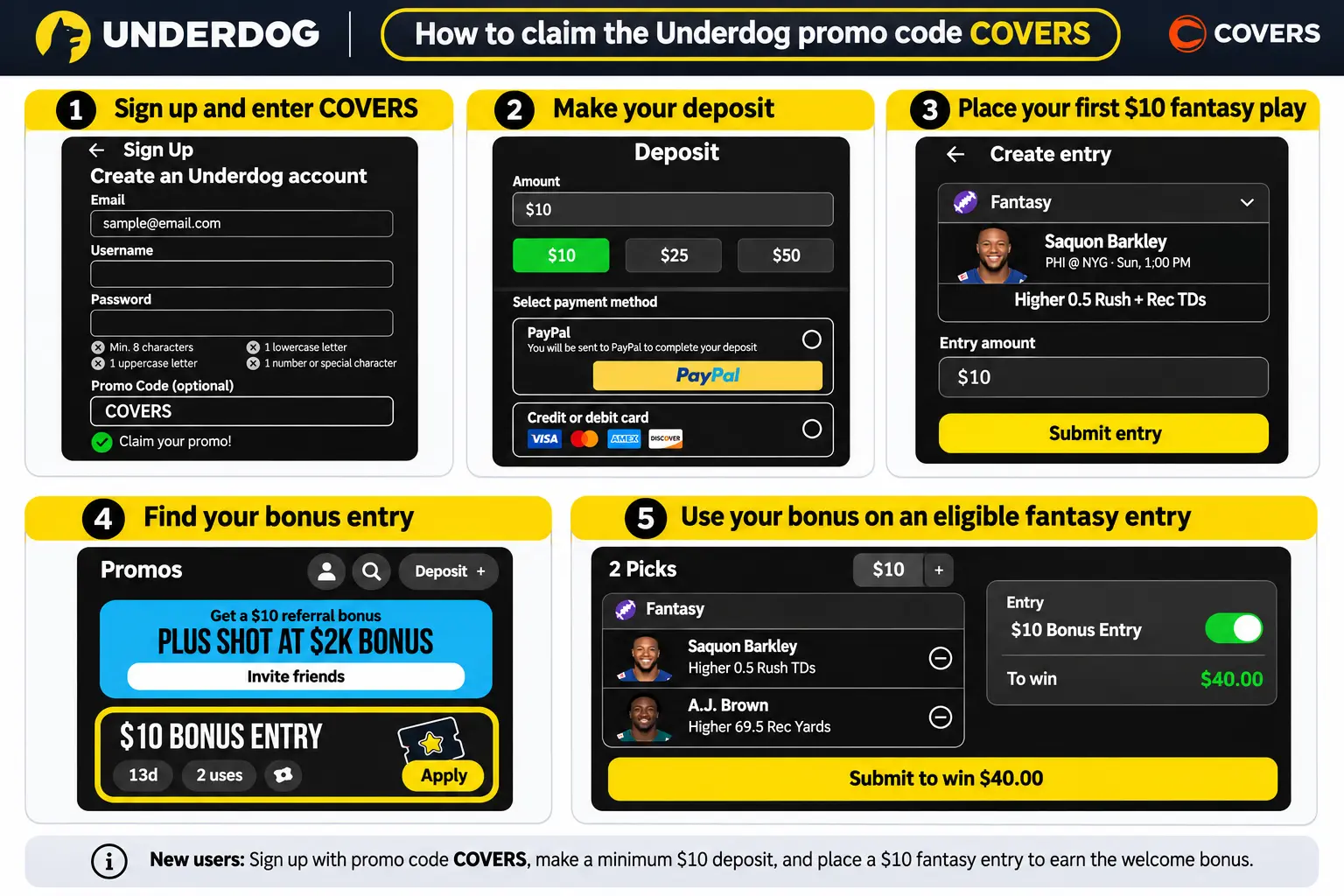
Create an Underdog account
Start through the Covers Underdog link and register as an eligible new customer. I found the account setup straightforward during my earlier testing, but I learned to pay particular attention to the promotion attached to the registration. Underdog offers different welcome bonuses, and choosing the wrong one can leave you with different qualifying requirements than expected.
Enter Underdog promo code COVERS
Enter COVERS during registration and confirm that the displayed promotion is Play $10, Get $50 in Bonus Entries. Underdog may present multiple welcome offers, including its separate 50% deposit match. Having previously tested that deposit-match promotion, I wouldn't treat the offers as interchangeable. The current $50 promotion distributes rewards as five $10 bonus entries, while the deposit match credits a percentage of your initial deposit and carries different playthrough requirements. Make sure you're selecting the offer you actually want before continuing.
Verify the account and make a deposit
Complete Underdog's identity verification requirements and deposit at least $10. When I tested the earlier deposit-match offer, my $100 deposit generated $50 in bonus funds, which appeared within approximately 30 minutes. The crediting was relatively quick, but the important catch was that my $100 deposit and $50 match created $150 in qualifying playthrough within 14 days.
That experience changed how I evaluate Underdog bonuses. For the current Play $10, Get $50 promotion, depositing money is only one requirement. You still need to complete the qualifying entry before the promotional rewards are triggered.
Complete the qualifying $10 play
Submit at least $10 in an eligible fantasy entry. This is the step I'd pay the most attention to because Underdog combines several different sports products within the same app. Fantasy Pick'em, standalone Prediction Picks, and mixed Combo entries aren't necessarily treated the same way for promotional purposes.
The Play $10, Get $50 welcome offer is tied to qualifying fantasy activity, not standalone Prediction Picks, and Draft contests don't count toward the qualifying entry requirement. I recommend checking the entry type and promotion eligibility before submitting rather than assuming any $10 play will unlock the bonus.
Follow the daily bonus schedule
After completing the qualifying play, check the Promos tab in the Underdog mobile app, accessible through the gift icon near your account balance. The current promotion provides one $10 bonus entry per day over five days, for $50 in total promotional value.
This is a meaningful difference from the deposit match I previously tested. Instead of receiving the entire promotional amount together, you're managing separate rewards as they're issued. I prefer the smaller starting commitment of the current offer, but the trade-off is that you need to keep track of the daily entries rather than assuming the full $50 will be immediately available.
Apply each entry before its deadline
Open an eligible fantasy entry, select the available $10 bonus entry, and review the updated payout before submitting. I pay attention to the difference between promotional entry value and actual winnings: a winning bonus entry doesn't return the original promotional stake, so its payout isn't identical to using $10 in cash.
Also check the expiration displayed on each reward. The five-day distribution period describes when the entries are issued, not necessarily how long every individual entry remains available. The promotion's playthrough conditions and the expiration shown in your account are worth checking before making selections.
My takeaway: My earlier Underdog testing showed me that the headline bonus is only part of the value equation. The 50% deposit match required more qualifying play than the $50 bonus amount alone suggested. The current Play $10, Get $50 offer is more approachable for a smaller starting budget, but it requires a qualifying fantasy entry and attention to five separate rewards. I'd prioritize confirming the correct promotion, checking the entry type, and reviewing each bonus entry's payout and deadline over simply getting through registration as quickly as possible.
Underdog Play $10, Get $50 terms and conditions
When I tested Underdog's earlier 50% deposit match, the biggest lesson wasn't how quickly the bonus arrived. It was understanding what I could actually do with it. My $100 deposit earned a $50 match, but the combined $150 had to satisfy the promotion's playthrough requirements. That's why I now pay particular attention to how Underdog awards promotional funds, which entries qualify, and what ultimately becomes withdrawable.
The current COVERS offer works differently, but those same distinctions matter. Here are the terms I consider most important before claiming it:
 Eligibility: The advertised welcome offer is for eligible new users who meet the applicable account, age, and location requirements. Fantasy promotion eligibility is separate from Prediction Picks availability.
Promo code: Enter COVERS and confirm that the $50 offer is attached to the account. Underdog's alternative welcome offers have different requirements, and the selection is final.
Qualifying play: Complete $10 of eligible fantasy play. Registration and depositing alone do not unlock the reward, and Draft contests do not qualify.
Bonus amount: The total promotional value is $50, awarded as five separate $10 bonus entries rather than one unrestricted balance.
Distribution: The featured offer issues one $10 bonus entry per day for five days. The initial qualifying play activates the promotion; another $10 qualifying play is not required each day.
Bonus format: The rewards are promotional entries, not $50 in withdrawable cash. When an eligible bonus entry wins, the promotional stake itself is not returned with the winnings.
Eligible products: The Play and Get promotion is intended for qualifying fantasy entries, not standalone Prediction Picks. Mixed fantasy and prediction Combos have separate rules. Bonus funds cannot be applied to entries with a payout multiplier below 2x.
Playthrough: Underdog's Play and Get rules require 1x turnover of the promotional reward. The bonus is subject to forfeiture if the requirement is not completed within 14 days of issuance.
Expiration and usage: Check the deadline attached to each bonus entry in the app. The five-day distribution schedule and the period for using or clearing the reward are different conditions.
My takeaway: The biggest mistake I would avoid is comparing Underdog bonuses by headline value alone. My previous deposit-match test showed how a $50 reward could come with $150 in qualifying playthrough. The current offer has a smaller entry requirement, but its five separate rewards introduce a different responsibility: keeping track of when each entry arrives, where it can be used, and what the final payout actually represents.
Does a bonus entry return its original stake?
No. Underdog uses a no-stakeback system for bonus entries. A winning bonus-funded entry pays the profit without returning the original promotional stake. When a bonus entry is selected, the app adjusts the displayed payout to reflect that difference.
Consider a $10 cash-funded entry with a standard 3x return. A winning cash entry would return $30, including the original $10 stake. Using a $10 promotional entry on the equivalent selection would instead produce $20 in winnings, because the $10 bonus stake is not returned. The exact figures depend on the entry's displayed multiplier and payout conditions.
This distinction matters more to me than the advertised multiplier alone. During my earlier deposit-match testing, I learned to separate the amount credited to my account from the amount I could ultimately withdraw. Bonus entries make that distinction even more visible: the $10 reward covers the entry, but it isn't $10 of cash that comes back when the selection wins.
My approach is to compare the entry slip before and after applying the bonus, then use the final displayed payout to decide whether the selection is worthwhile. That avoids treating a promotional entry as interchangeable with a cash-funded one.
How long do I have to use the bonus entries?
The featured Underdog promotion distributes one $10 bonus entry per day for five days, but that does not mean the five rewards share one expiration date. Each entry should be checked against its displayed deadline and eligibility requirements in the Underdog mobile app.
Underdog's published Play and Get rules establish a 14-day turnover period from issuance of the promotional bonus, with a 1x playthrough requirement. Any applicable deadline displayed on the individual reward also matters. Promotional value that does not satisfy the required conditions can be forfeited.
What I'd watch most closely is the difference between receiving an entry and using it. The daily distribution can make the $50 offer feel like a single ongoing reward, but each $10 entry represents a separate opportunity to submit an eligible selection. I'd check the Promos tab regularly, review the payout conditions, and avoid leaving the entries unused simply because the overall promotion lasts five days.
 Underdog responsible gaming
Must be 18+ (19+ in AL, NE; 19+ in CO for some games; 21+ in AZ, MA, and VA) and present in a state where Underdog Fantasy operates. Terms apply. Offer not valid in MD, MI, NJ, NY, OH, and PA. Concerned with your play? Call 1-800-MY-RESET or 1-800-GAMBLER or visit www.ncpgambling.org; AZ: 1-800-NEXT-STEP (1-800-639-8783) or text NEXT-STEP to 53342; NY: Call the 24/7 HOPEline at 1-877-8-HOPENY or Text HOPENY (467369).
Does the Underdog promo code work on Prediction Picks?
No, not on standalone Prediction Picks. The Underdog promo code COVERS unlocks the featured 'Play $10, Get $50 in Bonus Entries' promotion, but its bonus entries are intended for eligible fantasy contests. There is an important exception: qualifying Combo entries can include both fantasy selections and Prediction Picks, subject to the promotion's specific rules.
This distinction matters because Underdog brings multiple sports products into one app. I can evaluate an NFL game winner, a point spread, or a player's passing-yard total, but those selections don't necessarily follow the same entry, payout, or promotional rules. After testing Underdog's welcome-offer process, my biggest takeaway is that the bonus should influence how I evaluate an eligible entry, not push me toward a product I wasn't planning to use.
If my goal is to trade an individual event contract, I wouldn't count on the five $10 promotional entries to fund it. If I'm already interested in fantasy Pick'em or a qualifying Combo, the bonus becomes more relevant.
 Covers Expert Analysis
Which Underdog entries qualify for bonus entries?
Here's how I distinguish the main entry types when deciding whether the Play $10, Get $50 promotion is useful to me:
| Underdog entry type | Can I use this welcome bonus? | What matters |
|---|---|---|
| Fantasy Pick'em | Yes, on eligible entries | The bonus can cover qualifying fantasy entry fees, subject to payout multipliers and promotional restrictions. |
| Standalone Prediction Picks | No | These are regulated event contracts. The Play and Get bonus isn't an unrestricted balance for buying individual contracts. |
| Prediction Combos | Potentially, if eligible | A Combo must contain at least one Prediction Pick and two fantasy picks from different teams. The bonus and each portion of the Combo follow their respective rules. |
The practical lesson is that sharing the same app doesn't make the products interchangeable. I'd rather confirm that my intended entry qualifies than discover after building it that the promotional reward can't be applied.
What about Underdog Combo entries?
Combo entries let me combine an event-contract prediction with fantasy selections in one entry. Underdog requires at least one Prediction Pick and two fantasy picks involving players from different teams. For example, I could combine a Prediction Pick on an NFL game winner with two qualifying player-stat fantasy selections from different teams.
I like the flexibility, particularly when I have opinions about both the game's outcome and individual player performances. However, the risk is more complicated than placing those selections separately. To earn the full potential Combo payout, the Prediction Pick and all fantasy picks need to be correct. If the prediction succeeds but a fantasy selection loses, the Combo pays nothing. If the prediction loses while all fantasy selections win, a smaller fantasy-based payout may still apply under Underdog's Combo rules.
That's the trade-off I'd focus on before using a $10 promotional entry. Adding a Prediction Pick doesn't simply increase the potential reward; it also changes how the entire entry is evaluated. A bonus-eligible Combo still needs to be a selection I'd be comfortable making without the promotion.
How do I know which type of entry I'm making?
I look at the completed entry slip and the individual selections rather than relying on the sport or player involved. In states offering both fantasy and prediction products, Underdog can automatically determine the entry type based on the picks selected and the markets available. A single player projection may be routed as a Prediction Pick, while a different combination can qualify as a fantasy entry.
One detail I find especially useful is that a slip marked Predictions indicates that it includes at least one Prediction Pick, but that label alone doesn't mean the entire entry is a standalone prediction. I still need to distinguish a pure prediction entry from a Combo containing fantasy selections.
For example, an NFL quarterback's passing-yard projection and a game-winner contract may both look like straightforward football predictions, but one can be a fantasy selection while the other is an exchange-traded event contract. The distinction affects the payout, available features, and whether this particular welcome bonus applies.
My recommendation: Before submitting, I would check three things: the entry type shown on the slip, whether the $10 bonus entry is available to apply, and the final displayed payout. If the bonus isn't available, I wouldn't assume it's an app error or deposit more money to force the entry through. I'd first confirm whether I've built a standalone Prediction Pick, a fantasy entry, or an eligible Combo.
Underdog $50 offer vs. $1,000 deposit match
The Play $10, Get $50 offer is the main promotion featured on this page. Underdog also has a separate 50% first-deposit match up to $1,000, subject to the offer presented and customer eligibility. I compare the structure, not just the largest number. One distributes a fixed amount in daily bonus entries; the other scales with the qualifying deposit.
| Offer detail | Play $10, Get $50 | 50% deposit match |
|---|---|---|
| Bonus value | $50 in bonus entries | Up to $1,000 |
| How it is calculated | Five $10 bonus entries | 50% of the qualifying first deposit |
| Distribution | One $10 entry daily for five days | Under the deposit-match crediting terms |
| Main qualifying action | Eligible $10 play | Qualifying first deposit |
| Best suited to | A smaller starting commitment and daily entries | A larger already-planned deposit |
How do I get the maximum $1,000 deposit-match bonus?
A $2,000 qualifying first deposit produces the maximum $1,000 match. Smaller deposits receive the same 50% rate: $100 earns $50, $200 earns $100, and $500 earns $250.
The deposit-match terms are separate from the daily-entry promotion. They specify a $10 minimum deposit, crediting within 72 hours of deposit resolution, and 1x playthrough of the deposit plus bonus within 14 days.
For example, a $100 deposit plus a $50 match creates $150 in qualifying playthrough. That calculation belongs to the deposit match—not automatically to the Play $10, Get $50 offer.
Which Underdog welcome offer would I choose?
I’d lean toward Play $10, Get $50 when I want a smaller starting commitment and am comfortable receiving promotional entries over five days.
The deposit match becomes more interesting when I already intend to fund the account with a larger amount. At a $100 deposit, a 50% match reaches the same $50 headline value; above that, the match produces a larger promotional amount. That doesn't make the offers equivalent because distribution, eligible use, and playthrough differ.
I would not increase my deposit just to chase the larger headline.
Can I claim both welcome offers?
When Underdog presents promotions through Choose Your Offer, I must select one. Its published rules say the selection is final and does not entitle me to the other welcome offers shown alongside it.
I’d compare the available options before choosing rather than treating the $50 promotion and $1,000 match as a combined bonus.
Best Underdog promos for existing users in November 2026
Underdog isn't just about welcome bonuses. Existing users may also qualify for referral rewards, multiplier boosts, Challenges, Wildcard offers, and other account-specific promotions, depending on their location and eligibility.
After testing Underdog's earlier deposit-match offer, I learned to pay closer attention to the difference between promotional value and money I could actually withdraw. My $100 deposit earned a $50 match, but the combined $150 still had to satisfy the playthrough requirement. That experience is especially relevant to returning-user promotions, where an attractive boost or reward can come with another set of conditions.
For me, the most useful ongoing promotion is one that improves an entry I already intended to make, rather than encouraging me to spend more just to unlock a reward. Here's how the main recurring offers compare with the new-customer COVERS promotion.
| Underdog promo | Who can qualify | What you get | Checked on |
|---|---|---|---|
| Refer-a-friend | Eligible existing users who meet the referral requirements | Account-specific bonus cash when a qualifying friend registers through the referral, makes the required deposit, and completes the applicable entry conditions |
Nov. 5, 2026 |
| Multiplier boosts | Eligible Pick'em users | Increased payout multiplier on qualifying entries; winnings above the standard multiplier are awarded as bonus cash requiring 1x playthrough |
Nov. 5, 2026 |
| Underdog Challenges | Users shown eligible Challenges | Rewards for completing specified milestones within a deadline, including boosts, bonus entries, or eligible Draft rewards |
Nov. 5, 2026 |
| Wildcard: Pick Your Promo | Users offered Wildcard | Review three promotional offers and select one; the choice is final once confirmed |
Nov. 5, 2026 |
| Underdog Rips referral | Eligible Rips users and qualifying referred friends | Referral rewards for the existing user; eligible referred friends may receive a free $5 Rips pack with potential value up to $150 |
Nov. 5, 2026 |
These are published promotion types, not guaranteed offers for every account. Reward amounts, eligibility, product restrictions, and expiration dates depend on the specific promotion displayed in Underdog.
How do I find Underdog promos for existing users?
I start in the Underdog mobile app's Promos section, where available bonuses and Challenges can appear. For multiplier boosts and specials, I also review the available promotions from my account or while building an eligible Pick'em entry. Referral offers have a separate location under the account's Invite Friends area.
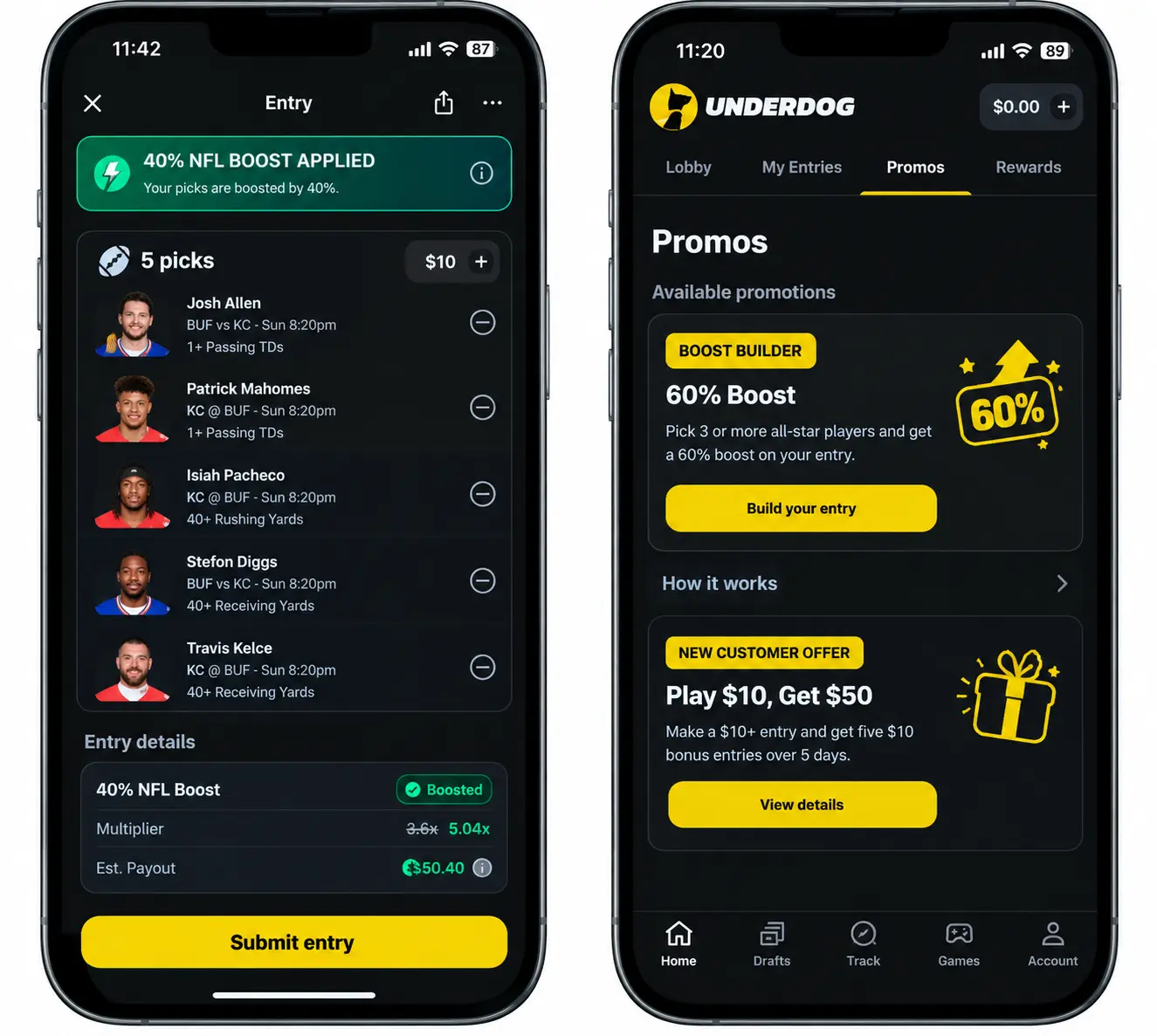
One thing I like about Underdog's approach is that returning users aren't limited to a single standing reward. A boost can improve the payout on a selection I'm already interested in, while a Challenge can reward activity I was planning anyway. The downside is that these offers aren't consistent across every account. Something advertised publicly might not appear for me because of eligibility, location, or campaign targeting.
Multiplier boosts are a good example of why I read beyond the headline. Underdog illustrates a five-pick entry whose normal 20x multiplier increases to 50x with a promotion. That sounds like a straightforward improvement, but the additional 30x portion is credited as bonus cash and requires 1x playthrough before withdrawal. I still see value in the boost, but I wouldn't treat the entire enhanced payout as immediately withdrawable cash.
Challenges require a different calculation. Each one has milestones and a deadline, and unfinished progress doesn't earn a partial reward when the time runs out. Canceled qualifying entries can also reduce milestone progress. I wouldn't add extra entries purely to finish a Challenge if doing so meant spending more than the reward was worth to me.
Wildcard offers are more flexible, but they're also worth examining carefully. Underdog presents three options and allows me to choose only one. I'd compare their qualifying requirements, bonus formats, and deadlines before selecting anything. The best-looking headline isn't automatically the most useful option for how I actually play.
My tip: I look at the final entry slip to confirm that a boost or promotional token is applied, then check whether any additional winnings will be credited as bonus cash. I'd also avoid cashing out an entry with a promotion attached without understanding the consequences, because Underdog's rules state that cashing out forfeits the applied promotion rather than returning it for another entry.
Which Underdog promotion is best for returning users?
My preference is a multiplier boost on an entry I already wanted to make, provided I understand the payout split. It can add value without requiring me to change my usual approach just to complete a promotional milestone.
I'd place Challenges behind boosts unless their requirements align naturally with my planned activity. A Challenge that rewards several entries sounds appealing, but completing extra entries simply to reach a milestone can outweigh the benefit. Wildcard is more interesting when its three choices let me select a promotion that genuinely suits my activity instead of accepting a predetermined reward.
Referrals are worth considering when I have a friend who independently wants to join Underdog. However, I'd check the terms before assuming the reward is guaranteed. The standard referral program requires the new customer to use the referral link or code, deposit at least $10, and meet the applicable entry requirements. The referrer's reward is bonus cash, not an immediately withdrawable payment.
I'd also distinguish the Rips referral promotion from a guaranteed cash reward. An eligible friend may receive a free $5 pack with potential value up to $150, but that doesn't mean the pack automatically contains $150 in value.
Can I use promo code COVERS as an existing Underdog customer?
No, not for the advertised new-customer welcome offer. The featured 'Play $10, Get $50 in Bonus Entries' promotion is intended for eligible new users. If I already have an Underdog account, I'd focus on the offers available through my existing account instead of attempting to claim another signup bonus.
There's another distinction I'd flag for anyone considering referrals: a friend's referral code and the COVERS welcome code aren't automatically stackable. Underdog's referral rules warn that using a different promo code during signup can invalidate the referrer's reward. I'd have the new customer compare the available options before registration rather than promising they can collect both.
My verdict: I like that Underdog gives existing users several ways to receive promotional value after the welcome offer, but I don't consider every promotion worth pursuing. Boosts are the most appealing when they improve an entry I already planned to make. Challenges and Wildcards deserve more scrutiny because the timing, selection, and usage rules can change their value. My earlier deposit-match experience reinforced the same lesson: what matters isn't just how much promotional value Underdog advertises, but how much of it I can realistically use under the conditions.
Covers verdict on Underdog
Best for: Sports-first prediction trading
Underdog's biggest strength, in my view, is how naturally its prediction markets fit into an existing sports routine. Instead of starting with unfamiliar financial terminology, I can evaluate an NFL game winner, an NBA point spread, or a player's statistical performance and then review the contract price and potential return. I like that familiar starting point, particularly for someone approaching prediction markets from fantasy sports. However, recognizing the sport doesn't automatically mean understanding the trade. I still need to examine the pricing, fees, settlement conditions, and any available early cash-out option before committing money.
My firsthand experience with Underdog's earlier 50% deposit match also influenced how I assess its promotional value. I deposited $100 and received $50 in bonus funds, but the detail that mattered most was the $150 in qualifying playthrough required to clear the promotion. That made the bonus less flexible than the headline suggested. The current 'Play $10, Get $50 in Bonus Entries' welcome offer is more approachable because it requires a smaller initial commitment, but I wouldn't mistake its five daily $10 bonus entries for an unrestricted $50 Prediction Picks balance. The rewards are tied to eligible fantasy activity, which is an important limitation for someone primarily interested in event contracts.
Customer support exposed another weakness during my testing. I contacted Underdog to clarify which entries qualified for the COVERS welcome bonus. The automated chat transferred me to a human representative, Jason, who was courteous and offered further assistance. However, my original eligibility question wasn't resolved during the captured conversation, and I was told the appropriate team would need to follow up. I appreciated being able to reach a real person, but I would have preferred a definitive answer without another handoff. That experience reinforced why I check promotional eligibility before making an entry rather than relying on support to resolve an issue afterward.
My verdict: I'd recommend Underdog to sports-focused users who want to explore prediction markets alongside fantasy products and are comfortable evaluating the differences between them. Its familiar sports coverage is appealing, and the smaller qualifying commitment of the featured welcome offer makes getting started less intimidating. What holds it back is the complexity beneath that simplicity: fantasy bonuses don't automatically apply to prediction contracts, promotional balances can have meaningful restrictions, and getting a specific support answer may require additional follow-up. For me, Underdog is most compelling when I choose the market first, understand its mechanics and costs, and treat any promotion as an added benefit rather than the reason to participate.
Keep Your Million promotion
The Keep Your Million promotion starts eligible participants with a virtual balance of $1,000,000 in Milly Bucks and asks them to work through as many as 20 two-outcome player-pick questions.
Milly Bucks are not $1 million in cash, cannot be withdrawn, and are used only within the promotion.
Whatever remains after all 20 questions are completed converts into bonus entries, up to a maximum of $1 million. Those bonus entries must then be played through once before resulting winnings become eligible for withdrawal.
How Keep Your Million works
- Start with $1,000,000 in Milly Bucks. Every eligible player begins with the same virtual pot.
- Choose a two-outcome player question. One example could ask whether Tarik Skubal finishes Higher or Lower than 7.5 strikeouts.
- Split the pot between both outcomes. I could put 650,000 Milly Bucks on Higher and 350,000 on Lower rather than going all-in.
- Keep only the winning allocation. If Skubal finishes with eight strikeouts, my new balance is 650,000 Milly Bucks. The 350,000 placed on Lower disappears.
- Continue for up to 20 questions. The current balance becomes the pot for the next round.
- Finish with a balance remaining. Whatever remains after the 20th completed question converts into bonus entries. Reaching zero ends the promotion without a prize.
Complete all 20 questions within 60 days. Keep Your Million selections lock immediately and cannot be canceled after submission.
A Keep Your Million example
Suppose I begin with 1,000,000 Milly Bucks:
- Question one: Tarik Skubal Higher or Lower than 7.5 strikeouts? I place 650,000 on Higher and 350,000 on Lower. Higher wins, leaving me with 650,000.
- Question two: Aaron Judge Higher or Lower than 1.5 total bases? I place 400,000 on Higher and 250,000 on Lower. Lower wins, leaving me with 250,000.
- Question three: A pitcher to record Higher or Lower than 5.5 strikeouts. I split 175,000 and 75,000. The 175,000 side wins, so that becomes my next pot.
The game is really a repeated risk-allocation puzzle. A wider split protects me from one outcome, but repeatedly preserving both sides can shrink the final balance quickly.
Keep Your Million terms to know
Based on the current terms:
- Milly Bucks have no cash value.
- The promotion includes up to 20 sequential questions.
- You must complete all questions within 60 days.
- A zero balance ends the promotion without a prize.
- The remaining balance after 20 questions converts to bonus entries.
- The maximum possible conversion is $1,000,000 in bonus entries.
- Bonus entries have a 1x playthrough requirement.
- New users must make a first deposit.
- Existing users may have to make a separate qualifying deposit.
- The advertisement shown to the customer controls the qualifying deposit.
- Bonus funds are not directly withdrawable cash.
Underdog Rips promo: Get 5 free packs up to $750
Underdog has expanded beyond Prediction Picks with Underdog Rips, its sports card ripping experience. The product also lands on our list of the best card rip sites, giving me another way to use Underdog outside its prediction markets.
New Rips users can currently get five free rip packs worth up to $750, subject to eligibility and the promotion’s terms. Instead of trading an event contract, I open digital packs for a chance to pull sports cards, with the experience built directly around the excitement of traditional card breaks and pack openings.
I’d treat the Rips promotion separately from Underdog’s COVERS fantasy welcome offer. If sports cards are what I’m after, the free-pack promotion is the more relevant starting point.
What are Underdog Rips?
Underdog Rips turns opening sports card packs into a digital experience. I can choose an available pack, rip it to reveal the cards immediately, and see what I pulled. That makes it a very different product from Underdog Prediction Picks, but one that still fits naturally with the platform's sports-first approach.
For the full offer, available packs, and how Underdog compares with other platforms, check our guide to the best card rip sites.
What is Underdog Predict?
Underdog Predict is the event-contract side of the Underdog app. Instead of building a fantasy entry, I buy contracts tied to real-world outcomes such as a team winning, covering a spread, or finishing higher or lower than a total.
Each contract is priced between $0 and $1 based on the market’s estimated probability. A correct contract settles at $1, while an incorrect contract settles at $0. Prediction Picks are regulated financial instruments and are separate from Underdog’s fantasy Pick’em product.
In July 2026, Underdog launched its own federally licensed exchange after acquiring a CFTC-registered designated contract market and derivatives clearing organization. Underdog also operates as a registered futures commission merchant, giving it control of its own exchange infrastructure while continuing to offer contracts from partner exchanges.
Which exchanges power Underdog Prediction Picks?
Underdog currently works across three regulated exchange providers:
| Provider | Role inside Underdog |
|---|---|
| Underdog Exchange, or UDX |
Underdog’s own CFTC-regulated exchange |
| Kalshi |
Partner exchange providing eligible event contracts |
| Nadex/Crypto.com |
Partner exchange providing sports and certain culture contracts |
Underdog generally shows one market per game and handles the exchange selection in the background. Users may hold positions from more than one provider at the same time, and each position settles under the rules of the exchange that listed it.
That is convenient, but it also means I cannot assume every Underdog market has identical fees, suspension rules, settlement rules, or availability.
How Underdog Prediction Picks work
Underdog Prediction Picks use regulated event contracts rather than traditional sportsbook odds. I choose an outcome, review the price per contract, decide how many contracts I want, and check the total cost, including exchange fees, before submitting the trade. Under normal win-or-lose settlement, each contract pays $1 if my prediction is correct or $0 if it is incorrect.
What I like about this format is that I can calculate my potential return before entering a position. What requires more attention is deciding whether the price actually represents good value. A contract can describe an outcome I expect to happen and still be too expensive for me to justify buying.
I also check the market's settlement rules before trading. While most contracts have straightforward $1 or $0 outcomes, certain cancellations, ties, and other exceptional circumstances can result in a different settlement value. That's one reason I don't treat Prediction Picks as interchangeable with ordinary fantasy entries or sportsbook wagers.
Contract prices and payouts
A contract priced at $0.70 represents an estimated 70% market-implied probability before fees. That doesn't guarantee the outcome has a 70% chance of occurring; it tells me what the market is charging for that possibility. I still need to decide whether I agree with the price.
Underdog provides a useful illustrative example involving five contracts on the Bills to win at $0.70 each:
- Contract cost: 5 × $0.70 = $3.50
- Illustrative exchange fee: 5 × $0.02 = $0.10
- Total amount risked: $3.60
- Winning settlement: 5 × $1 = $5.00
- Net profit if correct: $1.40
- Settlement if incorrect: $0, resulting in a $3.60 loss
Those figures come from Underdog's published example, not a claim that every market charges a two-cent fee. Actual fees and contract prices can vary by exchange and market.
The detail I'd emphasize is the difference between the contract's advertised probability and the price I actually pay. In this example, the contracts cost 70 cents each, but the additional two-cent fee raises my effective cost to 72 cents per contract. I would need to believe the Bills had a better than 72% chance of winning for the position to offer positive expected value under that simplified calculation.
That's why I don't automatically buy a 70-cent contract just because I think the team is likely to win. If my own assessment is that the outcome has only a 65% chance, I'm paying more than I believe it's worth. Even agreeing with the market's 70% assessment wouldn't give me an advantage once the fee is included.
The same principle becomes clearer at different prices. Buying a winning contract at $0.85 leaves only $0.15 in gross upside before fees, while buying at $0.55 leaves $0.45. The lower-priced contract offers more potential profit, but only if the underlying probability justifies the risk.
My takeaway: I start with the total amount at risk and work backward from the potential settlement. I want to know what I stand to gain, what I could lose, and whether my assessment of the outcome differs enough from the market price to justify the trade. If I can't identify that difference, I'd rather pass than buy an outcome simply because it seems likely.
Cash out and liquidity
Underdog may allow me to cash out a Prediction Pick before the event settles. Unlike a traditional cancellation, this means selling my contracts at the available market price. The amount I receive can be higher or lower than my original cost, and exchange fees may apply to the sale.
Consider the five-contract example above. I paid $3.60, including the initial exchange fee. If the available selling price later rises to $0.80 per contract, selling all five would return $4.00 before any exit fees. That leaves a $0.40 gain before those additional costs. If the selling price falls to $0.60, the same contracts would return only $3.00 before exit fees, leaving me with a loss of at least $0.60.
This is why I treat Cash Out as a trading decision rather than an insurance feature. An early exit can preserve part of my balance when a prediction looks less likely, but it can also sacrifice potential upside if the outcome eventually settles in my favor.
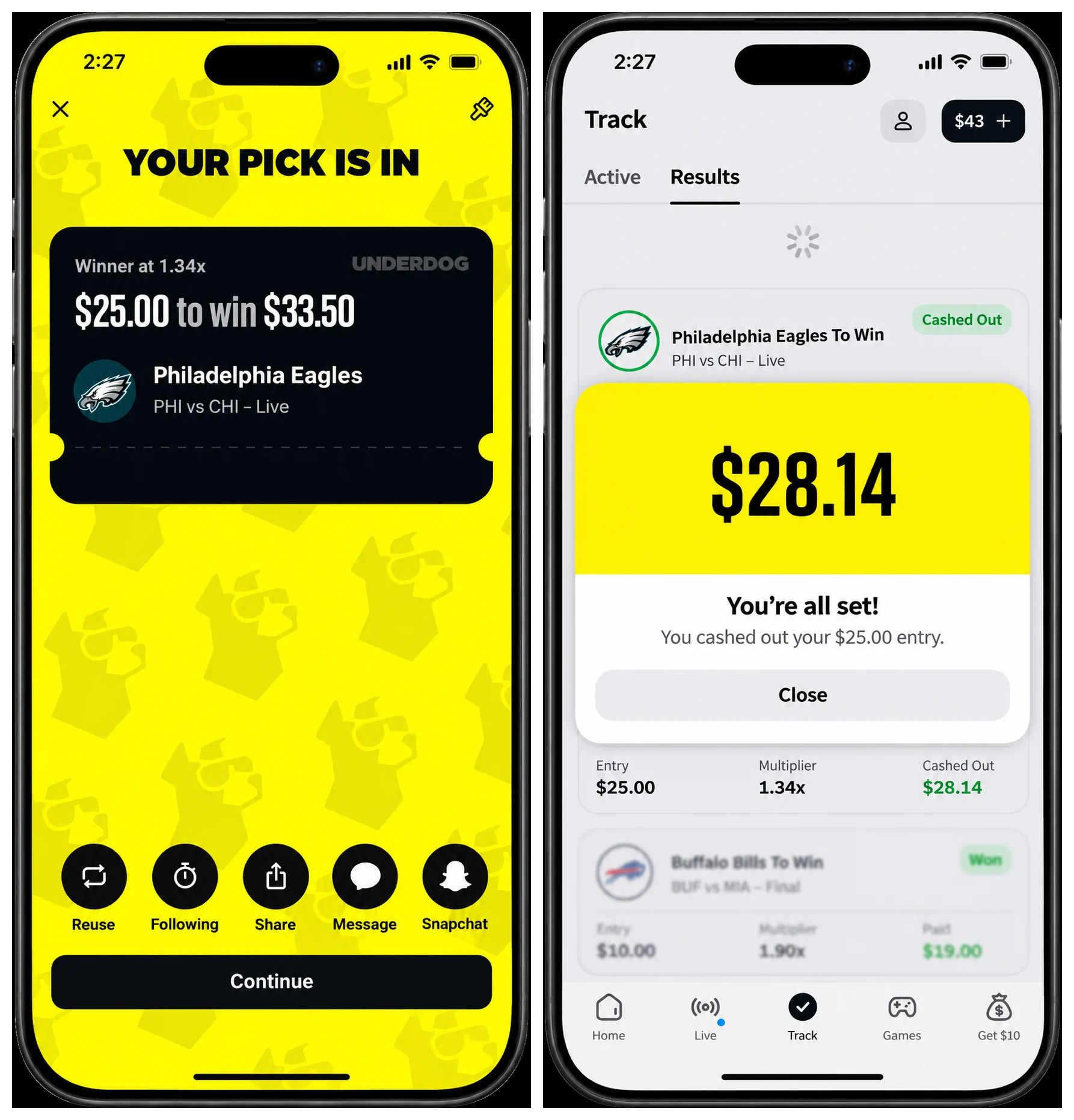
The other limitation is liquidity. Even if the app displays a higher market price, I still need another participant willing to buy my contracts. In a fast-moving game, especially near the final result, the available price and number of buyers can change quickly.
Cash Out may be unavailable or suspended when:
- Liquidity is insufficient: There may not be enough buyers to complete the sale.
- Trading is temporarily suspended: Significant in-game developments can cause an exchange to pause a market.
- The event is nearing completion: Cash-out opportunities may disappear as the result becomes increasingly certain.
- I'm outside an eligible state: Cash Out requires physical presence in a location where Prediction Picks are available.
Underdog also offers Auto Cash Out for eligible single Prediction Picks. I can set a target price, and the platform attempts to sell my contracts if that price becomes available. I like the idea of establishing an exit target in advance, particularly when I won't be watching a game continuously, but the instruction doesn't guarantee a completed sale. The market still needs to reach my target and provide enough liquidity.
Auto Cash Out can also fill partially. If buyers take only some of my contracts, those contracts are sold while the remaining position stays open. This is another reason I wouldn't assume that setting an exit target means my entire position will close at once.
My approach: Before entering a Prediction Pick, I consider whether I'd be comfortable holding the contract until settlement. If my decision depends entirely on being able to cash out early, the position is less attractive to me. Liquidity can disappear precisely when market conditions become most uncertain.
Why I check the exchange before trading
Underdog can offer Prediction Picks through UDX, Kalshi, and Nadex. I appreciate being able to access different regulated markets through the same app, but each exchange has its own contract rules, fees, and settlement procedures. Underdog displays the market and passes through the exchange's official result; it doesn't independently decide whether my prediction should win.
That distinction is easy to overlook when I'm browsing familiar sports. For a straightforward NFL game-winner contract, the outcome may seem obvious. But a postponed game, abandoned match, player who doesn't participate, or unusual final result can introduce settlement conditions that aren't apparent from the market's headline.
For example, Underdog's football guidance explains that a game postponed beyond the applicable 48-hour window can trigger a fair-market-price settlement under UDX or Kalshi rules, while Nadex uses its separate canceled-event procedure. That means a postponed game doesn't necessarily result in the same treatment across every exchange. Depending on the market, a canceled or otherwise unresolved contract may pay an adjusted value instead of the usual $1 or $0.
That changes how I evaluate certain markets. If I'm considering a tennis contract involving a player with an injury concern, for example, I want to understand how a retirement would be handled before buying. The same applies to weather-sensitive events, postponed games, and player markets where nonparticipation is possible.
I pay particular attention to three details:
- The exchange: Whether the contract is offered through UDX, Kalshi, or Nadex, since that determines the applicable rulebook.
- The exact settlement condition: What must happen for the contract to pay $1, and how ties, cancellations, postponements, or nonparticipation are handled.
- The official resolution source: Which result the exchange uses to settle the market, rather than relying solely on the live score or statistics displayed in the Underdog app.
One detail that surprised me when reviewing the settlement guidance is that even an apparent statistical correction doesn't necessarily change a completed trade. Each exchange has its own rules for recognizing corrections, including deadlines after which a revised statistic may no longer affect settlement.
Most single-game markets settle within a few hours after the event concludes, with payouts typically processed within 24 hours of settlement. Futures can take considerably longer because the final outcome must be officially determined. I distinguish that contract-settlement timeline from the separate process of withdrawing money from my Underdog account.
If I believe a contract settled incorrectly, I'd keep the entry details, identify the exchange and market, and contact Underdog support with the specific discrepancy. Underdog can review the issue with the exchange, but it cannot independently reverse an official settlement. Any confirmed correction follows the exchange's amendment process.
My takeaway: I find Prediction Picks easiest to evaluate when I understand both the price and the rule that determines the payout. A familiar game or player can make an event contract feel straightforward, but that familiarity doesn't eliminate settlement risk. I'd rather spend an extra minute checking the provider and contract terms than discover afterward that a cancellation, tie, or stat correction is treated differently than I expected.
Covers Expert Analysis Christian Stringer, Prediction Markets Editor
Today’s Underdog Prediction Picks
🏈 Underdog NFL prediction markets
November is an important stretch of the NFL season, with playoff races taking shape, division standings becoming more meaningful, and injuries increasingly influencing team expectations. Underdog's available NFL Prediction Picks can include game winners, spreads, totals, and player performances, alongside longer-term Super Bowl, conference, division, playoff, and MVP contracts.
When evaluating NFL markets, I pay particular attention to how one development can affect several contracts at once. A quarterback injury, for example, might influence a team's game-winner price, its expected scoring total, and its longer-term playoff chances. I don't automatically view a price drop as a buying opportunity. I want to understand whether the market has reacted appropriately to the underlying news or whether the new price still overestimates the team's chances.
I also distinguish between shorter-term markets and season-long futures. A game-winner contract gives me a relatively immediate outcome to evaluate, while a Super Bowl or division future depends on considerably more uncertainty. I find the shorter-term markets easier to assess when injuries or lineup changes are driving prices, but futures can be useful when I have a broader view of a team's remaining schedule and postseason prospects.
🏀 Underdog NBA prediction markets
The NBA regular season continues throughout November, giving traders opportunities to evaluate game-winner, spread, total, and player markets as teams establish their rotations and playing styles. Championship, conference winner, and MVP futures provide longer-term alternatives, although early-season performances can cause expectations to move quickly.
For NBA player markets, I tend to focus more on playing time and role changes than a player's name recognition. A high-profile scorer can still be a poor selection if his minutes are restricted, his usage has changed, or his team is experimenting with a different rotation. I've found that evaluating the circumstances behind a projection is more useful than simply recognizing a familiar player and agreeing with the outcome.
I'm also more cautious with early-season futures. A strong opening stretch can make a championship or MVP candidate look particularly appealing, but there's a long season ahead. I'd rather compare the current contract price with the player's or team's realistic full-season prospects than react to a short winning streak. For me, the question isn't just who I expect to succeed, but whether Underdog's available price offers reasonable value for that expectation.
🏟️ Underdog college football markets
November brings a particularly consequential stretch of the college football calendar. Conference championship races, College Football Playoff qualification, and national title expectations can change substantially as teams approach the end of the regular season. Underdog may offer game-winner and player markets alongside longer-term contracts tied to conference championships, playoff qualification, the Heisman Trophy, and the national championship.
College football is an area where I pay close attention to the relationship between an individual result and the bigger postseason picture. A single loss can have very different implications depending on a team's conference position, remaining opponents, and potential playoff path. That's why I wouldn't evaluate a playoff qualification contract using a team's record alone.
I also review the exact settlement conditions before considering a longer-term college football position. A contract on winning a conference, reaching the playoff, or claiming a national championship represents three different outcomes. Even when I'm confident in a team's overall quality, that doesn't mean all three markets deserve the same level of confidence.
📊 How I evaluate Underdog prediction markets
My approach throughout November is to start with sports and teams I already follow, then work from the underlying event toward the contract price. I want to understand what has to happen for the contract to settle successfully, what the market is currently implying, and whether the potential return justifies the risk.
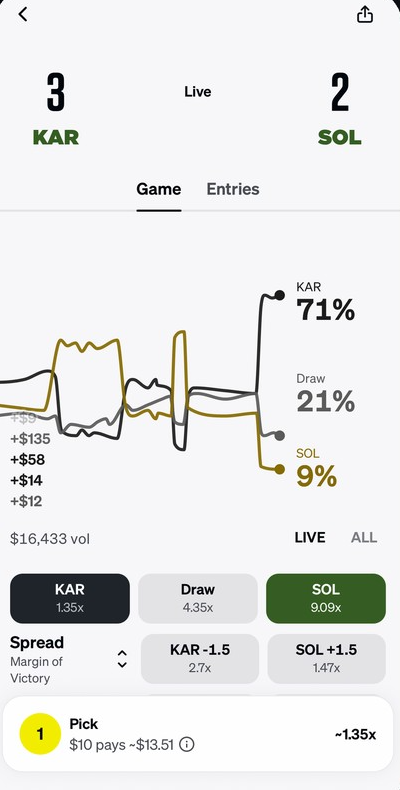
For example, a contract trading around 65 cents suggests an implied probability of roughly 65% before fees. I might agree that the outcome is likely, but that alone doesn't make it a worthwhile trade. If I believe its true chances are closer to 55%, the price is too expensive for my assessment. I'd rather pass on a familiar outcome than pay more than I believe it's worth.
I also look beyond the headline price. Available liquidity, the gap between buying and selling prices, trading costs, and the ability to exit a position can make a meaningful difference. A contract might appear attractively priced but become less appealing once I consider the full cost of entering and potentially closing the trade.
My takeaway: I find Underdog's sports prediction markets most useful when I approach them as probability-based trading opportunities rather than ordinary game picks. NFL injuries, NBA rotation changes, and college football postseason developments all create reasons for prices to move, but not every movement represents good value. Throughout November, my priority is understanding why a price has changed, checking the contract's settlement rules, and being comfortable passing when the available terms don't justify the risk.
Underdog Prediction Picks fees
Underdog fees can differ based on the entity and exchange handling the contract.
The published UDM fee schedule lists a $0.01 commission per contract, per side. In other words, buying 10 contracts creates a $0.10 commission when opening the position, and selling 10 contracts to close it can create another $0.10 commission. Separate exchange or regulatory fees may also apply.
Underdog’s Prediction Picks help center separately uses an example containing a $0.02 exchange fee per contract. Because Underdog routes markets through multiple providers, I would not reduce the entire fee section to a generic “two cents per contract” claim.
The order ticket is the source of truth. Before submitting, I would check:
- Contract price
- Number of contracts
- Underdog or UDM commission
- Exchange fee
- Any applicable regulatory fee
- Total amount at risk
- Potential $1-per-contract settlement
The price on the market board is not always the final all-in price.
What markets can I trade on Underdog?
Underdog is primarily a sports-first prediction market, although some users can also access culture and current-event contracts.
Current sports categories include:
- NFL
- College football
- NBA prediction markets
- College basketball
- WNBA
- NHL
- MLB
- Soccer
- Tennis
- MMA
- Esports
- Championship and season futures
The exact selection depends on whether UDX, Kalshi, or Nadex powers the account and market.
Sports market types
| Sport or category | Available market types |
|---|---|
| Football |
Game winner, spread, total, futures |
| Baseball |
Game winner, run line, total, first 3/5/7 innings, first-inning run |
| Basketball |
Game winner, spread, total, futures |
| Hockey |
Game winner, spread-style markets, total, futures |
| Soccer |
Three-way result, to advance, spread, total, first team to score |
| Tennis |
Match winner and eligible set-specific outcomes |
| MMA and esports |
Winner and event-specific contracts |
| Futures |
Championships, conference titles, season awards, win totals |
Futures positions can remain open for weeks or months and may be eligible for early cash out when liquidity is sufficient.
Underdog culture markets
Some Nadex-powered accounts can access non-sports markets covering:
- Awards shows and entertainment
- Elections and government
- Economic decisions
- Business milestones
- Cryptocurrency prices
Underdog currently says culture markets are available for Nadex-powered accounts, with broader provider support expected later. The available questions change as events open and resolve.
Prediction Player Picks
Prediction Player Picks are available in Connecticut, Idaho, Iowa, Louisiana, Maine, and Washington. These can cover statistics such as passing yards, rushing yards, receiving yards, anytime touchdowns, and multiple touchdowns.
This is an important distinction from standard fantasy Pick’em. Prediction Player Picks are event contracts and follow the applicable exchange rules.
Prediction Parlays
Prediction Parlays let users combine multiple team contracts into one prediction entry. Not every market can be combined. A Prediction Parlay cannot be canceled after submission, although a cash-out option may appear based on the current market value and available liquidity.
Underdog payment methods and withdrawals
Underdog supports several deposit and withdrawal methods, including debit and credit cards, Apple Pay, PayPal, Venmo, and online banking through Trustly. However, the options available for fantasy contests aren't necessarily the same as those for Prediction Picks. The minimum deposit is $10, and most approved deposits are available immediately. Underdog doesn't directly charge deposit fees, although your bank or card issuer may impose its own charges.
When I tested Underdog's earlier 50% deposit-match promotion, I deposited $100 and received $50 in bonus funds approximately 30 minutes later. The experience highlighted an important distinction: seeing $150 associated with my account didn't mean I had $150 available to withdraw. The promotion required qualifying playthrough on the combined deposit and bonus, which made the terms just as important as the speed of the credit.
That is what I'd encourage readers to consider before choosing a payment method. I look beyond how quickly I can deposit and consider whether the same method can receive withdrawals, whether the funds are eligible for Prediction Picks, and whether any bonus restrictions apply.
Underdog deposit methods
Underdog's deposit methods depend on the product, device, and payment account. Debit cards, credit cards, eligible Apple Pay cards, and Trustly can fund Prediction Picks. PayPal and Venmo are supported elsewhere on Underdog but cannot currently fund standalone Prediction Picks.
I find that distinction particularly important because the products share an app. If I'm depositing specifically to trade Prediction Picks, I want to confirm that the money will be usable for those contracts before completing the transaction.
| Payment method 🏦 | Deposit 💰 | Prediction Picks | Processing time 🕒 | Minimum deposit 🪙 | Underdog fee 💲 |
|---|---|---|---|---|---|
 Visa |
✅ | ✅ Eligible cards | Typically instant | $10 | Free |
 Mastercard |
✅ | ✅ Eligible cards | Typically instant | $10 | Free |
 American Express |
✅ If accepted | Eligible cards only | Typically instant | $10 | Free |
 Discover |
✅ If accepted | Eligible cards only | Typically instant | $10 | Free |
 PayPal |
✅ | ❌ | Typically instant | $10 | Free |
 Apple Pay |
✅ | ✅ Eligible card | Typically instant | $10 | Free |
 Google Pay |
Eligible Android users | ❌ | Typically instant | $10 | Free |
 Venmo |
✅ | ❌ | Typically instant | $10 | Free |
 Cash App/prepaid card |
Limited Fantasy use through eligible cards or wallets | ❌ | Varies | $10 | Free |
 Trustly |
✅ | ✅ | Typically instant; bank posting delays possible | $10 | Free |
 Bank transfer via Trustly |
✅ See Trustly | ✅ | Varies by bank | $10 | Free |
Payment availability depends on the account, product, card issuer, and device. Bank transfers are offered through Trustly. Underdog does not directly charge deposit fees, but a bank or card issuer may assess its own charges.
What I learned from depositing: My earlier $100 deposit earned a $50 promotional match, but that credit was not the same as $50 in unrestricted cash. I needed to account for the promotion's playthrough requirement before treating the reward as money I could withdraw. The deposit itself was only the beginning of the process.
I'd also check that the name and billing details on my payment method match my Underdog account. Underdog can reject payments when those details differ, including discrepancies involving account-name suffixes. That's an avoidable source of friction, especially when someone is trying to complete a time-sensitive promotion.
For Prediction Picks, my preference would be an eligible debit card or Trustly-linked bank account, depending on which withdrawal option I wanted to use later. That choice avoids relying on a payment method accepted for fantasy contests but unavailable for prediction contracts.
Underdog withdrawal methods
Underdog withdrawals are free and generally have a $10 minimum. If the total remaining account balance is below $10, the smaller balance can be withdrawn. Only withdrawable cash is eligible; promotional bonus funds must first satisfy the applicable playthrough conditions.
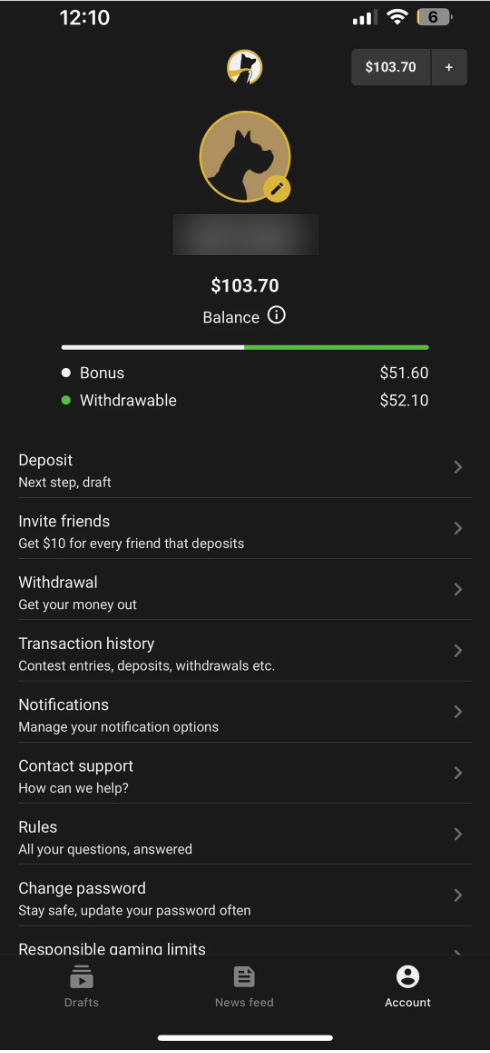
The distinction I find most important is that not every deposit method can receive a withdrawal. Credit cards and prepaid cards cannot be used for withdrawals. Visa and Mastercard withdrawals require eligible debit cards, while PayPal, Venmo, and Apple Pay have their own previous-deposit requirements. Trustly is an exception because it does not require a previous Trustly deposit.
| Withdrawal method 🏦 | Available? | Underdog processing 🕒 | Delivery after processing | Minimum withdrawal 🪙 | Fee 💲 |
|---|---|---|---|---|---|
| Visa debit |
✅ Prior debit deposit required | Typically 48-72 hours | About 24 hours | $10 | Free |
| Mastercard debit |
✅ Prior debit deposit required | Typically 48-72 hours | About 24 hours | $10 | Free |
| Trustly |
✅ | Typically 48-72 hours; may be faster | Instant at some banks; otherwise 1-3 business days | $10 | Free |
| PayPal |
✅ Prior PayPal deposit required | Typically 48-72 hours | Varies | $10 | Free |
| Venmo |
✅ Prior Venmo deposit required | Typically 48-72 hours | Varies | $10 | Free |
| Apple Pay |
✅ Eligible Visa debit card with prior Apple Pay deposit | Typically 48-72 hours | Varies by bank | $10 | Free |
| Credit card | ❌ | - | - | - | - |
| Prepaid/Cash App card |
❌ | - | - | - | - |
Visa and Mastercard debit withdrawals require a previous deposit using the eligible debit card. The same prior-deposit principle applies to PayPal and Venmo. Apple Pay withdrawals are supported for eligible Visa debit cards previously used through Apple Pay. Trustly does not require a previous Trustly deposit.
My takeaway: A payment method can be convenient for depositing without being convenient for withdrawing. For example, a credit card can fund an eligible account, but the winnings cannot be withdrawn back to that credit card. That's why I'd think about the withdrawal route before making the first deposit, not when I'm ready to cash out.
How long do Underdog withdrawals take?
Underdog generally processes withdrawal requests within 48-72 hours, although individual payment methods may be processed faster. After approval, debit-card withdrawals typically settle within about 24 hours. Trustly can deliver funds immediately at participating banks, while other banks may take an additional one to three business days. Weekends, holidays, payment-provider delays, and security reviews can extend the timeframe.
There's another step I'd be careful not to overlook. After requesting a withdrawal, Underdog requires confirmation. On iOS and Android, the confirmation typically involves a one-time code sent by SMS. On the web, the confirmation arrives by email. The confirmation must be completed within 10 minutes, or the withdrawal request is canceled and the money is returned to the Underdog account.
This is the kind of detail that can make a withdrawal appear delayed even when the payment method itself isn't the problem. I'd check for the confirmation immediately after submitting, then monitor the withdrawal status before contacting support. I also wouldn't repeatedly cancel and resubmit a pending withdrawal, because doing so resets the processing period.
My earlier $100 deposit test established how the deposit-match credit behaved, but it doesn't establish a verified withdrawal completion time. For withdrawals, I use Underdog's published processing windows rather than claiming a payout speed I haven't documented. The practical distinction remains the same: depositing successfully, clearing bonus restrictions, confirming a withdrawal, and receiving the money are four separate stages.
Underdog customer support
Underdog provides customer support through live chat and email, but my testing revealed an important distinction between reaching an agent and actually getting an answer. The chat interface was easy to access, although I had to work through automated responses before reaching a human representative.
What happened when I tested Underdog customer support?
I contacted Underdog support to ask which types of entries were eligible for my COVERS welcome bonus. I wanted clarification before using promotional funds, particularly because Underdog offers both fantasy entries and Prediction Picks.
The automated assistant didn't answer the eligibility question. Instead, it offered to transfer me to an agent and displayed a message saying the team's usual reply time was a day. That was disappointing for a relatively straightforward promotional question, especially when I was using a live chat feature.
A human agent named Jason subsequently joined the conversation. That was encouraging, and he was courteous when I asked whether email or phone support was available. He confirmed that email was an option, but explained that I would need to start a separate email conversation rather than continue through chat. He also offered to transfer my original bonus question to the appropriate team.
What stood out to me was the extra effort required to get a specific answer. I'd reached a real representative, but I still hadn't received confirmation about which entries qualified for the promotion. My screenshots document the transfer and Jason's response, not a completed resolution of the original bonus question.
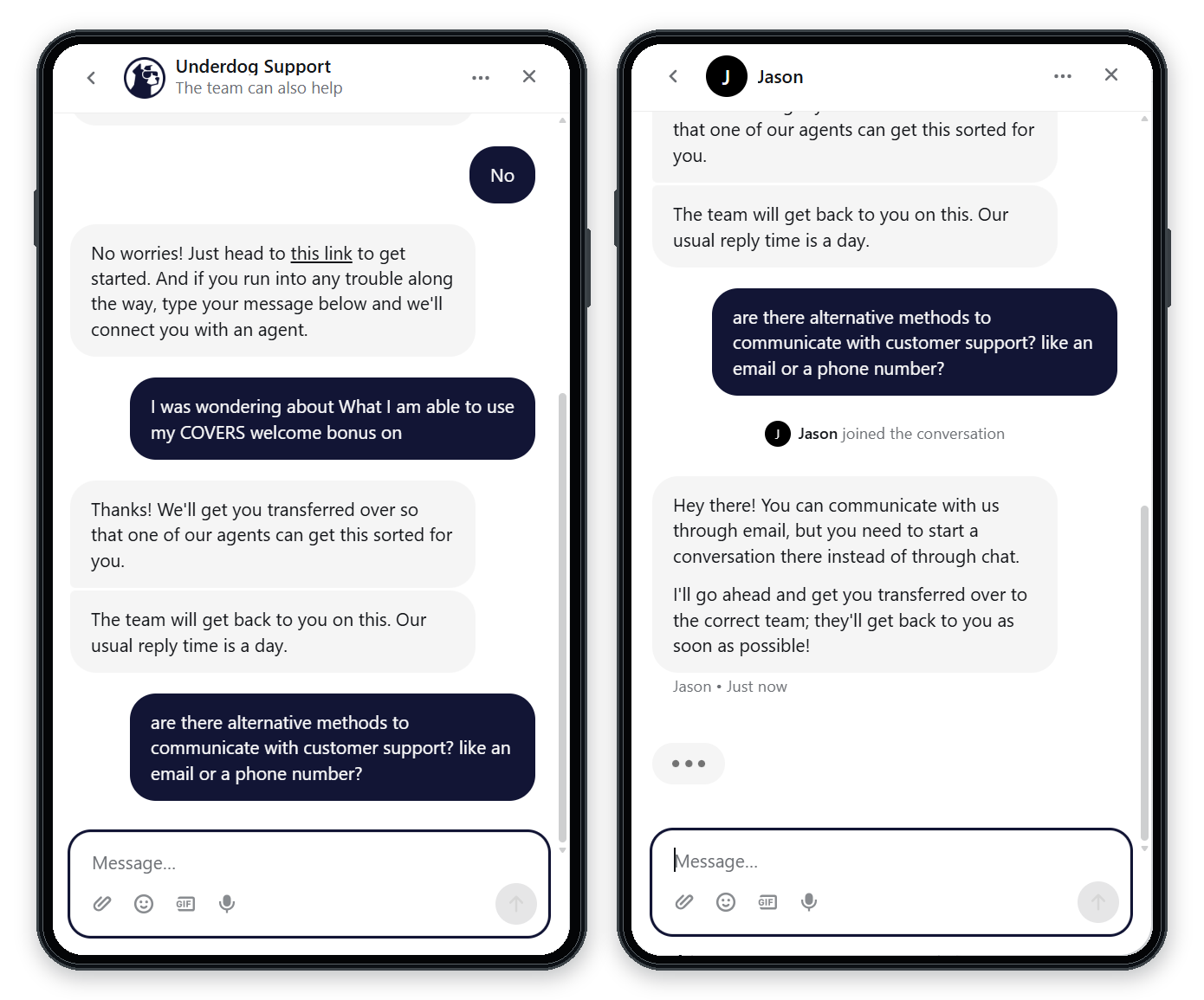
My verdict: I liked that Underdog's chat allowed me to reach a human representative without leaving the conversation. However, I was less impressed by the need for another handoff and the uncertainty around response times. For basic account questions, the chat is a convenient starting point. For something time-sensitive, such as confirming whether an entry qualifies for a bonus, I wouldn't assume the first conversation will provide an immediate answer.
How can I contact Underdog support?
On desktop, click the chat bubble in the bottom-right corner of Underdog's website. In the mobile app, open the Account tab and select Contact Support. The chat also provides automated help prompts for common questions, although more specific issues may require a transfer to a support representative.
- Live chat: Available through the Underdog website and mobile app. Automated assistance may precede a human response, and resolution times vary.
- Email (Fantasy and general support): support@underdogsports.com
- Email (Underdog Predict): support@underdogpredict.com
- Phone: No general customer support phone line advertised
- X (Twitter): @UDSupport
My recommendation: If I need clarification about a welcome bonus, I'd include the promotional offer, the exact entry type I'm considering, and a screenshot of the relevant terms in my initial message. I'd also keep a record of the conversation. My test showed that support may need to escalate a question about promotional eligibility, so getting confirmation before submitting an entry is preferable to trying to resolve a missing bonus afterward.
Where are Underdog Prediction Picks available?
Underdog Prediction Picks are currently available in 46 states plus Washington, D.C.
Eligible locations are:
Alabama, Alaska, Arkansas, California, Colorado, Connecticut, Delaware, Florida, Georgia, Hawaii, Idaho, Illinois, Indiana, Iowa, Kansas, Kentucky, Louisiana, Maine, Maryland, Massachusetts, Minnesota, Mississippi, Missouri, Montana, Nebraska, New Hampshire, New Jersey, New Mexico, North Carolina, North Dakota, Ohio, Oklahoma, Oregon, Pennsylvania, Rhode Island, South Carolina, South Dakota, Tennessee, Texas, Utah, Vermont, Virginia, Washington, Washington, D.C., West Virginia, Wisconsin, and Wyoming.
Prediction-only states
The following 14 states currently have Prediction Picks but do not have Underdog Pick’em or Drafts: Connecticut, Hawaii, Idaho, Iowa, Louisiana, Maine, Maryland, Massachusetts, Mississippi, Montana, New Jersey, Ohio, Pennsylvania, and Washington.
Prediction Picks availability does not automatically mean a user qualifies for Underdog’s fantasy welcome bonus, which has separate product and promotional eligibility requirements.
Ineligible Prediction Picks states
Prediction Picks are not currently available in:
Arizona, Michigan, Nevada, and New York. They are also unavailable in Ontario and U.S. territories.
Eligibility is based on physical location, not permanent residence. Users who travel into an ineligible state cannot place new trades or cash out until they return to an eligible location. Existing positions remain active and settle according to their market rules.
Is Underdog legit and regulated?
Yes. Underdog Prediction Picks are event contracts traded through Commodity Futures Trading Commission (CFTC)- regulated exchanges.
Underdog now owns and operates UDX, which includes a CFTC-registered designated contract market and derivatives clearing organization. UDM, LLC, doing business as Underdog Predict, is also a registered futures commission merchant regulated by the CFTC and NFA.
Underdog Predict and Underdog Fantasy are separate legal entities. Funds held in an eligible UDM futures account receive certain CFTC customer-fund protections, while fantasy-account funds do not receive those same futures-account protections.
Regulated does not mean risk-free. A losing contract settles at $0, and I can lose the full contract cost plus fees. Cash out is not guaranteed, and a thin market may leave me holding the position until settlement.
My Underdog Predict review
Underdog is one of the more approachable ways for sports fans to explore regulated event contracts. Its biggest strength is the familiar sports-first experience: I can move from browsing a game to evaluating a contract price without navigating a professional trading interface. However, the simplicity of the presentation can hide important differences in fees, settlement rules, and the exchange providing the market.
My biggest reservation is product separation. Underdog's featured welcome bonus applies to eligible fantasy activity rather than standalone Prediction Picks, and payment methods and account rules can differ between the two products. I like having both available through one app, but I wouldn't assume that a promotion, deposit method, or feature works identically across them.
 Who it's for
Underdog Predict is best suited to sports fans who want a mobile-first prediction market experience without a complicated trading interface. I like that the markets are organized around familiar sporting events and that contract prices can be understood as probabilities. Someone who already uses Underdog for fantasy sports may also appreciate having access to Prediction Picks through the same app, where available.
That familiarity has limits, though. Prediction Picks are regulated financial contracts, not simply another type of fantasy selection. The underlying exchange determines the contract's rules and settlement, while fees, liquidity, and cash-out availability can vary. I'd recommend Underdog to someone willing to learn those distinctions, but less readily to someone who expects every market to behave like a conventional sports entry.
It's also worth considering in states where Prediction Picks are available but other Underdog contests are restricted. However, access to Prediction Picks doesn't automatically establish eligibility for the fantasy welcome promotion.
 Covers TradeGrade Rating: ⭐ 4.8/5
| Banking and payout speed | ⭐ 4.6/5 |
| Customer security, regulation, and trust | ⭐ 4.8/5 |
| Bonuses and promotions | ⭐ 4.8/5 |
| User experience and support | ⭐ 4.5/5 |
| Key features | ⭐ 4.6/5 |
| Pricing, fees, and spreads | ⭐ 4.6/5 |
| Contract clarity and settlement rules | ⭐ 4.5/5 |
| Market liquidity and variety | ⭐ 4.8/5 |
I evaluate Underdog's prediction-market experience separately from its fantasy products, using the criteria detailed in how we rate prediction markets.
How I tested Underdog Predict
My review combines firsthand account testing with an evaluation of Underdog's prediction-market features, pricing controls, account requirements, and published exchange rules. I pay particular attention to what happens between seeing an advertised offer, funding an account, selecting a market, and understanding the potential payout. Those stages don't always work the way the headline promotion or initial interface might suggest.
During my earlier Underdog welcome-offer testing, I deposited $100 and received a $50 promotional match. The bonus appeared in approximately 30 minutes, but I still had to account for $150 in qualifying playthrough. That was an important lesson about the difference between money appearing in an account and money being available to withdraw. It also highlighted why I assess fantasy promotions separately from Prediction Picks, which have different funding and contract rules.
I also contacted Underdog customer support to ask which entries qualified for the COVERS welcome bonus. The automated chat offered to transfer my question, and I reached a human representative named Jason. He was courteous and explained how to contact the team by email, but I didn't receive a definitive answer to the promotional eligibility question during the documented exchange. I appreciated reaching a person, although the additional handoff made the support experience less decisive than I'd hoped.
For the Predict-specific assessment, I examined how contract probabilities and potential returns are presented, how Price Change Tolerance affects order submission, and how exchange-specific rules influence cash-out and settlement. I distinguish those product and rules checks from an executed prediction trade or a completed withdrawal. My documented deposit and support tests provide firsthand evidence of those parts of the experience, but they don't establish a personally measured withdrawal time or prove that every Predict feature behaves identically across markets.
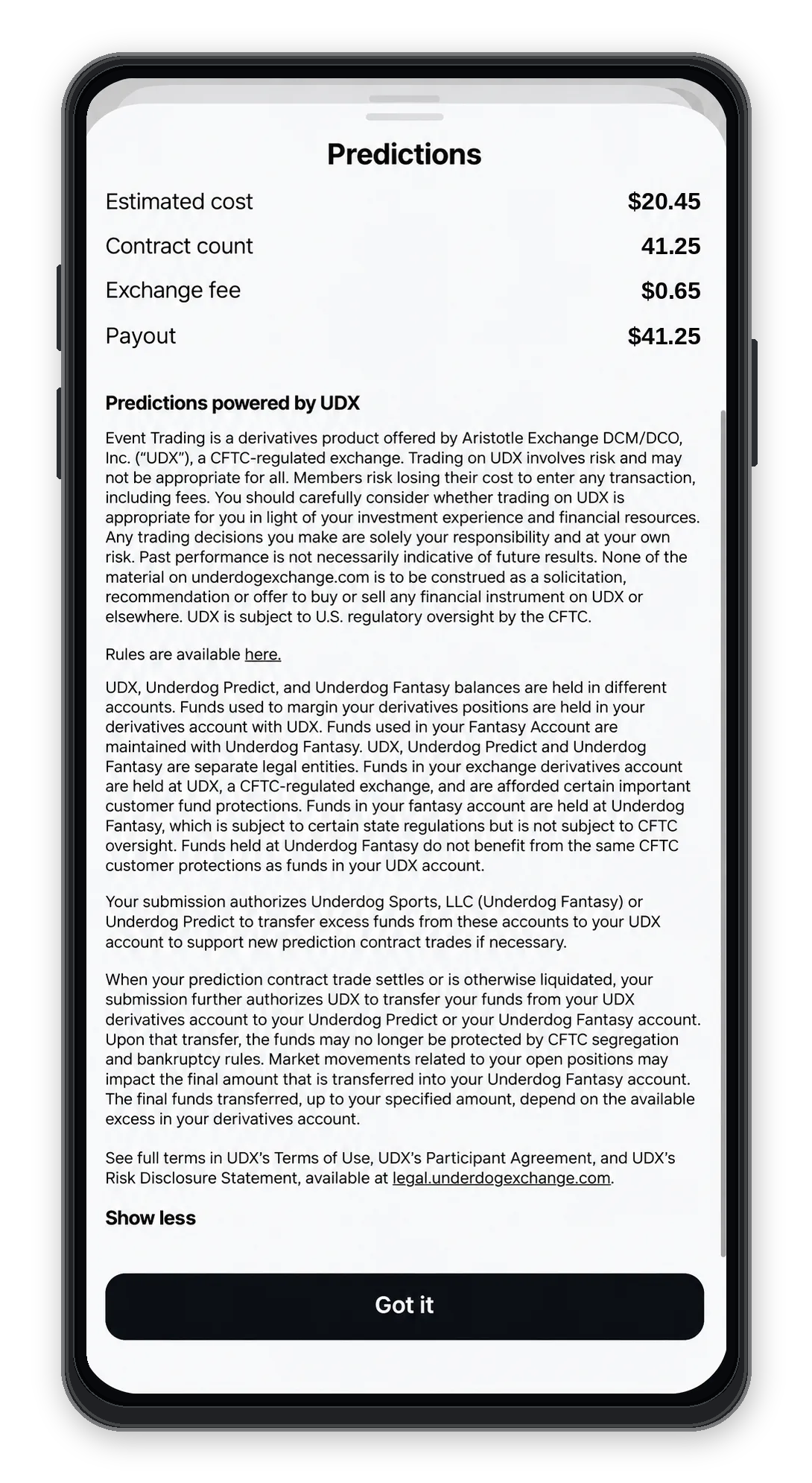
What testing changed about my opinion: I initially found Underdog's familiar sports interface its most attractive feature. After working through the promotional requirements, support process, and Predict rules, I consider clarity about the underlying product just as important. The app makes getting interested in a market relatively easy, but understanding exactly what I'm buying, how much it costs, and when I can exit requires more attention than the interface alone might suggest.
 User reviews
"First of all, wanna give a shout-out to Andre from customer support, extremely quick and very kind. Secondly, the app is very good and very well made. There's no rigged competition, and every game makes it possible for anyone to win. Withdrawals do take a bit longer. However, they do all withdrawals manually, and you get to communicate with real people, so it's way more worth it."
- App Store reviewer
"Lots of reasons to love Underdog. I love the quick payout action. Super promotions from time to time, too."
- App Store reviewer
How does Underdog price change tolerance work?
One Underdog Predictions feature I find particularly useful is Price Change Tolerance. Sports contract prices can move between the moment I build an entry and the moment I submit it. This setting determines how much the price can move against me before Underdog requires another confirmation.
The default tolerance is 5%, but I can adjust it from 0% to 20% or choose to accept any price change. Favorable price movements are accepted automatically. I can change the tolerance through the Entry Slip or Account Settings, and choose to display prices as probability percentages or multipliers.
Here's an example of why the setting matters. Suppose I'm expecting to receive 25 contracts at 40 cents each. If the market moves before submission and my entry would now purchase only 24 contracts, that's a 4% reduction in the contract count. With the default 5% tolerance, Underdog can accept that change automatically. With a 0% tolerance, I'd need to approve the worse price before continuing.
One fewer contract might sound insignificant, but a winning contract pays $1 before applicable fees. Receiving 24 contracts instead of 25 reduces the potential gross settlement payout by $1. I like having control over that difference, particularly when I'm evaluating an outcome where a small price change could eliminate the value I originally saw.
My preference would be a tighter tolerance when prices are moving quickly or when the available liquidity is limited. The trade-off is convenience: setting tolerance too low can mean more interruptions when trying to submit an entry. A wider tolerance makes submission easier, but it can also mean accepting a less attractive position than I originally intended.
Price Change Tolerance applies to single Prediction entries and Pick'em + Prediction Combos. It doesn't apply to Prediction Parlays, which are submitted at the exact quoted price and contract count.
My takeaway: Price Change Tolerance is a useful execution control, not protection against losing money after a trade is placed. It helps me decide how much movement I'll accept while entering a position. Once I'm holding the contract, its value can still change substantially, and an early cash-out depends on market conditions and available liquidity.
Underdog Predict at a glance
| 💰 Sign-up bonus | Play $10, Get $50 in Bonus Entries (eligible fantasy activity, not standalone Prediction Picks) |
| ⏩ Underdog promo code | COVERS |
| 🏅 Top feature | Sports prediction markets routed across regulated exchanges, including UDX, Kalshi, and Nadex |
| 💵 Minimum deposit | $10 |
| 💵 Minimum entry | Fantasy welcome-offer qualifying play: $10 (Prediction Picks have separate contract requirements) |
| 🕒 Withdrawal processing | Typically 48-72 hours for withdrawal requests; contract settlement follows the applicable exchange rules |
| ✅ Last verified | Nov. 5, 2026 |
What I like about Underdog Predict
What I don't like about Underdog Predict

Underdog app review
Underdog's mobile app combines Prediction Picks, fantasy Pick'em, and other sports games in one place. I like the convenience of browsing familiar NFL, NBA, and other sports markets without switching between separate platforms, but the shared interface comes with a learning curve: a fantasy entry and a regulated event contract can look similar while following very different rules.
That distinction became important during my Underdog testing. When I deposited $100 under an earlier welcome offer, the $50 match appeared relatively quickly, but understanding the associated playthrough requirement took more attention than simply funding the account. The same lesson applies to the app itself. I want to know which product I'm using, what the displayed payout represents, and whether any promotional funds actually qualify before submitting an entry.
🍎 Underdog iOS app
The Underdog iOS app earned 4.8/5 stars from approximately 332,000 ratings in the App Store snapshot I reviewed for this November audit. That listing also showed version 26.68.0, an app size of 199 MB, and an 18+ age rating. The comparison image below includes an earlier App Store capture showing approximately 322,000 ratings and version 26.63.0. The figures above reflect the newer listing and can change as the app receives updates.
You can download the Underdog iOS app from the App Store.
One detail I noticed in the App Store presentation was how much emphasis Underdog places on different experiences. The promotional screenshots feature the Play $10, Get $50 welcome offer alongside fantasy picks, Rips trading cards, and other games. I appreciate the variety, but I'd prefer clearer separation between fantasy promotions and Prediction Picks for someone installing the app specifically to trade event contracts.
There's also a good reason not to rely solely on the app listing for bonus information. The screenshots I reviewed prominently featured Play $10, Get $50, while the release notes referenced an alternative deposit-match promotion. That doesn't necessarily mean either offer is unavailable, but it demonstrates why I check the actual registration offer and qualifying conditions rather than treating app-store marketing as the final word.
🤖 Underdog Android app
The Google Play listing I reviewed showed a 4.7/5-star rating from approximately 35,600 reviews, with more than 1 million downloads. The app is rated for adults 18 and older and is published by Underdog Sports Wagering, LLC.
Android users see a similar combination of welcome-offer advertising, fantasy selections, Rips, and other sports games. That consistency is useful because the broad Underdog experience doesn't depend entirely on which mobile operating system I'm using. However, I wouldn't assume that every promotional feature, payment method, or prediction market will be available simply because it appears in a store screenshot.
I also pay attention to the criticism in user reviews rather than judging the app only by its strong overall rating. Some Google Play reviewers have reported lag, unclear payout calculations, or difficulty understanding fees. Those reports don't establish that every user will encounter the same problems, but they reinforce something I consider important when evaluating Underdog: the final entry slip needs to make the price and potential return understandable before money is committed.
My takeaway from comparing the listings: Both versions have substantial user ratings and promote a broad sports experience, but neither store rating tells me how a particular Prediction Pick will execute or settle. I place more weight on the clarity of the entry slip, promotional eligibility, and account controls than on the difference between a 4.8 and 4.7 overall rating.
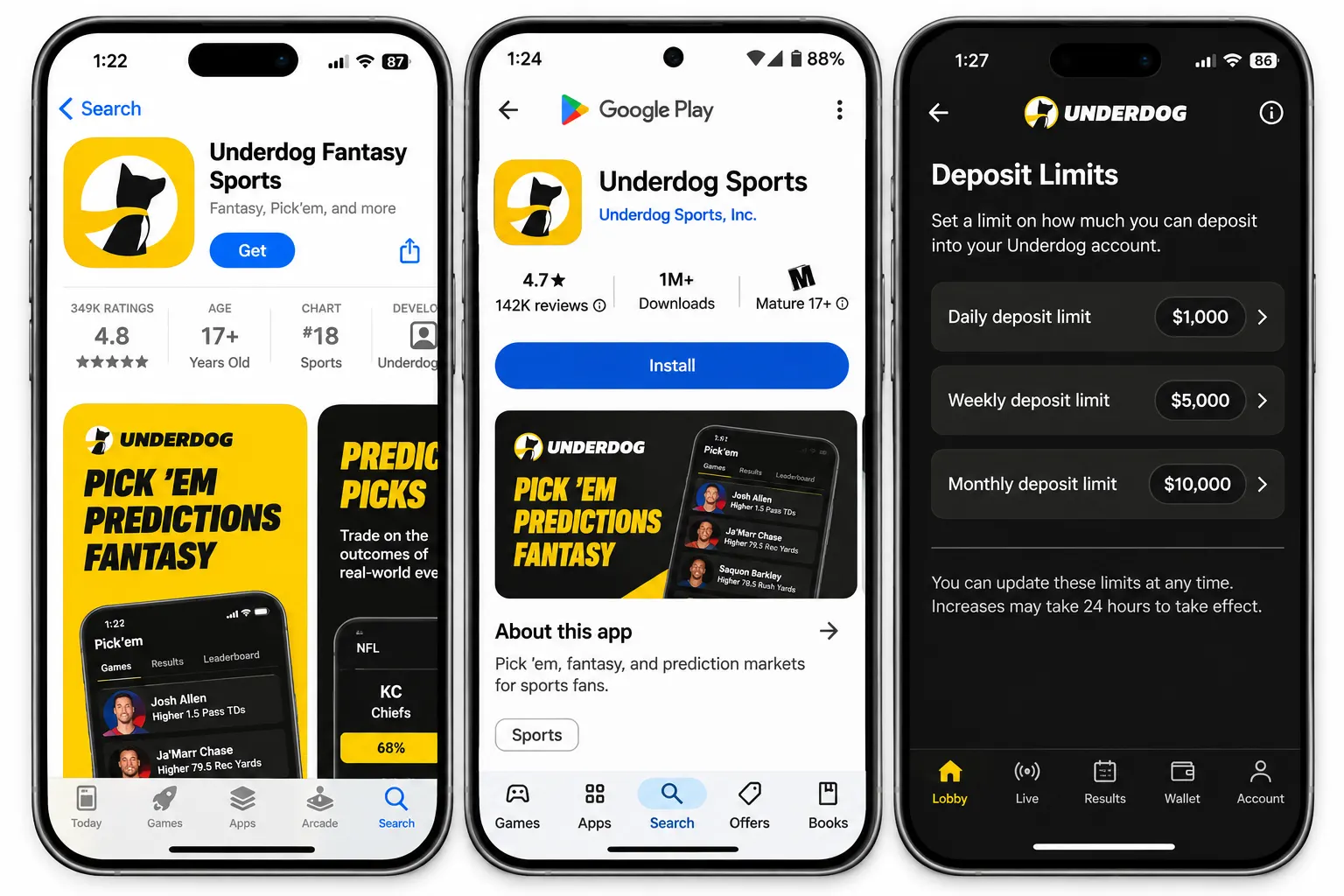
📱 Underdog app design
Underdog's biggest design advantage is that it presents sports predictions through familiar teams, games, and player outcomes rather than requiring me to navigate a traditional financial exchange interface. I can begin with an event I recognize and work toward the available contract price, potential payout, and entry details.
That approach makes browsing approachable, but I think the most important part of the interface is the final entry slip. A game-winner Prediction Pick, a fantasy player-stat entry, and a Combo can involve similar sporting outcomes while using different pricing and settlement rules. I don't want the familiarity of the sport to distract me from those distinctions.
For a Prediction Pick, I focus on the contract price and how many contracts the entry purchases. For fantasy Pick'em, I look at the selections and payout multiplier. When a promotion is involved, I also confirm that the intended bonus is actually applied. Those checks tell me considerably more than the headline potential payout alone.
Another usability consideration is finding existing positions. Underdog's Track area provides access to Prediction Picks and their status, including eligible cash-out options. I like being able to review an existing position without rebuilding the original entry, although I wouldn't confuse having a Cash Out feature with being guaranteed an opportunity to exit at any moment.
What I'd improve: I'd make the product boundaries and reward restrictions more obvious throughout the experience. My support test reinforced that concern. When I asked which types of entries qualified for the COVERS welcome bonus, the automated chat transferred me to a human agent, but the original eligibility question wasn't resolved during the documented exchange. A clearer explanation within the entry flow would reduce the need to seek support for something as fundamental as where a bonus can be used.
📈 What I like about the Underdog mobile app
Sports-first navigation: I can start with leagues and games I already follow rather than searching through financial-market terminology. That helps me find relevant opportunities, but I still evaluate whether the contract price offers reasonable value instead of automatically selecting a familiar team.
Readable contract pricing: Prediction Picks display prices that correspond approximately to market-implied probabilities. A contract priced at 65 cents, for example, implies roughly a 65% chance before fees. I like that the potential return can be calculated from the contract price, although a likely outcome can still be an unattractive trade when the price is too high.
Price Change Tolerance: Underdog lets users control how much an adverse price movement can affect a Prediction Pick before additional confirmation is required. I value that control because the number of contracts I receive can change while I'm preparing an entry, especially around significant sports news or live events.
Prediction Cash Out: Eligible Prediction Picks can be sold before settlement at the available market price. This provides flexibility if my assessment changes, but the amount offered can be lower than my original cost, and insufficient liquidity can prevent an early exit entirely.
Multiple sports experiences: Underdog also includes fantasy Pick'em, promotions, and other games within the broader app. I appreciate having those options available, although I consider them separate products rather than assuming a fantasy bonus can be applied to a prediction contract.
Overall, the app earns its place among our recommended apps like Novig because of its accessible sports-focused presentation. My main reservation is that the simplicity of the interface can make the underlying distinctions between fantasy entries and prediction trading easier to overlook.
How does Underdog Pick'em Cash Out work?
Underdog replaced its former two-minute cancellation window for Pick'em entries with a Cash Out feature that allows eligible fantasy entries to be settled early at an offered value. Instead of simply canceling an entry for a full refund, I can review the available cash-out amount and decide whether accepting it makes sense.
I like having another way to manage an entry, but I wouldn't describe Cash Out as a safety net. The offered amount can be lower than the original stake, availability varies by entry type and conditions, and cashing out an entry with an attached promotion can permanently forfeit that promotional reward.
That last restriction matters with Underdog's daily $10 welcome bonus entries. If I apply a promotional entry and then cash out, I shouldn't expect the reward to return to my account for another attempt. Bonus-funded entries can also have additional restrictions on when Cash Out becomes available. I'd compare the offered exit value with the possibility of keeping the entry active, rather than assuming cashing out is automatically the more cautious choice.
Prediction Cash Out works differently. A Prediction Pick represents event contracts traded through an exchange. Closing a position early means selling those contracts at the available market price, potentially with exchange fees. Underdog also offers an auto cash-out feature for eligible single Prediction Picks, allowing me to set a target price, but that order only executes if the target is reached and sufficient liquidity exists.
For example, if I buy a contract at 40 cents and its available selling price rises to 60 cents, an early sale could lock in a gain before fees. If the market moves against me and the available price falls to 25 cents, exiting would instead realize a loss. And if no buyers are available, I might not be able to close the position at all.
My verdict on Cash Out: I appreciate the flexibility, especially because sports markets can move quickly after an injury or major play. However, the fantasy and Prediction Picks versions are not interchangeable. Before entering, I want to understand whether an early exit is supported, what it could cost, and what happens if I need to hold the position until settlement. That's more useful than relying on the presence of a Cash Out button alone.
Prediction markets in the news
Underdog vs. other prediction market apps
I've showcased how the Underdog offer compares to the Kalshi promo code and Polymarket promo code below:
 Underdog
|
 |
 |
 Novig
|
|
|---|---|---|---|---|
| Welcome bonus | Play $10, Get $50 in Bonus Entries | Exclusive $60 Bonus | Deposit $10, Get $25 Bonus | Deposit $10, Get $50 |
| Promo code | COVERS | MAX60 | COVERS | COVERS |
| Bonus type | Play and get | Trade and get | Deposit and get | First purchase |
| Bonus form | $50 bonus | $60 bonus | $25 trading bonus | Ten (10) Trade Credits of $5.00 each |
| Qualifying activity | $10 | $25 | $10 | $5 |
| Min. deposit | $10 | $10 | $10 | $10 |
| Covers TradeGrade Bonus Rating | ⭐ 4.6/5 | ⭐ 4.9/5 | ⭐ 4.9/5 | ⭐ 4.8/5 |
For another prediction-market breakdown, see our Onyx promo code guide.
Alternatives to Underdog


More prediction market resources


Underdog promo code FAQ
The featured Underdog promo code is COVERS, which unlocks 'Play $10, Get $50 in Bonus Entries' for eligible new customers. Confirm the offer appears during registration because Underdog has several welcome promotions with different requirements.
Eligible users receive five $10 bonus entries, issued one per day over five days, totaling $50 in promotional value. The full amount isn't available upfront or credited as unrestricted cash. I would check the app each day rather than assume all five entries are available immediately.
The published minimum deposit is $10, but depositing alone doesn't activate the featured welcome bonus. You must also complete $10 in qualifying play. I consider those separate requirements because funding an account is not the same as earning the promotion.
Complete at least $10 in eligible fantasy play under the COVERS promotion. Standalone Prediction Picks don't qualify under the Play and Get rules. Before submitting, check the entry type shown on your slip rather than assuming every Underdog selection counts toward the offer.
Open the Underdog mobile app and check the Promos tab, identified by the money-bag icon in the bottom navigation. Eligible rewards may also appear while building an entry. Select the available bonus, tap Apply, and check the final payout before submitting. Underdog says bonus entries must be redeemed in the mobile app rather than a web browser.
Not on standalone Prediction Picks under the featured Play $10, Get $50 promotion. Underdog's Play and Get rules limit these rewards to eligible fantasy activity. Qualifying Combos involving fantasy selections and prediction contracts have separate funding rules. I would verify that the specific reward appears as eligible on the entry slip before building a Combo around it.
Not directly. The $50 is promotional entry value, not withdrawable cash. When an eligible bonus-funded entry wins, Underdog pays the profit without returning the original promotional stake. That distinction matters: a $10 bonus entry with a standard 3x cash payout would return $20 in winnings rather than $30 because the $10 promotional stake isn't returned. Check the displayed payout and applicable promotion requirements before submitting.
The five-day schedule describes when the rewards are issued, not necessarily when each entry expires. Underdog's Play and Get rules impose a 1x turnover requirement within 14 days of a promotional bonus being issued. Individual rewards may also display their own expiration conditions. I would check each entry when it arrives rather than wait until all five have been credited.
Yes, for eligible customers in states offering both Underdog fantasy contests and prediction markets. The alternative welcome offer matches 50% of the first qualifying deposit up to $1,000, meaning a $2,000 deposit reaches the maximum. Prediction-only states have a different offer: a 25% deposit match up to $250.
When I tested Underdog's earlier 50% match, my $100 deposit earned $50 in bonus funds. The important catch was the required $150 in combined deposit-and-bonus playthrough. I'd calculate that obligation before choosing a larger match over the smaller Play $10, Get $50 promotion.
No. When Underdog presents these promotions through Choose Your Offer, eligible new customers must select one welcome bonus. The selection is final and cannot be changed after confirmation. I would compare the qualifying play, reward format, and playthrough conditions before choosing, rather than selecting the offer with the larger headline amount.
COVERS is the Covers promo code for the featured 'Play $10, Get $50 in Bonus Entries' welcome offer. Covers doesn't publish a separate Underdog referral code. Underdog also has an account-based refer-a-friend program, but its rewards and eligibility are different. Don't assume a friend's referral offer can be combined with the Covers welcome promotion.
Not for the featured COVERS welcome offer. You must fund your account and complete $10 in eligible play to qualify. The advertised $50 is awarded as promotional entries, not a no-deposit cash balance. Other targeted promotions may have separate requirements.
Register as an eligible new user with COVERS, deposit at least $10, and complete $10 in qualifying fantasy play. Underdog then issues five daily $10 bonus entries.
The important distinction is that this is $50 in promotional entry value, not $50 in free cash. Check the Promos tab to find each reward, confirm where it can be used, and review its expiration before applying it.
The featured COVERS welcome promotion is for eligible new customers and cannot be claimed again through an existing account. Returning users can check their Promos tab for account-specific multiplier boosts, Challenges, referral rewards, and other targeted offers.
I'd prioritize a promotion that improves an entry I already intended to make rather than spending extra money solely to unlock a reward. Availability, payout conditions, and expiration dates can vary between accounts.