


Below are the latest odds on the most intriguing midterm races on prediction markets like Kalshi and Polymarket. With control of both chambers of Congress up in the air, plus governors’ races in key swing states, the stakes have rarely been higher. US midterm election odds can change quickly, so getting the most up-to-date odds is crucial.
Senate Control odds
With Democrats favored to win the House, most of the country's attention on politics is focused on control of the Senate. With Republicans holding a 53-47 Senate majority and Vice President JD Vance breaking 50-50 ties in Republicans' favor, Democrats need to pick up four seats this November to win Senate control. Democrats are currently 61% to win the Senate, per Kalshi.
The seven true battleground Senate races, Texas, Maine, Michigan, Alaska, Iowa, Ohio, and Nebraska, will decide Senate control. If the odds in safe seats are accurate, Democrats will need to win four of the seven competitive races to take the Senate. Right now, market odds favor them in five races, but narrow shifts could make all the difference in Senate control.
Thirty-five seats are up for grabs this November, but prediction-market probabilities consider most states safe for the party that holds them. In 23 states, the incumbent party has a greater-than-90% chance of winning the seat again, which considerably reduces the number of competitive seats. Another five states have leading-party odds between 80% and 90%, including Democrats' odds of flipping North Carolina's Senate seat.
 Why midterm odds can add up to more than 100%
House Control odds
Democrats need to overcome a 220-215 deficit to flip the House. In 2024, Republicans kept the House after flipping it in 2022, but they will have to hold it this year with a small majority. November election odds currently favor Democrats for the House, but favorable court rulings in Florida and Virginia have buoyed Republicans and increased their chances of retaining control of the House.
House odds could be more volatile than usual this year. As some states redraw their district lines ahead of 2026 and reduce the number of competitive districts, each competitive seat matters more. The winning party has won the last three House elections with 222, 222, and 220 seats, barely above the 218-seat majority threshold for House control. This suggests House control markets could be volatile as we learn more in key battleground districts.
Congress balance of power odds
Prediction market odds reflect a decisive shift toward a full Democratic sweep of Congress, with the probability of Democrats winning both chambers surging from 39% in February 2026 to 62%. This rally has displaced a divided Congress as the most likely scenario, while the likelihood of Republicans retaining both chambers has dwindled to an outlier 8% despite their current governing trifecta.
At the same time, prediction market pricing remains more tempered on Democratic prospects than headline polling because markets weigh forward-looking volatility rather than treating point-in-time voter preferences as guaranteed results. While polling averages provide snapshots of immediate candidate leads (such as James Talarico leading in Texas), prediction markets factor in shifting dynamics and uncertainty to assess the probability of how the races will ultimately finish.
Battleground states odds
Senate control races and Governors’ Mansion races across America will come down to key battleground states. With statewide races heating up everywhere, many key states have plenty of interesting races.
- Alaska Midterm Odds
- Florida Midterm Odds
- Georgia Midterm Odds
- Iowa Midterm Odds
- Maine Midterm Odds
- Michigan Midterm Odds
- Texas Midterm Odds
Follow this space for the most recent news and market probabilities.
Kalshi vs. Polymarket midterm odds
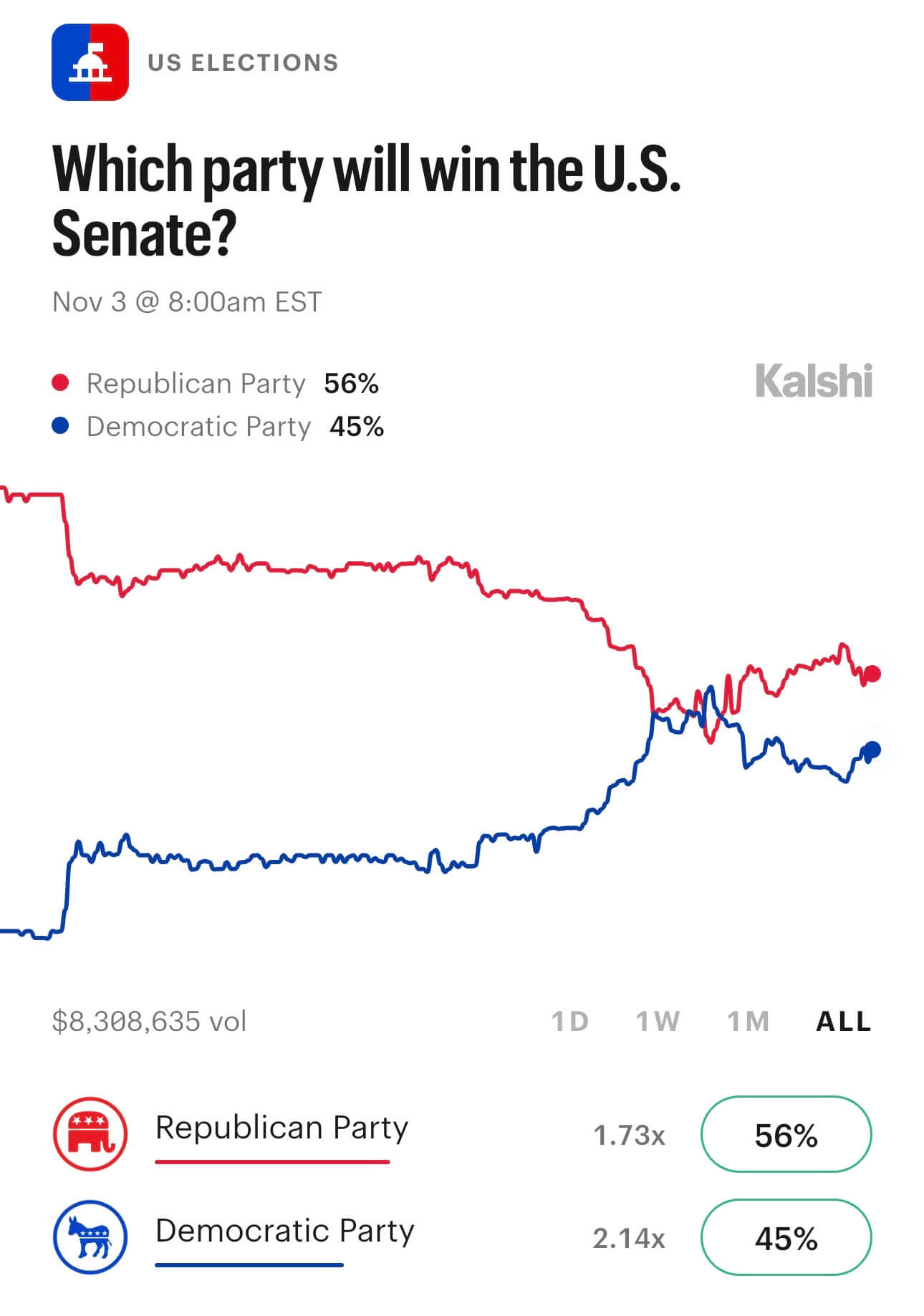
Several prediction market apps, including Kalshi and Polymarket, offer similar but not identical political prediction markets. They offer odds on Senate Control, House Control, who will win the Governor and Senate races across the country, and on individual House races. Odds are driven by the trades people make on each site, and one site’s users might have a different take on a poll or news story. Finding the best odds for the trade you want to make matters.
Both Polymarket and Kalshi use official sources to resolve markets, which can mean that results that seem certain on election night may take time to pay out officially. When looking at odds, especially in volatile or changing markets, stay on top of the latest news, because in dynamic markets that shift as people trade, missing information could mean the difference between winning and losing.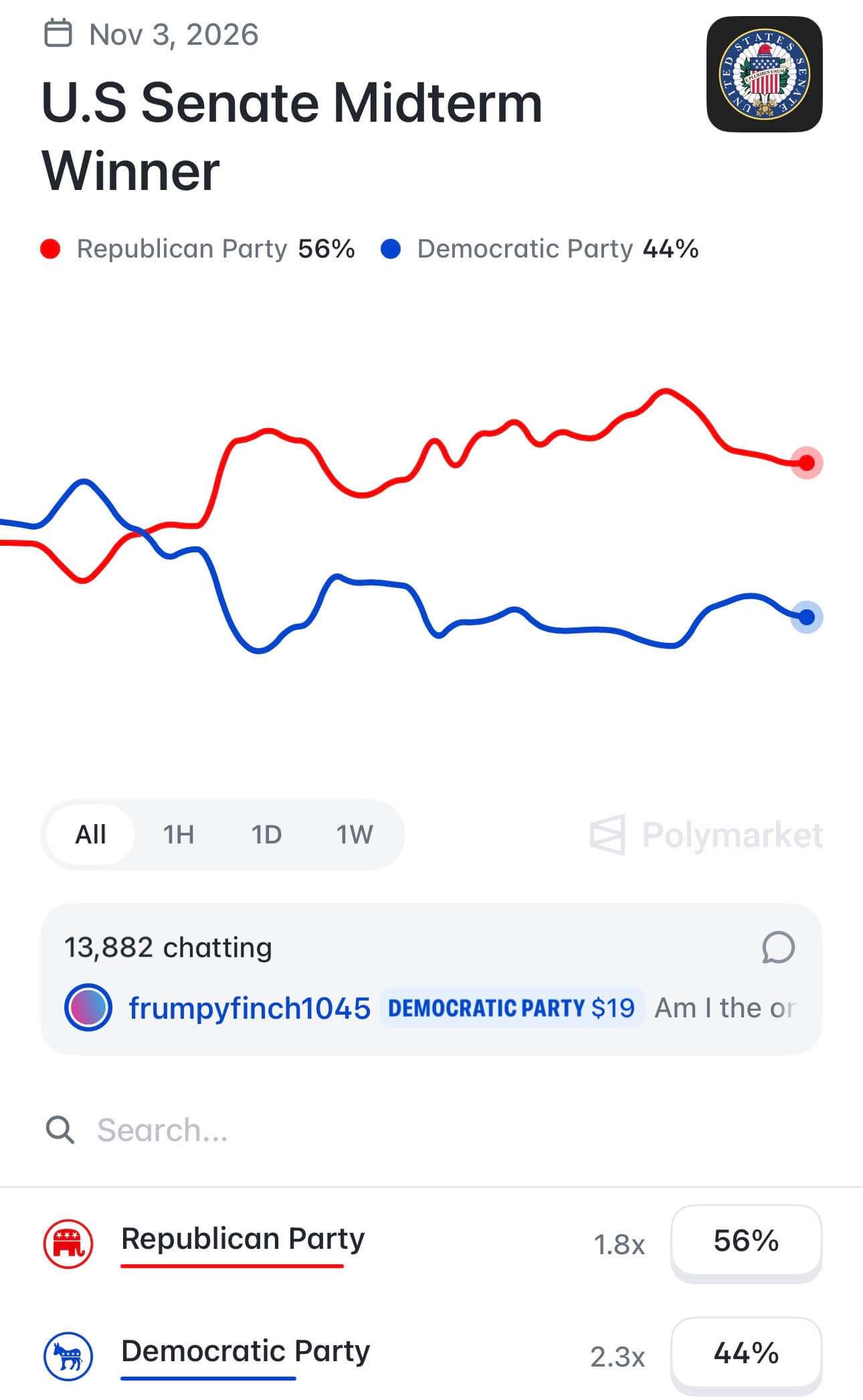
How to read prediction market odds
Prediction markets don’t price outcomes like a traditional sportsbook, but their odds are intuitive. If a party has a $0.62 price, the market is saying there’s a 62% chance it will happen. Prediction markets aren’t polls; they’re the consensus of what traders in that market think will happen.
Markets with more trades and more dollars traded tend to be more stable, but newer or less-traded markets may move significantly as people start trading. Additionally, polls and predictions can move traders’ opinions. Polls are snapshots of where a race stands at the time of the poll, whereas prediction markets are about what will happen. Models attempt to use quantifiable information, including polls and other metrics, to predict the current state of play.