


The Torvik Ratings are one of the most valuable, easy-to-use tools available during March Madness season.
Widely referred to as "BartTorvik," this college basketball analytics site gets used constantly by sharp bettors throughout the regular season and deep into the tournament. No betting resource is a magic bullet, but Torvik is a genuine standout, and it offers a few real advantages over its more widely known counterpart, KenPom.
Below, we break down what the Torvik Ratings actually measure, how they differ from KenPom, and how to put both the team and player data to work when handicapping games.
What are the Torvik Ratings?
Found at barttorvik.com , the Torvik Ratings were created by Bart Torvik, a lawyer with a serious passion for basketball data. The rankings date back to 2008, though the site really started gaining traction around 2015.
The centerpiece of the site is "T-Rank," a power rating covering all Division 1 men's college basketball teams from top to bottom. Bettors tend to favor T-Rank over traditional poll rankings because it strips out voter bias and accounts more precisely for strength of schedule. The most commonly cited individual metrics are Adjusted Offensive Efficiency (ADJOE), Adjusted Defensive Efficiency (ADJDE), and Adjusted Tempo (ADJ T).
Enjoying Covers content? Add us as a preferred source on your Google account
Torvik vs. KenPom
The two sites share a lot of DNA. Both build their power ratings from similar core efficiency metrics, and they tend to agree closely on which teams sit at the top of the sport, though the exact order can differ. The real separation comes down to a handful of concrete differences.
| Feature | Torvik | KenPom |
|---|---|---|
| Recency weighting | Yes, games lose weight after 40 days | No, all games weighted equally |
| Women's basketball coverage | Yes | No |
| Custom date range filtering | Yes | Limited |
| Core efficiency metrics | Adjusted offense, defense, tempo | Adjusted offense, defense, tempo |
The recency weighting is the most notable difference. Torvik starts discounting games after they're 40 days old, shaving off roughly a percentage point of emphasis for every additional day up to the 80-day mark, at which point older games settle at a flat 60% weight relative to the most recent ones. Whether that adjustment makes the ratings more predictive is debatable, but it's a meaningful design choice that separates Torvik from a straight season-long average, and plenty of bettors, including us, are fans of the approach.
Torvik also covers women's college basketball with its own dedicated ratings and data, an area KenPom doesn't touch. For bettors who follow both games, that alone can make Torvik the more complete resource.
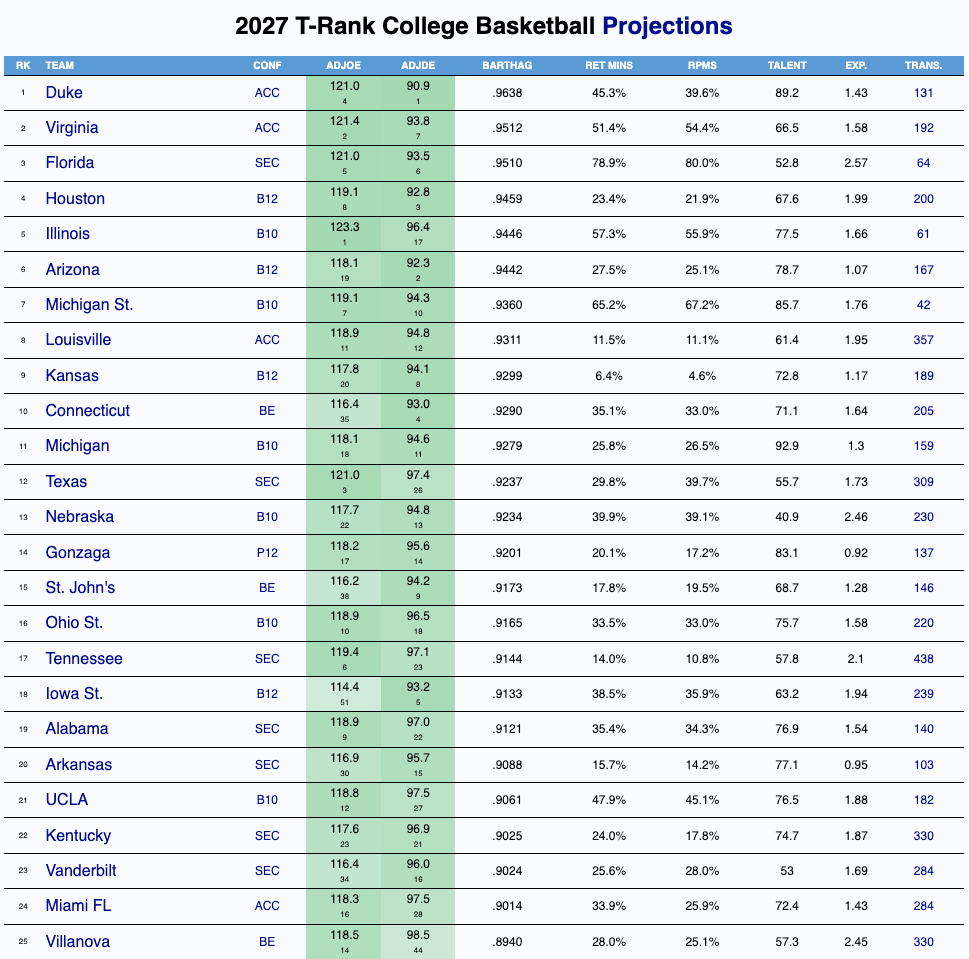
How to use the Torvik Ratings
The feature that sets BartTorvik apart is how easily users can slice the data to a specific window of time. Entering a start and end date at the top of the site, similar to searching flights, lets bettors isolate a team's performance over any custom stretch. That's a simple but powerful way to answer a question like "who's actually playing the best right now," rather than relying on a rating built on the full season.
This becomes especially useful once the NCAA Tournament tips off. Setting the date range to cover only tournament games shows which teams have performed best under the bright lights so far, even though that sample shrinks to just a game or two early on. Small as it is, that window matters, since performing under March pressure is a different test than a random Tuesday in January.
How to use Bart Torvik's player data
Bettors building same-game parlays around individual player props will also want to spend time on the "Player Stats" page, found under the "Stats" tab on the main site. It's an easy way to identify the best and worst players nationally across categories like assists, offensive rebounds, and defensive rebounds, and like the team ratings, it can be filtered to a specific date range.
One metric worth knowing well is PRPG!, short for Points Over Replacement Per Adjusted Game At That Usage. Think of it as college basketball's answer to baseball's Wins Above Replacement. When a key player is out of the lineup, PRPG! gives a quick, data-backed read on exactly how much that absence is likely to hurt the team, which makes it a useful gut check before betting a total or spread that assumes business as usual.
Putting it together
Neither Torvik nor KenPom is a standalone betting system, and neither should replace matchup-specific research. But used together, T-Rank's recency-weighted power ratings and the player-level PRPG! data give bettors a faster, more objective read on team strength than box scores or poll rankings alone. Checking both sites before placing a spread, total, or player prop bet is one of the simplest habits a college basketball bettor can build.
Torvik Ratings FAQs
The Torvik Ratings, also known as "T-Rank" or "BartTorvik," are advanced college basketball analytics created by Bart Torvik. They rank all Division 1 men's teams using adjusted efficiency metrics rather than traditional polls, removing voter bias and accounting for strength of schedule.
The biggest difference is recency weighting. Torvik discounts games after 40 days and settles older games at a flat 60% weight, while KenPom treats every game in the season equally. Torvik also covers women's college basketball, an area KenPom doesn't include.
PRPG! stands for Points Over Replacement Per Adjusted Game At That Usage. It measures how much value a player adds compared to a replacement-level player, similar to how Wins Above Replacement works in baseball.
Yes. BartTorvik lets users enter a custom start and end date to see how a team or player has performed over any specific stretch, which is especially useful for isolating recent form or tournament-only performance.
Yes. Bettors can set the date range to cover only tournament games to see which teams are performing best under pressure, and the recency-weighted power ratings help identify teams playing their best basketball heading into the bracket.
Yes. BartTorvik maintains a separate set of ratings and data for women's college basketball, which is a notable point of separation from KenPom, since that site focuses exclusively on the men's game.