DraftKings could shift prediction-market spending toward states where this week’s election results improved the prospects for legal sports betting, CEO Jason Robins said Friday, potentially giving its customer acquisition push value beyond event contracts.

- Texas, Minnesota, and Georgia offer potential legalization openings, though DraftKings has not identified specific targets.
- DraftKings projects $650 million to $700 million in prediction-market adjusted EBITDA investment this year.
- Its downside model assumes sports contracts end in July 2028, with returns supported by other existing products.
Robins did not identify the states or announce spending changes during the company’s third-quarter earnings call. But results in Texas, Minnesota, and Georgia offer potential examples of the political openings he described, with new leadership or legislative majorities giving gambling supporters opportunities to revisit stalled proposals.
DraftKings would consider whether to spend differently in those states, he said. Until now, the company had evaluated markets based on expected prediction-market returns without assigning additional value to potential sportsbook legalization.
The company estimates that 99% of its prediction market trading volume comes from the roughly two-dozen states it doesn’t offer its online sportsbook. These customers could be major revenue drivers if or when sports betting becomes legal in their states.
DraftKings weighs next financial steps
The company is committing substantial money before any state-level sports betting moves – and before either the prediction market legislative or legal outlook is settled. DraftKings increased its projected 2026 prediction-market adjusted EBITDA investment to $650 million to $700 million, with another $250 million to $350 million projected next year.
DraftKings now expects overall total adjusted EBITDA of $175 million to $275 million this year, down from $700 million to $900 million in its prior projection. This helped spark a more than 25% drop in company stock when markets opened Friday morning.
This cut in companywide earnings guidance, and the accompanying stock hit, underscores DraftKings' belief in prediction markets’ long-term value despite the short-term pain.
The company also noted in the earnings call that its investment model assumes a Supreme Court ruling in mid-2028, although that is a company forecast rather than an established court schedule. DraftKings estimates customers acquired this year would recover acquisition marketing costs by May 2028.
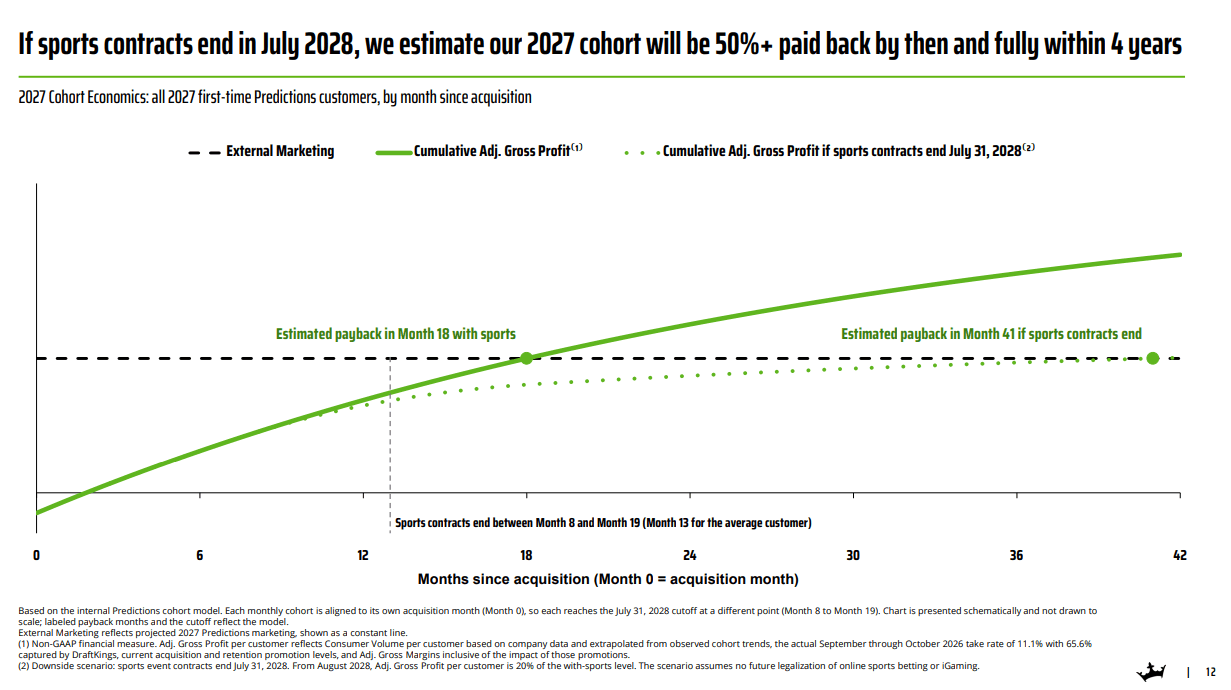
For customers acquired next year, its downside scenario assumes sports contracts end July 31, 2028. Even then, DraftKings projects payback within 41 months through non-sports predictions and other existing products, without assuming additional sportsbook or iGaming legalization.
A new Democratic-controlled Congress as well as less prediction-market-friendly state legislatures and attorneys general could influence or shut down operators before a court decision. Though federal regulators told operators after the elections to continue offering their platforms regardless of state-level legal threats, DraftKings was among the companies that restricted their Utah offerings recently amid state legal pressure.
A range of appellate court decisions involving tribal jurisdictions and a number of other states could also accelerate legal battles.
In the meantime, Robins said this week’s political developments could nevertheless influence how DraftKings distributes its local advertising dollars as the company weighs where customers might become more valuable. Though prediction markets present a massive growth area, sports betting has a broader product range and, with Tuesday’s election results, potentially increased odds of legalization.
“That is very much our brand and our core audience and I think it’s important strategically for us and also it could be a huge financial opportunity,” Robins said.
Enjoying Covers content? Add us as a preferred source on your Google account
Potential new markets
Texas presents one of the biggest markets and, after Tuesday, one of the clearest changes in the political landscape. Democrat Vikki Goodwin defeated Republican Lt. Gov. Dan Patrick, removing a Senate leader whose opposition had repeatedly blocked gambling legislation.
Goodwin has supported a voter-backed ballot measure to authorize casinos and sportsbooks. The lieutenant governor presides over the Senate and influences committee assignments and legislation, making the office especially consequential for gambling proposals.
Democratic Texas Gov.-elect Gina Hinojosa defeated incumbent Gov. Greg Abbott, though her victory offered a less definitive gambling-policy shift. Hinojosa had not outlined a specific legalization framework and voted against the sports betting constitutional amendment that passed the House in 2023.
Neither result guarantees passage. A gambling amendment still requires two-thirds support in both legislative chambers before reaching Texas voters, leaving supporters dependent on a broad coalition.
Minnesota offers a different opening. The Democratic-Farmer-Labor Party won decisive House control and expanded its Senate majority, giving supporters more room to advance a tribal-led sportsbook proposal despite some opposition within their own party.
A previous agreement among tribes, horse tracks and charitable gambling interests provides a starting point. A bipartisan bill nevertheless stalled in committee this year, and concerns about addiction and financial harm remain potential obstacles.
Georgia’s shift is less directly tied to sports betting. Governor-elect Keisha Lance Bottoms campaigned on allowing voters to authorize casinos, potentially creating room for broader gambling negotiations.
Her proposal did not establish a separate sportsbook framework. Lawmakers would still need to decide whether to combine the issues or consider them separately, while a casino amendment would require two-thirds legislative approval before going to voters.
DraftKings has not confirmed that any of those states would receive additional spending. Robins also cautioned against assuming prediction markets would automatically push lawmakers to authorize traditional sportsbooks.
“I don’t think we can count on every state suddenly legalizing sports betting,” Robins said. “I think it could happen. It could also be states just take a while or don’t do anything at all or decide to tax prediction.”