Everybody (and their dog... and cat... and parakeet) fills out a March Madness bracket.
But you're not here to listen to everybody (and their assortment of pets); you're here to see who the experts are taking to cut down the nets on April 6.
We've asked our March Madness experts, as well as created an AI-generated bracket, to weigh in on who their Cinderellas will be, who will make the trek to the Final Four... and who will be crowned National Champion.
(Spoiler alert: We're very... blue)
March Madness bracket predictions for 2026






Enter the Kalshi billion-dollar bracket!
Turn this March into a life-changing experience, as Kalshi is offering one billion dollars for a perfect NCAA Tournament bracket!
If nobody is perfect, there is still one million dollars available for the highest-scoring bracket in the contest!

*Eligible U.S. locations only

March Madness bracket prediction: Jason Logan
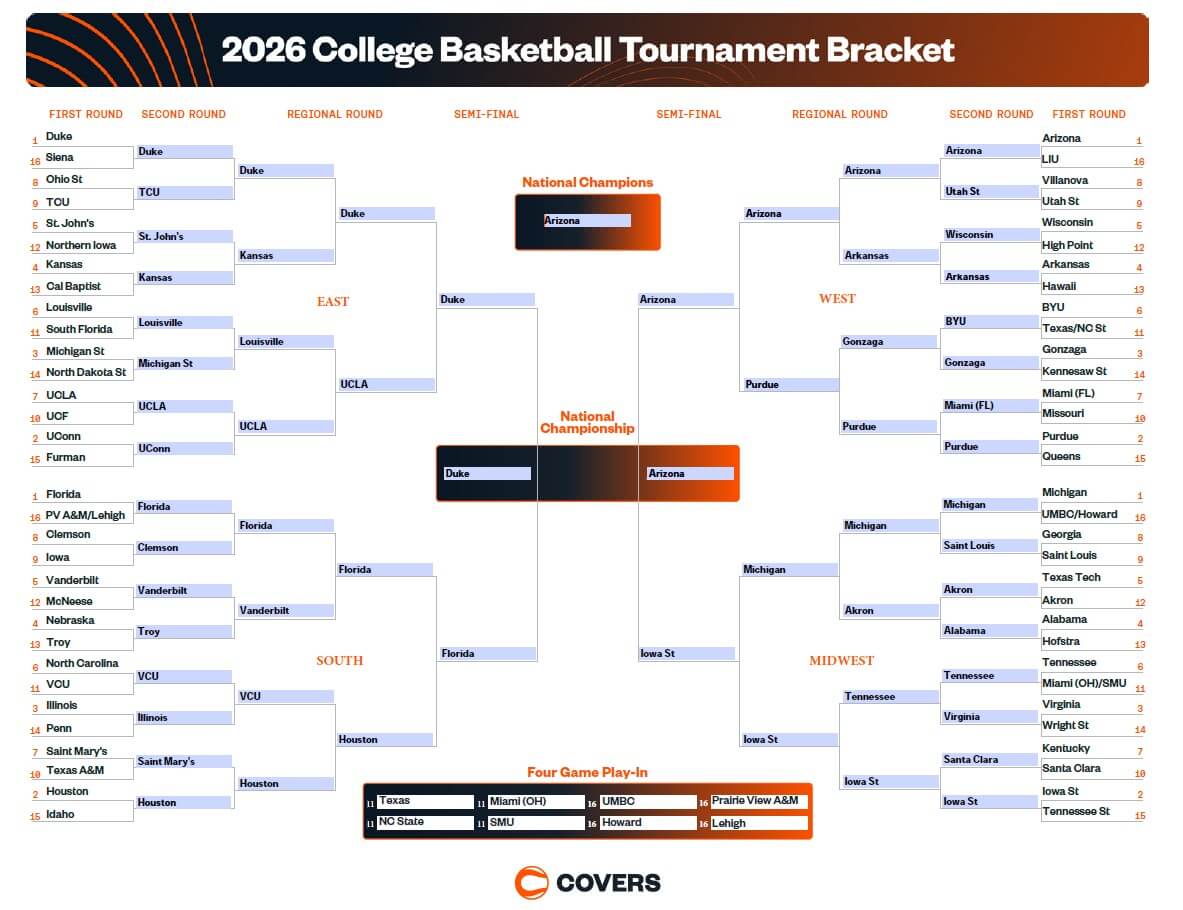
Championship: Arizona over Duke
Total Round 1 upsets: 6
Cinderellas: 7 UCLA, 11 VCU, 12 Akron
The sky-rocketing analytics around this year’s higher seeds mean that teams seeded No. 1 through No. 4 will cruise through to the second week of the tournament, while chaos will ensue in the mushy middle of the bracket.
My bracket follows that path, advancing the chalkiest of the chalk while calling a handful of upsets early on... but when it comes down to business, the best of the best ascend to Indianapolis.
March Madness bracket prediction: Rohit Ponnaiya

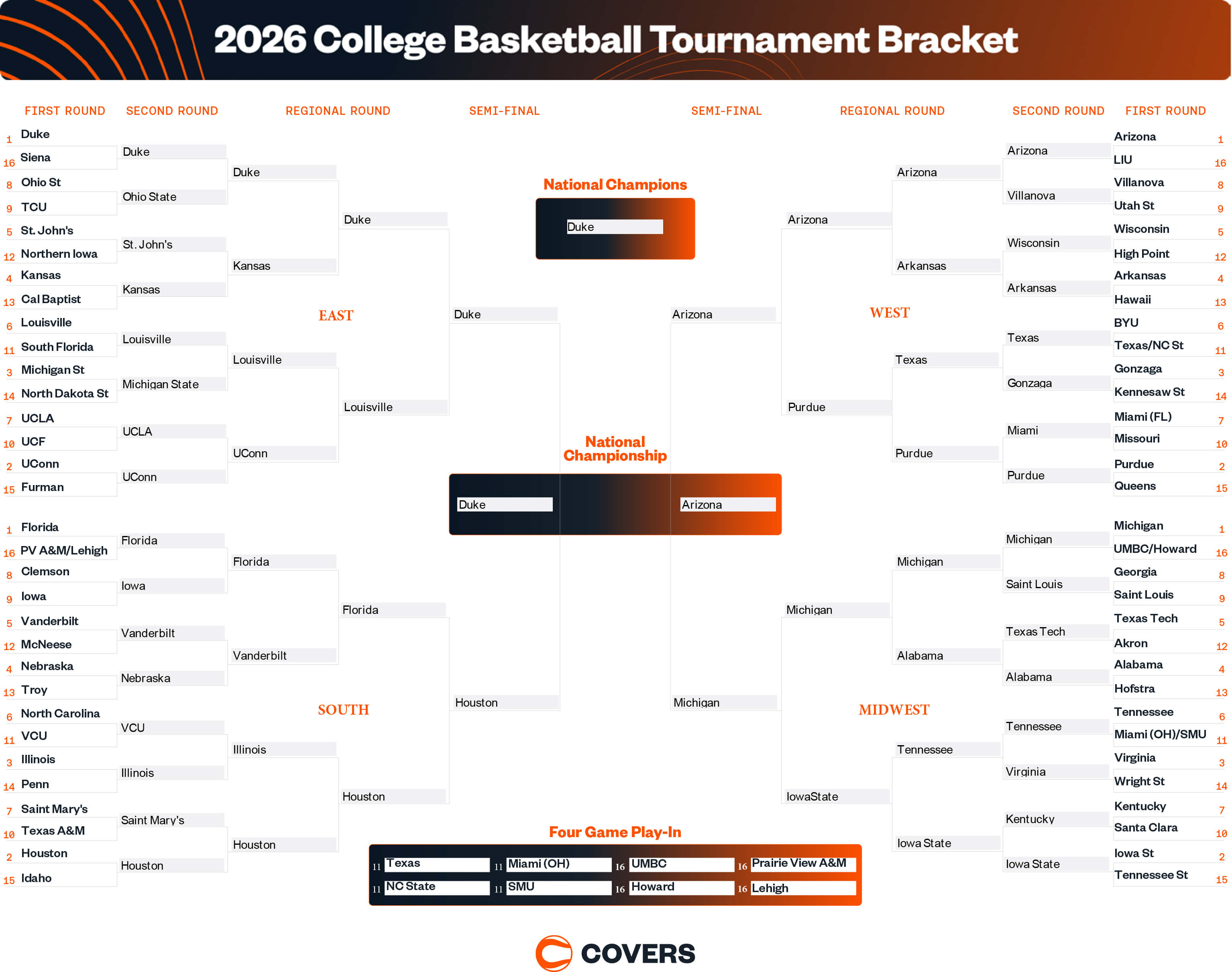
Championship: Duke Over Arizona
Total Round 1 upsets: 4
Cinderellas: 11 Texas
The difference between the haves and have-nots in college basketball keeps getting wider, which resulted in a chalky NCAA Tournament last year — and my bracket picks this year again is betting on another tournament with few upsets in the opening rounds.
March Madness bracket prediction: Douglas Farmer
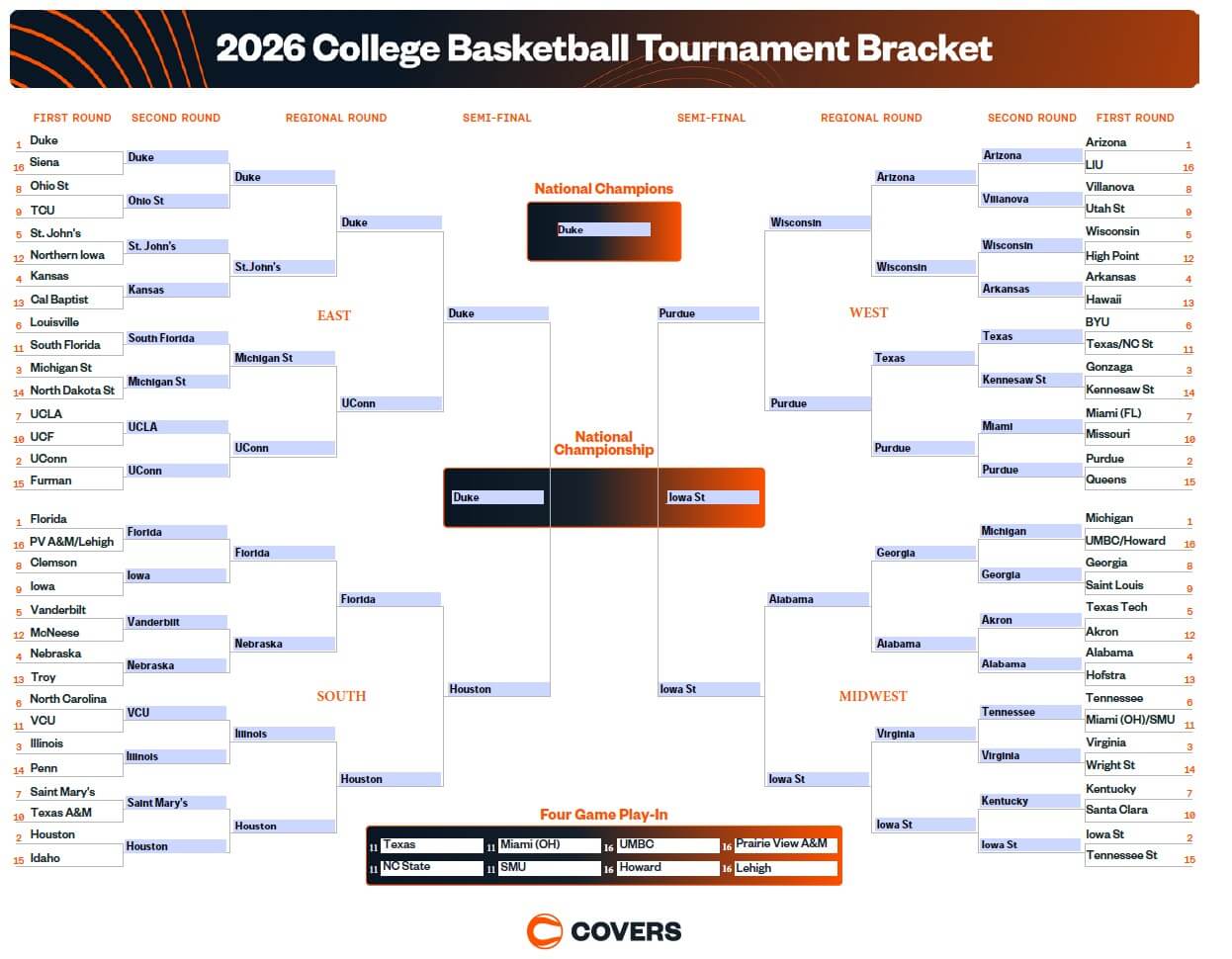
Championship: Duke over Iowa State
Total Round 1 upsets: 5
Cinderellas: 8 Georgia, 11 Texas
Duke star Cameron Boozer may fall short in the eyes of some NBA front offices, but he will do no such thing in my bracket. He's the best player in the country and should lead the Blue Devils to their sixth national championship.
The twist is that I expect Duke to be the only No. 1 seed to make the Final Four in Indianapolis in April.
March Madness bracket prediction: AI-generated
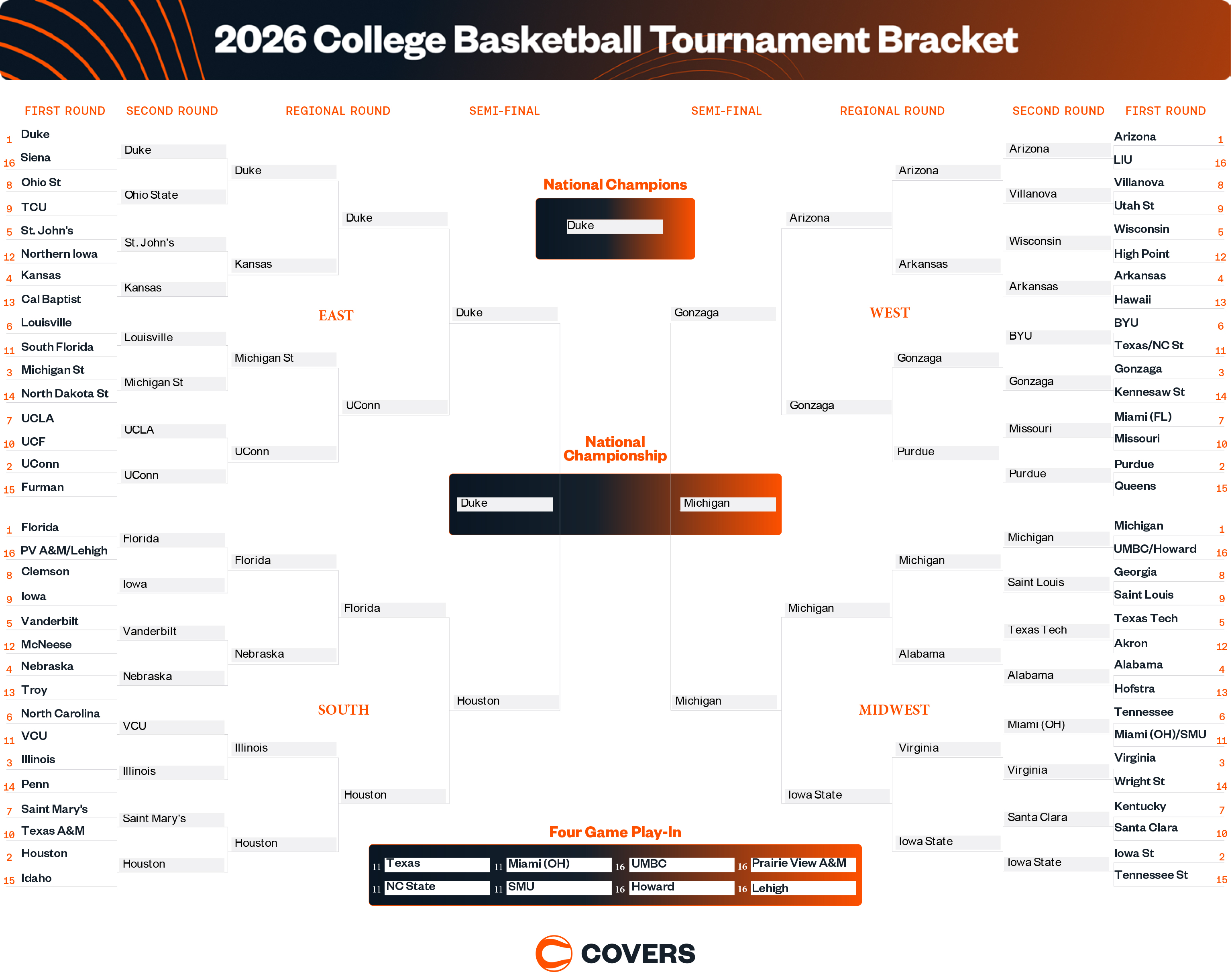
Championship: Duke over Michigan
Total Round 1 upsets: 6
Cinderellas: 11 VCU, 11 Miami (OH).
Cameron Boozer becomes the first freshman since Anthony Davis (2012) to dominate both ends of the floor so thoroughly. His ability to handle the ball like a guard, while rebounding like a traditional center, allows Duke to play a versatile, positionless style that no opponent can fully solve.

4 March Madness bracket tips from an expert bracketologist
Few people understand brackets better than Tim Chartier, an award-winning Professor of Mathematics and Computer Sciences at Davidson College who teaches students how to create mathematical formulas to predict winners.
Chartier recently spoke to Covers to share four key things to consider before submitting your bracket.
1. Be wary of your intuition
"Brackets aren’t just about probabilities — they’re about people," Chartier explains. "We all carry bias into March, whether it’s loyalty, rivalry, or gut instinct. The danger isn’t ignoring analytics; it’s using them to justify what we already wanted to pick. The art of data science is knowing when to trust the data — and when to admit your intuition may be leading you astray."
2. Cinderellas can be tough to spot in advance
"First-round upsets tend to come in two main styles," Chartier insists. "The first is momentum. These are teams whose overall record may not jump off the page, but who closed the season strong, beating quality opponents and carrying real 'Madness mojo' into the tournament.
"The second is variability. Some teams are volatile — they run hot or cold. That inconsistency may hurt their season-long record, but if they get hot at the right time, they can string together wins in a hurry.
"The most difficult teams to spot are those that haven’t shown sustained success during the season but suddenly adapt to the win-or-go-home reality of March. Those are the true bracket-busters — and they rarely look obvious in advance."
3. Identify teams that others may overlook
"Winning an office pool isn’t just about being right — it’s about being right when others are wrong," Chartier says. "That requires some calculated risk. You want to identify teams that others may overlook, but without taking wild swings on long shots that are unlikely to pay off.
"For example, a 16-over-1 upset can happen — history shows it’s possible — but those games are extremely difficult to predict in advance. Picking all the No. 1 seeds in the first round is analytically sound. The challenge is that almost everyone else will do the same.
"So the real strategic question becomes: where do you differentiate? The edge often comes from finding modest underdogs with a legitimate path forward — not from chasing the most shocking upset on the board."
4. Matchups matter more than box scores
"Winning isn’t just about how strong a team is in general — it’s about how strong they are against that specific opponent," as Chartier puts it. "Matchups are more than box scores. A team can have outstanding statistics, but struggle against a particular defensive scheme or a certain style of offense.
"The key question becomes: how does this team perform against similar styles of play and similar types of players?
"In the first round, you can sometimes dig into that. But even then, there are 32 games. Coaches spend hours studying film and analytics to uncover matchup nuances. Fans have from Sunday evening to Thursday afternoon to make their picks.
"And once you move beyond the first round, the combinations explode. A team might match up well against one potential opponent but poorly against another.
"Still, if you’re unsure about a game, examining how a team has performed against comparable opponents during the season can sometimes provide that small analytical edge."