NEW YORK – The prediction market crown is not quite theirs, but DraftKings has at least already clambered onto the podium.
So said DraftKings CEO Jason Robins on Thursday at the NEXTPredict conference in New York City.

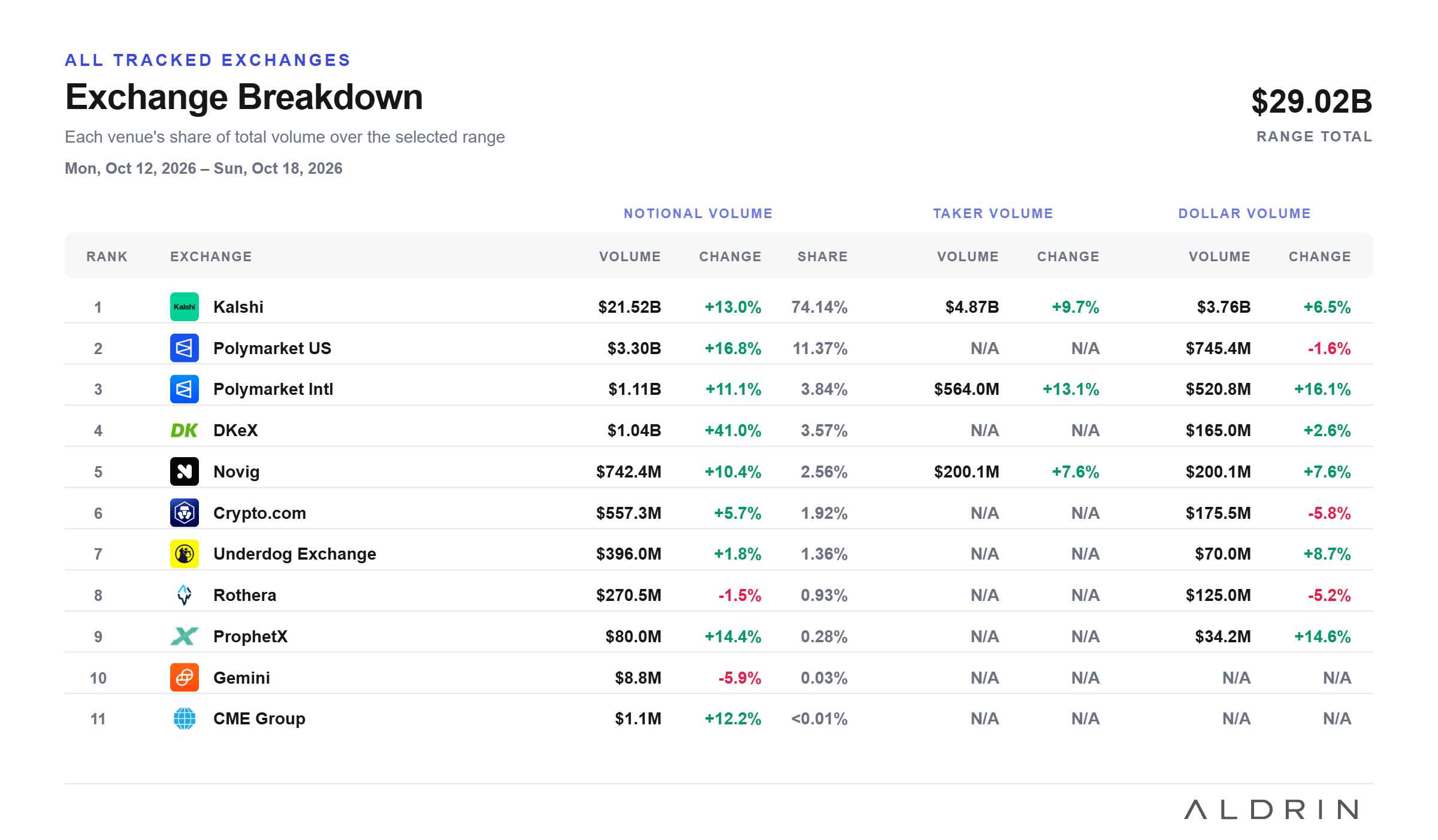
- DraftKings Exchange placed third in notional trading volume for the week that ended Oct. 18.
- The company's CEO is also pleasantly surprised with growth seen in non-sports prediction markets.
- Robins addressed recent negative press involving responsible gaming and the use of artificial intelligence.
The Boston-based company is well-known for its online sportsbook, as it is one of the two biggest operators in that business. However, during a Q&A with CNBC’s Contessa Brewer, Robins was asked why their prediction market platform is now getting more notice.
“We only launched (the) DraftKings exchange a few months ago, and we're already the clear No. 3, which is great and we continue to gain share,” Robins said.
The spot on the podium for DraftKings comes as the prediction market space continues to get more crowded and competitive. Exchange operators are spending big on buying infrastructure, getting regulatory approvals, and acquiring customers. Kalshi and Polymarket had a sizable headstart on others as well, but Robins claims they are now a top-three platform.
Data from Aldrin Research also backs that claim up.
According to the research firm's figures, DraftKings' exchange (DKeX), was third in notional trading volume for the week that ended Oct. 18. While Kalshi and Polymarket were a clear first and a relatively distant second, DraftKings facilitated $1.04 billion in trading, good enough for 3.57% market share and a place on the podium. That's up from the 2.33% market share DKeX possessed for the week ended Sept. 26.
It’s also while DraftKings continues to steer clear of offering sports event contracts for trading in states where it offers state-regulated online sports betting. Its prediction market rivals don’t have the same self-imposed restrictions.
“We've done that with a much more limited state footprint than all of the others that we're talking about competing with,” Robins said.
DKeXperience
The DraftKings CEO nodded toward his company’s success in online sports betting as what’s helping it with sports-focused prediction markets.
“We know what works,” he said. “We know what customers want.”
Speaking now at the NEXTPredict conference… DraftKings CEO Jason Robins, who says they are already the clear number three in the PM space. And with their exchange not offering sports contracts in every state. https://t.co/IhtX9aYkOD
— Geoff Zochodne (@GeoffZochodne) October 22, 2026
With all that said, it’s not necessarily what investors have wanted. Shares of DraftKings are down more than 40% this year, which has come amid the boom in prediction market growth.
While there may be concern from some investors about prediction markets stealing from state-regulated sportsbooks, Robins laid the blame on the uncertainty swirling around the federally regulated exchange business. The numerous challenges to the legality of sports-related event contracts have begun landing on the doorstep of the U.S. Supreme Court, and there is no guarantee that product (which is by far the most popular offering from prediction markets) will survive.
“Private markets love uncertainty,” Robins said. “That's what they thrive on. They like big beta. Public markets are the opposite. They do not like uncertainty.”
But DraftKings also feels like they have positioned themselves well in the event that sports-focused prediction markets are spiked by the Supreme Court, or if they survive. Robins called it a “win-win” spot for this company.
“I think the more that people come to understand that we're really well positioned either way, I think we'll start to overall get more credit for that,” Robins said. “And I think people are starting to understand that.”
Robins confessed to DraftKings being pleasantly surprised by the growth of some non-sports prediction markets as well, such as those tied to financial markets. That could remain viable even if sports event contracts are ultimately taken away by the courts. It’s also partly why DraftKings is putting significant resources into its prediction platform.
DraftKings Predictions slots into the company’s “super app” strategy as well, which is why it’s advertising itself as available in all 50 states. The difference is, in some states, the app will only allow you to use some products. In Nevada, for instance, Robins said DraftKings only offers free-to-play sports contests. So, still available in that state, but not fully available.
Enjoying Covers content? Add us as a preferred source on your Google account
Addressing bad press
Robins was also asked about his company’s use of artificial intelligence and responsible gambling efforts after some recent rough press. Among other things, he said that the company is doing the opposite of targeting problem gamblers, and instead referring them to a specialized team.
“It's just completely not how we're built and how we philosophically and in-practice operate,” Robins said.
But some people just don’t like gambling, he added.
“I can't really change their minds on that if you're starting from a stance that we just don't like the industry and we think that you're bad people,” Robins said.
Robins had less to say about another prediction market news item, the recent lawsuit filed against him and his company in Florida by the state’s Seminole Tribe. While he acknowledged it was interesting that DraftKings was singled out for a lawsuit, despite other prediction markets operating in the state, he said that he couldn’t speak to why that happened.