After oddsmakers release their opening lines, bettors should expect movement right up until kickoff, first pitch, or tip-off.
These shifts, commonly called "line moves," are a normal part of the market. If you locked in a number before it moved, that's the price a sportsbook will pay out if your bet wins, regardless of where the line ends up.
This guide breaks down why lines move, what those moves can tell you, and how to use that information to bet smarter. Whether you're planning a trip to Vegas or placing wagers from your phone through one of the best sportsbook apps, understanding line movement is one of the more valuable skills a bettor can develop.
Why does a line move?
Sportsbooks adjust point spreads, totals, moneylines, and other markets for a handful of specific reasons. Learning to recognize which one is driving a given move is a genuinely useful skill, since it can turn a confusing shift into a clear signal.
New information
New information can be almost anything: injury news, a trade, a confirmed illness moving through a locker room, or an unexpected inactive announced 90 minutes before an NFL kickoff. Sportsbooks want their lines to stay accurate, since an inaccurate line invites lopsided betting and a losing outcome for the book. If you happen to catch a piece of news before an oddsmaker adjusts for it, you can sometimes get a bet down before the line moves to reflect it.
Liability
Sportsbooks want balanced action, not a lopsided book. Imagine 95% of the money on the Yankees and just 5% on the Mets in a Subway Series. If the Yankees win, the book loses money even after collecting the vig on every losing bet. Books would much rather see something close to an even split on both sides, since that guarantees a profit regardless of outcome. When action gets too lopsided, sportsbooks shift the number to make the other side more attractive and even things out.
Sharp money
Sportsbooks track their customers closely and generally know who wins consistently and who doesn't. Bettors with a proven long-term track record are often called "sharps," "wise guys," or "respected money," and their action can move a line within minutes. Sharp money can move a line even when it creates a liability problem for the book, because sportsbooks put real weight behind the opinions of certain professional bettors. Think of it as a variation on the new information scenario above, except this time the "new information" is a sharp bettor's read on the game.
Copycat sportsbooks
Books that don't see much sharp action of their own will often copy line moves from books that do. If Pinnacle adjusts a spread from -3 to -3.5 on the strength of sharp money, a book like bet365 might follow suit and move to -3.5 as well, even without receiving any of that sharp action directly. In that scenario, it's fair to say sharp money moved the line at bet365, just indirectly, through Pinnacle. This kind of copycat movement is extremely common today. It wasn't always the case; decades ago, Las Vegas held something close to a monopoly on U.S. sportsbooks, and there weren't nearly as many books to compare against each other.
Enjoying Covers content? Add us as a preferred source on your Google account
How to diagnose which scenario caused a move
Once you understand the four causes above, the next step is figuring out which one is actually behind a specific line move.
New information is the easiest to diagnose. Check X or a sports news site and you'll usually find your answer directly. If the Chiefs move from 6-point favorites to 3-point favorites and news breaks around the same time that Patrick Mahomes is injured, you can safely connect the two.
Sharp money is trickier, but public betting splits can help. These compare the percentage of bets on a side to the percentage of dollars on that side. If a team is drawing a low percentage of bets but a high percentage of the money at a respected book, that's a solid indicator of sharp involvement. Books like BetMGM regularly publish this kind of data across point spread, moneyline, and total markets, and learning to read it is how bettors "follow the smart money" or "fade the public."
Reverse line movement
Combining betting splits with line movement can reveal one of the more useful signals in sports betting: reverse line movement.
If the majority of bets and money are coming in on one side, liability logic says the line should move further in that direction to balance the book. Reverse line movement is when the opposite happens instead. Say the Eagles are -6 favorites against the Cowboys, and the clear majority of bets and money are on Philadelphia. Normal liability logic points to the next move being -6.5.
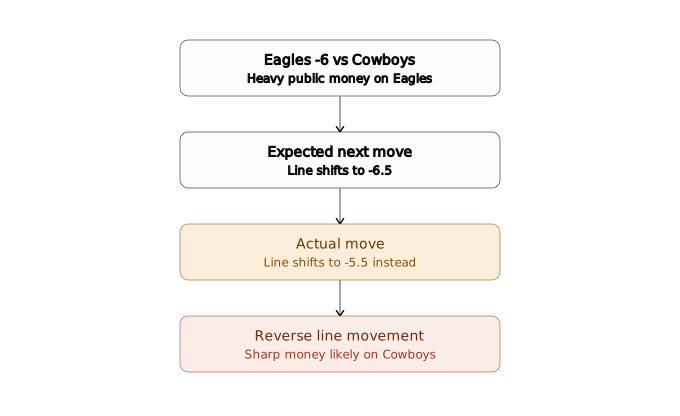
If the book instead drops the line to -5.5, actively encouraging even more action on the Eagles, that's reverse line movement, and it's a red flag that sharp money is sitting on the Cowboys side. The natural question to ask is why a book would want to make its liability worse, and the usual answer is that sharp action (at that book or another one) has been convincing enough to take the risk.
Spotting reverse line movement takes practice, but it's one of the more reliable data points available to a bettor willing to track it closely. It shouldn't be the only factor in a decision, but combined with injury news, betting splits, and your own read on a matchup, it adds real signal.
The timing of line movement
When a line moves can tell you almost as much as how much it moves.
Take the NFL as an example. Lines for the following week typically go up on Sunday night, and the volatility in the days that follow tends to come from professional bettors getting early money down. Recreational bettors, by contrast, usually aren't betting that far ahead of kickoff; they're either celebrating or nursing a loss from the weekend that just happened. Because of that gap, line movement early in the week is generally a stronger signal of sharp action than movement closer to game day, when public money dominates the volume.
One wrinkle worth knowing: sharp bettors sometimes use "head fakes," placing smaller wagers early in the week specifically to move a line in one direction, only to bet the other way later once limits rise. There's no foolproof way to tell a genuine early sharp move from a head fake in real time, which is one more reason to treat any single signal as part of a bigger picture rather than a standalone conclusion.
Who sets the lines?
Sportsbooks build their opening numbers from a mix of internal power ratings, formulas, and situational adjustments. A book might start with a rating that says one team is 3.5 points better than its opponent, then adjust for home field, injuries, and other factors. That same matchup could end up posted at 4.5 if the situational factors favor the better team, or drop to 2 if they cut the other way.
Some books skip building their own number from scratch and instead copy the opening line from a more prominent sportsbook, then tweak it based on their own customer base. A regional book based in the same city as one of the teams, for instance, might shade its number to account for heavy local betting on that team.
Why line shopping matters
Line movement isn't identical across every sportsbook, and that gap is exactly why shopping around pays off.
If FanDuel, DraftKings, BetMGM, and Caesars all have the Eagles at -7 and your app is still showing -6.5, that book is likely just behind the curve and about to catch up, which means -6.5 is a number worth grabbing while it's there. The reverse is true too: a book showing a different number from the pack isn't always late, sometimes it was first, and everyone else is still catching up to it.
The only way to tell the difference is by watching multiple books at once; once you're in the habit, the outliers become obvious. Tools like Prop Professor and Outlier can make comparing lines across books faster if you don't want to check each app manually.
The value here compounds fast. Say you like an underdog to pull off an outright upset, and you find it at +145 on one book, +150 on another, and +155 on a third. A winning $100 bet nets you $145, $150, or $155 depending on where you placed it.
That gap might look small on a single bet, but an extra $5 to $10 of value on every winning wager adds up significantly over a full season, and it holds true well beyond moneylines, from touchdown scorer props to NBA Finals futures. If you're only using one sportsbook, it's worth looking into welcome bonuses at additional books before you add one, since most offer meaningful sign-up value on top of the line-shopping benefit itself.
Watch the vig closely
Vig movement is often the first sign that a bigger line move is coming, arriving before the point spread or total actually shifts.
Say a total opens at 47.5 with standard -110 juice on both the over and the under. If the over shifts to -120 while the under sits at +100, that's a sign the book has taken heavy over action and is quietly discouraging more of it before it needs to move the number itself, most likely up to 48. Reading the shift is simple once you know what to look for: a book doesn't juice a side to -120 for no reason.
It does it because it wants to slow down betting on that side while it decides whether to move the actual line. If the money keeps coming despite the worse price, the number itself is usually next to move.
Putting it all together
No single signal, injury news, a betting split, a reverse line move, or a vig shift, tells the whole story on its own. The bettors who get the most out of line movement are the ones who combine several of these data points, understand the timing behind them, and check multiple sportsbooks before locking in a number. None of it guarantees a winning bet, but it does mean you're betting with the same information the market is reacting to, instead of against it.
Betting Line Movement FAQs
A line move is any change to a point spread, total, or moneyline after a sportsbook releases its opening number. Lines move for a handful of reasons, including new information like injuries or trades, liability concerns, sharp money, and other books copying a line that already moved elsewhere.
Reverse line movement happens when a line moves against the majority of public bets and money instead of with it. If most of the action is on one team but the line shifts to make betting that team even more attractive, it's usually a sign that sharp money is coming in on the other side.
Sharp money refers to bets placed by professional bettors with a proven track record of winning. Sportsbooks track these bettors closely and often move a line based on their action alone, sometimes even when doing so creates more liability for the book.
Adjusting the vig, the difference in juice between two sides of a bet, lets a book quietly discourage further action on one side without changing the actual number. It's often an early signal that a full line move is coming if the betting volume keeps pushing in the same direction.
No. Lines also move because of new information like injuries, roster changes, or weather, and because of straightforward liability management when a book wants to balance the money on both sides. Sharp money is one common cause, not the only one.
Each book sets its own opening numbers using internal ratings and formulas, then adjusts based on its own customer base and betting activity. Some books also copy a line from a more prominent sportsbook rather than building their own from scratch, which is part of why lines can vary from book to book at any given moment.