Polymarket vs. Kalshi


Polymarket vs. Kalshi: Which is best for me?
You're here for the Kalshi vs. Polymarket debate, so let's get right into it! Here's my argument for each prediction market app:
Why use Kalshi in September 2026?
You should choose Kalshi if you value a federally regulated, user-friendly prediction market platform with familiar USD-first banking options. Kalshi is a strong fit for beginners or casual event traders because it feels closer to a traditional financial exchange than a crypto-native prediction market.
Kalshi’s prediction markets tend to skew toward U.S. interests, with strong coverage of mainstream events like the Oscars, Super Bowl, March Madness, and U.S.-based elections. Its liquidity can be especially strong on major U.S.-focused markets, although users should still compare volume, spread, and order depth before placing larger trades.
Why use Polymarket in September 2026?
Polymarket is a strong choice for users who want global markets, niche topics, crypto-native trading features, and fast-moving event contracts. It is especially appealing if you already understand wallets, market depth, and how fees can vary by product, category, and maker/taker activity.
Polymarket’s biggest strength is still market variety. It tends to offer more niche interests than Kalshi, with especially strong coverage of global topics, politics, culture, crypto, and viral events. Polymarket is also my go-to for pop culture markets. If you need more supporting evidence, check out our in-depth Polymarket review.
For U.S. users, the key is to understand which version of Polymarket you are accessing. Polymarket US is the regulated U.S. product, while the broader global Polymarket experience remains more crypto-native. That distinction can affect funding methods, available markets, withdrawal options, and fees.
My verdict: Polymarket vs. Kalshi
The Polymarket vs. Kalshi debate is close and depends on the experience you want with your prediction market app.
Kalshi is still the cleaner starting point for most U.S. users, especially if you want familiar banking, mainstream sports markets, and a more traditional exchange-style setup. Polymarket is the better fit if you want global markets, niche topics, crypto-native features, and faster-moving event contracts.
For sports-focused users, Kalshi is generally stronger for mainstream North American coverage, while Polymarket can be more interesting for international, niche, or high-liquidity global events.
How do Polymarket vs. Kalshi compare in 2026?
Kalshi and Polymarket are widely considered two of the best prediction market apps in the U.S. in 2026. Both now have regulated U.S. paths tied to Commodity Futures Trading Commission-supervised event-contract markets, but their products, payment methods, market coverage, and user experience can still differ in important ways. Here’s how they compare:
| Polymarket 🔵 | Kalshi 🟢 |
|---|---|
| Legal status | |
|
Polymarket US operates through QCX LLC d/b/a Polymarket US, a CFTC-designated contract market. The broader Polymarket experience still varies by product, user eligibility, and jurisdiction. |
KalshiEX is a CFTC-regulated Designated Contract Market, with Kalshi Klear registered as its derivatives clearing organization. State-level challenges and market restrictions, including in Nevada and Washington, can still affect access. |
| User experience | |
|
Dynamic market discovery with a stronger global and crypto-native feel, plus active iOS and Android apps. Polymarket US may differ from the broader global product in funding, access, and account setup. |
Clean, beginner-friendly exchange experience with straightforward desktop and mobile trading, familiar USD-first banking options, and especially strong app-store traction. |
| Payment methods | |
|
Polymarket US supports USD funding through debit card and bank transfer/ACH. The global Polymarket product remains more crypto-native, so users should confirm which version they are accessing before depositing. |
Kalshi is more fiat-friendly for most beginners, with support for traditional banking options such as ACH, debit card, and bank transfers, along with select crypto funding options. |
| Market types | |
|
Sports, global politics, geopolitics, crypto, culture, technology, financial markets, viral events, and more. |
Sports, U.S. politics, economics, weather, climate, culture, financial markets, and other regulated event contracts. |
| Fees & Liquidity | |
|
Fees vary by product, market category, and maker/taker activity. Polymarket can be strong for global, crypto, politics, culture, and viral markets, but users should compare spreads and liquidity before trading. |
Fees vary by contract and funding method. Kalshi can be strong for U.S.-focused sports, economics, weather, and regulated event contracts, but users should still compare volume, spread, and order depth. |
| Best for... | |
|
Users who want global markets, niche topics, crypto-native features, and fast-moving event contracts, while understanding that Polymarket US may differ from the global product. |
U.S. users who want a simpler, fiat-friendly, CFTC-regulated exchange experience with familiar banking and mainstream event markets. |
Why compare Polymarket and Kalshi?

It makes sense to compare Polymarket vs. Kalshi, as they’re two of the most important prediction-market platforms for U.S. users in 2026. Both brands have drawn major investor attention, with recent valuation reports putting each company in the multi-billion-dollar range as event-contract trading moves further into mainstream sports, politics, finance, and culture.
Together, Kalshi and Polymarket play a massive role in the prediction market boom. Monthly volume estimates can vary depending on whether sources are counting Kalshi, Polymarket US, the broader global Polymarket product, or combined platform activity. But the broader trend is clear: prediction markets are becoming more relevant for sports, politics, finance, and culture traders as event-contract platforms expand their reach and mainstream visibility in 2026.
Experts believe the industry’s annual trading volume could reach $1 trillion by 2030, further underscoring why so many people are comparing Polymarket vs. Kalshi. Check out other apps like Polymarket to see how the broader market stacks up against Kalshi and Polymarket.

Expert Verdict
Kalshi and Polymarket have both drawn major investor attention as prediction markets move further into mainstream sports, politics, finance, and culture. Recent reports have tied both companies to multi-billion-dollar valuations, which helps explain why this comparison matters beyond casual app preference.


Polymarket vs. Kalshi bonus comparison
You can claim prediction market promos when you sign up for both Kalshi and Polymarket in September 2026. We've broken down each offer below, which presents different advantages and requirements for new users:
Polymarket welcome promo
Polymarket is offering a 'Deposit $10, Get $50 Bonus' welcome offer to new users. The ideal Polymarket promo code is COVERS, which can be entered during sign-up. Once your account is created, simply make an initial $10 deposit, and you'll receive a $50 trading bonus. You'll get your bonus within 24 hours of your first real-money deposit.
Existing users can also earn rewards by inviting friends; our Polymarket referral code guide explains how to earn $25 per qualifying referral, up to $350. 
 Polymarket responsible gaming
 18+ Only. Restrictions and eligibility requirements apply. Not available in all jurisdictions. Trading is risky. 100% loss can occur. See https://polymarket.com/tos for more information. The Polymarket US App serves as an independent software provider and affiliate of Polymarket US and Polymarket Clearing, the CFTC-regulated exchange and clearing organization.
Kalshi welcome promo
Eligible new customers can use the Kalshi promo code COVERS60 during registration to access the current Kalshi welcome offer, 'Exclusive $60 Bonus'. To qualify, complete the $25 trade requirement. Review the current promotion terms and eligibility requirements before signing up.
Our Kalshi referral code page has everything you need to know about snagging additional rewards.

Kalshi responsible gaming Certain limitations apply. The offer is available to new users only, subject to the terms and conditions specified by Kalshi. 18+ only. Restrictions and eligibility requirements apply. Event contract trading involves significant risk and is not appropriate for everyone. Please carefully consider if it is appropriate for you in light of your personal financial circumstances. Kalshi products are not available in all jurisdictions. See kalshi.com/regulatory for more information.
Polymarket vs. Kalshi: Regulation and legality
For Kalshi and Polymarket, the biggest questions users ask are simple: “What states are they legal in?” and “Who regulates them?” The answer is more nuanced in 2026 because both platforms now operate in a prediction-market landscape shaped by federal oversight, state-level challenges, and different product structures.
Kalshi remains the simpler U.S. regulatory story. KalshiEX is a federally regulated Designated Contract Market overseen by the CFTC, and Kalshi Klear is registered as its derivatives clearing organization. That gives Kalshi a traditional exchange-style framework, although state-level disputes and market restrictions can still affect what users can access.
Polymarket is more complicated because users need to distinguish between Polymarket US and the broader global Polymarket product. Polymarket US operates through QCX LLC d/b/a Polymarket US, a CFTC-designated contract market. That follows Polymarket’s 2025 move to acquire QCX and QC Clearing, which helped establish its regulated U.S. path.
The key takeaway: Kalshi is still the cleaner option for most U.S. beginners, while Polymarket has become a much more serious U.S. competitor. Apps like Kalshi continue to emerge, but both Kalshi and Polymarket now sit near the center of the U.S. prediction-market debate. Before signing up for either platform, confirm your local eligibility, available markets, and account requirements. If you’re wondering, is Kalshi legal in California? The answer is yes.
Expert Verdict
Whether you select Kalshi or Polymarket, it’s important to recognize that the legal landscape is changing, with several ongoing legal battles involving prediction markets as a whole. New York is the latest major example: a federal judge denied Kalshi’s request to block state gambling regulators from enforcing New York law against online prediction markets, and Kalshi has appealed.
That does not mean every platform or market is unavailable everywhere. It does mean users should treat state eligibility as a moving target, especially for sports event contracts. States including Massachusetts, Michigan, Nevada, New Jersey, Ohio, and New York have challenged or restricted access to prediction markets, so always confirm what is available in your account before trading.

Polymarket US vs. global Polymarket: What’s the difference?
Polymarket vs. Kalshi used to be an easier comparison: Kalshi was the regulated U.S. exchange, while Polymarket was the crypto-first global prediction market. In 2026, that line is blurrier because Polymarket now has a regulated U.S. path through Polymarket US.
Polymarket US
Polymarket US is the U.S.-regulated version of the platform. It operates through QCX LLC d/b/a Polymarket US, a CFTC-designated contract market, and is built around USD trading rather than the fully crypto-native experience many users associate with Polymarket.
That matters for U.S. users because account setup, identity verification, available markets, payment methods, and withdrawal options may differ from the global Polymarket product.
Global Polymarket
The broader global Polymarket product remains more crypto-native. It is better known for blockchain-based trading, global politics, culture, crypto, and viral event markets. This version may appeal more to users who are comfortable with crypto wallets and on-chain activity.
However, users should not assume the global Polymarket experience is available everywhere. Access can vary by country or region, and users should always confirm their eligibility before depositing or trading.
Why this matters for Kalshi vs. Polymarket
For most U.S. beginners, Kalshi is still the simpler prediction market app because it has a more traditional exchange feel and familiar banking options. Polymarket is now more competitive in the U.S. than it used to be, but users need to pay close attention to whether they are using Polymarket US or the global Polymarket product.
Before choosing between Kalshi and Polymarket, compare the exact product available to you, the markets you want to trade, the payment methods you can use, and the rules for resolving each contract.
Polymarket vs. Kalshi: What changed in 2026?
Polymarket vs. Kalshi used to be a cleaner split: Polymarket was the crypto-first global prediction market, while Kalshi was the regulated U.S. exchange. That comparison still matters in September 2026, but it is no longer the full story.
Polymarket now has a regulated U.S. path through its acquisition of QCX and QC Clearing, while Kalshi has continued to grow as a CFTC-regulated event-contract exchange. At the same time, sports prediction markets have become one of the biggest battlegrounds in the industry. Platforms have expanded sports coverage, but state regulators and courts are still debating whether certain event contracts should be treated as federally regulated derivatives, state-regulated gambling products, or something in between. New York, Michigan, Nevada, and other states have become especially important test cases.
User trust is also a bigger issue in 2026. Polymarket has faced scrutiny over alleged deceptive marketing, while Kalshi has added additional compliance guardrails to mitigate insider-trading risk. For users, it's even more important to check eligibility, market rules, settlement terms, and platform-specific restrictions before trading.
For users, the practical takeaway is simple: do not compare Kalshi and Polymarket based on old assumptions. Check which version of Polymarket you are accessing, whether your state is eligible, which payment methods are available, and how each contract settles before trading.
Kalshi also announced a partnership with The Weather Company, giving its weather markets a clearer data and visibility story. The Weather Company’s data will be used to help verify outcomes for Kalshi weather markets, while Kalshi probabilities will appear in select Weather Channel app and weather.com experiences. For users comparing Kalshi and Polymarket, that matters because weather contracts depend heavily on clear settlement sources and reliable data feeds.
Is Polymarket or Kalshi better for U.S. users?
Kalshi is still the simpler starting point for most U.S. users in September 2026. It has a more traditional exchange-style setup, familiar USD banking options, and a clearer regulated identity as a CFTC-supervised event-contract exchange.
Polymarket is now a much more serious U.S. competitor because of Polymarket US, but users need to pay closer attention to which product they are accessing. The U.S. version may differ from the broader global Polymarket product in account setup, funding methods, available markets, and withdrawal options.
Kalshi is better for simple U.S. access
Kalshi is the easier pick if you want a more familiar U.S.-first experience. It is generally better suited to beginners who want to deposit in USD, browse mainstream event contracts, and avoid the extra complexity that can come with crypto-native platforms.
That does not mean every market is available to every user. State-level restrictions, eligibility rules, and individual contract availability can still matter, especially for sports event contracts.
Polymarket is better for global and crypto-native users
Polymarket can be more appealing if you want global markets, niche topics, viral event contracts, or a more crypto-native trading style. It is especially interesting for users who already understand wallets, blockchain activity, or international market liquidity.
For U.S. users, the key is to distinguish Polymarket US from the broader global Polymarket product. Do not assume the same payment methods, markets, or restrictions apply to both.
The catch: state restrictions still matter
Even when a platform is federally regulated, state-level challenges and local restrictions can still affect what users see in their account. Sports event contracts are especially contested, and availability can change as laws, court decisions, and platform rules evolve.
Before choosing Polymarket or Kalshi, check your state eligibility, available markets, payment methods, withdrawal options, and contract rules directly inside the platform.
Can you use Kalshi or Polymarket in states without legal sports betting?
Yes, some users may be able to access prediction markets in states where traditional online sports betting is restricted or unavailable. That is one reason Kalshi and Polymarket are being compared so closely in 2026, especially among users in major states such as California, Texas, Georgia, Florida, and New York.
The important distinction is that prediction markets are not the same as sportsbooks. Kalshi and Polymarket offer event contracts, and access can vary by platform, state, market type, and current legal challenges. Sports event contracts are especially contested, so users should always confirm what is available in their account before trading.
For state-specific Kalshi guidance, see our pages on Kalshi in California, Kalshi in Texas, Kalshi in Georgia, Kalshi in Florida, and Kalshi in New York.
Polymarket vs. Kalshi: Markets offered
Kalshi and Polymarket each offer markets on a huge range of real-world topics, covering everything from sports and culture to politics and daily weather outlook. We've outlined and compared each operator's most popular contract type in 2026:
Sports 🏆
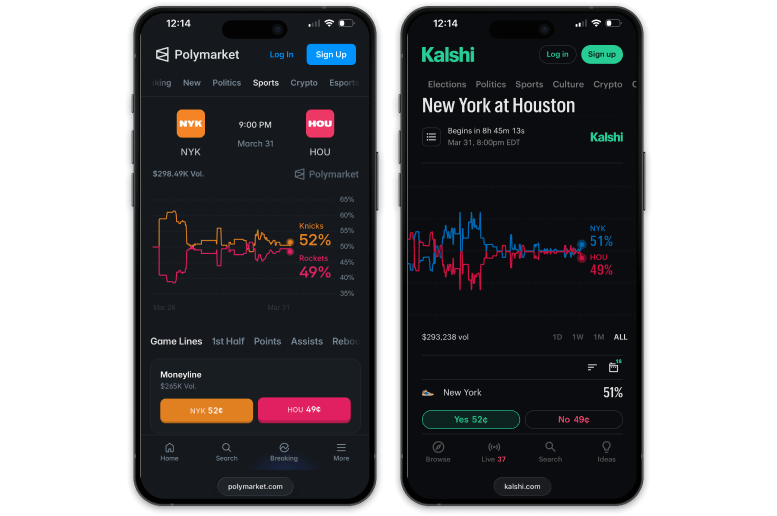
Sports are one of the biggest battlegrounds for Polymarket and Kalshi in September 2026. Kalshi is generally the cleaner starting point for mainstream U.S. sports users because it offers a more familiar exchange-style experience, USD-friendly banking, and strong coverage of major leagues and events. Polymarket can still be appealing for users who want global, niche, or fast-moving sports markets, especially when there is strong international trading interest.
Just remember that sports prediction markets are not the same as sportsbook bets. You are trading event contracts against other users, and prices can move based on liquidity, market demand, and the contract’s implied probability. Sports contracts are also one of the most contested areas in the prediction-market space, so users should always check platform eligibility, market availability, and local restrictions before trading.
Both operators are relevant to the growing NFL prediction markets conversation, but they are not interchangeable for sports users. Kalshi is generally the cleaner choice for U.S. sports fans who want a more familiar, USD-first trading experience across major leagues and events. Polymarket can be more interesting for global soccer, niche sports, international events, or fast-moving markets where broader trading interest creates more activity.
Kalshi is also leaning further into NFL-specific tools in 2026, including new market-implied NFL Power Rankings that turn live championship, conference, and game prices into a ranking of all 32 teams.
With the NFL season underway, both Kalshi and Polymarket are useful places to compare live weekly football markets. Week 4 opens Thursday with Steelers vs. Browns, continues Sunday with games such as Colts vs. Commanders, Patriots vs. Bills, Rams vs. Eagles, Chiefs vs. Raiders, and Lions vs. Panthers, and wraps Monday with Falcons vs. Saints. Prices, volume, spreads, and available market types can move quickly, so compare each platform’s board before trading rather than assuming the same odds or liquidity will be available on both.
The biggest caveat is availability. Sports prediction markets are one of the most contested areas in the industry, and access can vary by state, platform, and contract type. Before trading on either platform, check whether the specific sports market is available in your account and read the contract rules carefully.
Here are a few of the sports you may be able to trade on Kalshi and/or Polymarket:
| Aussie Rules | esports | Motorsport |
| Baseball (MLB) | Football | Rugby |
| Basketball (NBA) | Golf | Soccer (Premier League, MLS, international tournaments) |
| Boxing | Hockey (NHL) | Table Tennis |
| Cricket | Lacrosse | Tennis |
| Darts | MMA | Chess |
Politics 🗳️
Political events are among the most popular contracts at both Polymarket and Kalshi, with each earning a spot on our best political betting sites of 2026 list. Each prediction site offers a wide range of local and international political markets, such as 'How long will the U.S. government shutdown last?' and 'Outcome of the Brazil Presidential Election?'
Expert Verdict
While the variety of contracts is quite similar on both platforms, Polymarket tends to lean more toward niche and global political markets, including controversial or fast-moving event contracts. Kalshi is often the cleaner option for users who want a more regulated U.S.-exchange feel, but users should compare the exact market rules, eligibility, and settlement criteria before trading political contracts on either platform.

Economics
Financial markets are also covered, which truly brings forth the stock market comparisons that Kalshi and Polymarket typically get. Their financial contracts range from short-term predictions, such as Kalshi's 'Will U.S. Gas Prices Go Up This Week?', to markets covering specific companies like Polymarket's 'Will Procter & Gamble (PG) beat quarterly earnings?'
Expert Verdict
Kalshi is the stronger starting point for users who care most about financial and economic contracts. Kalshi offers well-rounded financial coverage, providing far more topical markets to buy, sell, and trade than Polymarket in 2026.
Culture 📺
This is the most wide-ranging contract category for both sites, covering topics such as music, movies, TV, celebrity, social media, major award shows, and more.
Expert Verdict
Kalshi sticks to clear, real-world topics you can measure, like the Academy Awards winners, Spotify music stats, and Billboard charts. You’ll see straightforward pop culture markets like “Who wins Best Picture?” or “Will a song hit #1 on Spotify this month?” Polymarket, on the other hand, leans more toward fun and viral topics, such as predicting celebrity headlines, social media moments, or questions about people like Elon Musk.
In short, Kalshi feels more like real-world forecasting, while Polymarket feels more like trading on what’s trending online, which is why it's our top-rated Oscars betting site in 2026.
Polymarket vs. Kalshi app experience
Kalshi and Polymarket both work for desktop and mobile users, but the experience feels different once you start comparing markets, funding options, and account setup.
When I compared the two app flows, I used similar UFC welterweight-title markets on each platform. On Kalshi, I opened “Welterweight Title Holder on Dec 31, 2026?”, selected Ian Machado Garry, and placed a $10 “Yes” trade. Before submitting, the ticket showed a Yes price of 26 cents, a 27% chance, and a max payout of $36.53, which made the cost, implied probability, and potential return easy to review before buying.
On Polymarket, I opened “Who will be UFC Welterweight champion at the end of 2026?”, selected Ian Machado Garry “Yes,” and entered the same $10 sample amount without submitting the trade. The ticket showed a Yes price of 27.9 cents, an average price of 29 cents, and a projected “To win” amount of $34.50 before the final trade step. The main difference I noticed was that Polymarket surfaced more market activity around the same topic, including higher displayed volume, while Kalshi’s ticket felt more controlled for reviewing and placing the trade.
The simplest takeaway: choose Kalshi if you want the easier U.S.-first app experience, and consider Polymarket if you care more about global market variety, crypto-native trading, and fast-moving event discovery.
Polymarket vs. Kalshi: Trading mechanics
Comparing the trading mechanics of Kalshi vs. Polymarket is crucial when determining which option is right for you. Both operators offer 'Yes' or 'No' positions on a wide range of event contracts valued between $0.01 and $1.00.
Making a trade is simple on both platforms. Whether you use Kalshi or Polymarket, just:
- Browse and choose your preferred event contract.
- Select the 'Yes' or 'No' position you want to take on the expected outcome.
- Click 'Buy' and enter the number of event contracts you want to purchase.
- You can also trade your positions with other users until the event officially ends. Just hit 'Sell', enter the number of contracts you want to move, and hit confirm.
- When the events conclude, winning contracts generally resolve to $1 and losing contracts to $0. Kalshi credits settled winnings to your cash balance, while the global Polymarket product settles trading activity in USDC, so the exact settlement rail depends on which Polymarket product you use.
Polymarket vs. Kalshi: Contract settlement
Contract settlement is one of the most important details to check before trading on either platform. Kalshi and Polymarket both use event contracts that resolve to either “yes” or “no,” but each market has its own rules, settlement source, and timeline.
Before buying a contract, read the market rules carefully. Check what has to happen for the contract to resolve, which source will be used to determine the outcome, when trading closes, and when the contract is expected to settle.
This matters most for fast-moving sports, politics, finance, and culture markets. A contract that looks obvious at first glance can still have specific wording around official results, deadlines, cancellations, tie scenarios, postponements, or data-source disputes. If you are choosing between Kalshi and Polymarket, compare the exact contract rules, not just the headline market.
Polymarket vs. Kalshi: Safety, KYC, and trading risk
Prediction markets can feel simple because contracts usually settle at either $0 or $1, but users should still treat them as risky financial products. Prices can move quickly, liquidity can change, and a market that looks obvious can still settle differently than expected based on the contract rules.
Kalshi and Polymarket may also require identity verification, account checks, or other compliance steps before you can deposit, trade, or withdraw funds. These requirements can vary by platform, product, market category, and user location.
Kalshi has also added extra compliance guardrails for certain higher-risk markets, including employment-information checks and restrictions designed to keep politicians, athletes, and other relevant insiders out of markets where they may have access to non-public information.
Users should also avoid trading on material non-public information. Prediction markets are attracting more regulatory attention, and platforms may restrict certain users, markets, or trading activity to reduce insider-trading risk.
Marketing and user-trust issues matter, too. Polymarket has faced recent scrutiny over allegations involving staged or simulated social-media betting videos, including a request from U.S. senators for CFTC answers and a consumer lawsuit over alleged deceptive marketing. Those claims remain allegations, but they are a reminder to treat viral profit claims carefully and make trading decisions based on platform rules, market liquidity, and your own risk tolerance.
Before trading, confirm your eligibility, read the market rules, and only risk money you can afford to lose.
Polymarket vs. Kalshi: Banking
Banking is one of the biggest practical differences between Kalshi and Polymarket, but the answer depends on which Polymarket product you are using. Kalshi is the more straightforward fiat option for most beginners, with traditional funding methods such as ACH, debit card, and bank transfers. Polymarket US also supports USD funding through debit card and bank transfer/ACH, while the broader global Polymarket product remains more crypto-native.
The simple rule: if you want the easiest USD-first setup, Kalshi is still the cleaner choice. If you are using Polymarket, confirm whether you are accessing Polymarket US or the global crypto-based product before assuming which payment methods, wallet requirements, or withdrawal options apply.
Polymarket vs. Kalshi: Fees and costs
Prediction market fees are not exactly the same as sportsbook vig. On Kalshi and Polymarket, your real cost can depend on the market category, contract price, payment method, maker/taker status, liquidity, and spread.
Kalshi charges transaction fees based on a contract's expected earnings. Fees can vary by market, and some major events or special markets may have different fee rules. Kalshi is still easier for most fiat-first users to understand because it supports familiar banking methods, but users should account for potential card deposit fees and any third-party fees associated with crypto deposits or withdrawals.
Polymarket’s fee model depends on the product and market category. On Polymarket’s crypto-native product, makers are generally not charged trading fees, whereas takers may incur fees on certain markets. Some categories may carry different fee rates, and sports markets have had their own updated fee structure in 2026.
The bottom line: Polymarket can be cheaper for crypto-comfortable users who understand maker/taker fees and already have funds on the right rails. Kalshi can be easier for beginners because it is more fiat-friendly and familiar. For active traders, the better deal is not just about posted fees. Compare the spread, liquidity, deposit method, withdrawal method, and contract rules before choosing where to trade.
Polymarket vs. Kalshi: Liquidity and volume
In financial trading, liquidity refers to how easily an asset can be converted into cash without affecting its market value.
In prediction markets, a liquid market means you can buy and sell event contracts without worrying that prices will move sharply before your order fills. Liquidity can also create tighter spreads, more reliable prices, and a clearer read on how traders view a specific outcome.
Kalshi and Polymarket both have strong liquidity, but not always in the same places. Kalshi can be stronger in U.S.-focused sports, economics, weather, and regulated event contracts, especially when there is broad mainstream interest. Polymarket can be stronger in global politics, geopolitics, crypto, culture, and viral news-driven markets, where its global audience and faster-moving market style can create more activity.
The best way to compare liquidity is market by market. Before placing a larger trade, check the bid-ask spread, total volume, order depth, and how much your trade would move the price. A platform can have strong overall volume while still offering thin liquidity on the exact market you want to trade.
Kalshi's trading liquidity
Expert Verdict
Kalshi is often the better fit for traders who want deeper liquidity on major U.S.-focused event contracts. That can include mainstream sports, economic indicators, weather markets, and other regulated event categories where a larger base of U.S. traders may be active.
Kalshi’s exchange-style structure can also feel more familiar for users who want to review an order book, compare prices, and trade through a more traditional financial interface.
Polymarket's trading liquidity
Expert Verdict
Polymarket is often more appealing for traders who care about global, niche, or fast-moving markets. Its strongest liquidity can show up in political markets, geopolitics, crypto, culture, and viral events that draw attention from a broader international audience.
That does not mean every Polymarket market is deep. Some niche markets can still have wide spreads or limited exit liquidity, so users should check market depth before taking a large position.
Best alternatives to Polymarket and Kalshi
Polymarket and Kalshi are two of the biggest names in prediction markets, but they are not the only platforms worth comparing in 2026. The right alternative depends on whether you care most about sports markets, promo value, app experience, state access, or crypto-native trading.
For sports-focused comparisons, start with our Kalshi vs Novig and Polymarket vs. FanDuel Predicts guides. FanDuel Predicts is especially relevant for users who want a more familiar sports-brand experience, while Polymarket and Kalshi remain stronger starting points for broader prediction-market depth.
Other prediction-market alternatives may include Novig, ProphetX, Underdog, OG.com, Crypto.com, and Robinhood prediction markets, depending on where you live and what markets are available. Before signing up for any platform, compare eligibility, available contracts, payment methods, promo terms, and withdrawal rules.
For the latest Underdog offer, eligibility details, and current terms, visit our Underdog promo code page.
Kalshi vs. Polymarket FAQ
Yes, Kalshi is available to many U.S. users because KalshiEX is a CFTC-regulated Designated Contract Market, and Kalshi Klear is registered as its derivatives clearing organization. Kalshi’s “yes” and “no” event contracts are structured as financial contracts, not traditional sportsbook bets. That said, availability is not as simple as “legal everywhere.” Kalshi is not currently available in Nevada, while Washington access is subject to a preliminary injunction and court-ordered restrictions. Other state-level challenges or market restrictions can also affect access to certain prediction-market products, especially sports event contracts. Before signing up or trading, check Kalshi’s eligibility rules and available markets in your state.
Polymarket US operates through QCX LLC d/b/a Polymarket US, a CFTC-designated contract market. That gives Polymarket a regulated U.S. path, but users should not treat Polymarket US and the broader global Polymarket product as identical. The global Polymarket experience remains more crypto-native and may have different eligibility rules, funding methods, market availability, and restrictions. U.S. users should confirm they are accessing Polymarket US, then check state eligibility, available markets, and account requirements before trading.
It depends on the market. Kalshi can have stronger liquidity on major U.S.-focused event contracts, including sports, economics, weather, and other regulated markets. Polymarket can be stronger on global politics, geopolitics, crypto, culture, and viral event markets. Before placing a larger trade, compare the specific market’s volume, bid-ask spread, order depth, and how much your trade could move the price. Overall platform volume does not always tell you where the best price is.
Kalshi is generally the better starting point for mainstream U.S. sports users because it has a more familiar exchange-style setup, USD-friendly banking, and strong coverage of major leagues and events. Polymarket can be more appealing for global, niche, or fast-moving sports markets, especially when there is strong international trading interest. Neither platform works exactly like a sportsbook. You are trading event contracts against other users, so prices can move based on liquidity, market demand, and implied probability. Sports contracts are also one of the most contested areas in prediction markets, so always check your state eligibility, available markets, and contract rules before trading.
Kalshi and Polymarket can both offer relatively fast payouts, but timing depends on the product, payment method, and withdrawal rail. Kalshi supports traditional banking methods, so some withdrawals can take anywhere from a few hours to several business days depending on the method used. Kalshi also supports select crypto deposit and withdrawal options, which may speed up some transactions. Polymarket payout timing depends on whether you are using Polymarket US or the broader crypto-native Polymarket product. Crypto-based withdrawals can be faster once a market resolves, while fiat-based withdrawals may depend on banking rails and account verification. Before trading, check the exact withdrawal methods and timelines available in your account.
Not always. Kalshi is the more fiat-friendly option for most beginners because it supports traditional funding methods like ACH, debit card, and bank transfers. Polymarket depends on which version of the platform you are using. Polymarket US supports USD funding, while the broader global Polymarket product remains more crypto-native and may involve wallets or blockchain-based activity. The simple answer: choose Kalshi if you want the easier USD-first setup. Consider Polymarket if you are comfortable checking which product you are using, how it is funded, and whether any crypto or wallet steps apply.
Yes, you may be able to access Kalshi, Polymarket, or similar prediction-market platforms in some states without legal online sports betting because event contracts are different from traditional sportsbook wagers. That said, access can vary by platform, state, product, and contract type. Kalshi is not currently available in Nevada, while Washington access is subject to court-ordered restrictions. Polymarket users should also confirm whether they are accessing Polymarket US or the broader global product before depositing or trading. Always check your account eligibility, available markets, and local restrictions directly with the platform.