FanDuel-owner Flutter Entertainment feels optimistic that additional states will legalize online sports betting or iGaming after last night’s midterm elections, even though a major ballot battle in one state went against the industry.

- Flutter remains optimistic about future sports betting and iGaming legalization, despite Nebraska voters rejecting mobile wagering measures.
- Prediction markets are having a limited impact on FanDuel’s customer wagering but are driving up marketing costs and pressuring profitability.
- FanDuel Predicts is growing, with rising trading volume, active users, and market-making revenue opportunities through exchange partnerships.
Flutter CEO Dan Taylor said Wednesday during the company’s latest earnings call that they were “disappointed” about the loss of twin online sports betting ballot measures in Nebraska on Tuesday.
“But I think we'll take something from that,” Taylor said. “When we look at the broader opportunities, I think we feel good about the prospect of future (online sports betting) and iGaming regulation over the coming years.”
The relatively new Flutter CEO added they “know that there’s a need for the tax dollars,” and that FanDuel could deliver.
“We're slowly at half of the U.S. with (online sports betting), and 10% from an iGaming perspective,” Taylor said. “And I'm not going to try and tell you which states in which order, but we feel good coming through this that there is a strong pipeline of further state openings.”
FanDuel-owner Flutter Entertainment reported this morning that it contributed ~$30M+ to a super PAC over the first nine months of 2026. https://t.co/DcLK7Cxxth
— Geoff Zochodne (@GeoffZochodne) November 4, 2026
Flutter and FanDuel apparently tried to help their cause this cycle, too.
The company contributed approximately $32 million to a super political action committee (super PAC), according to Flutter’s third-quarter financial results. That was most likely Win for America, which spent money in states that lack legal sports betting, such as Texas.
Texas indeed saw major political change on Tuesday, with Democrats winning the gubernatorial race. That could tee up another push for legalized sports betting in Texas in 2027, when the local legislature will sit again.
“State politics will play out over the coming years, but on the surface, (incoming lieutenant governor) Vikki Goodwin has supported the broader expansion of commercial casinos and online sports betting gambling through voter referendums,” stock analysts at Citizens wrote in a note to clients on Wednesday.
At any rate, the leadership of one of the biggest online sportsbook operators in the U.S. is sounding hopeful after Tuesday’s midterms. They’re also optimistic about their performance in the contested but growing space of prediction markets.
Prediction market pivot
Those federally regulated exchanges aren’t stealing much business from FanDuel at the moment, according to Taylor, but they are helping to increase media and marketing costs for the industry.
Taylor said in a letter to shareholders on Wednesday, released as part of Flutter’s third-quarter financial results, that the FanDuel parent company still sees “limited impact” from prediction markets on FanDuel's existing customers.
“Which I believe, and our consumer research affirms, reflects the superior proposition offered by sportsbooks,” Taylor wrote.
It’s instead on the marketing side where prediction markets are squeezing FanDuel, the CEO suggested.
“We are … beginning to see an impact on our overall media costs as prediction market operators increase marketing spend,” Taylor wrote. “The duration of this trend will depend in part on how the regulatory landscape develops, but at this early stage, we expect our marketing intensity to continue in 2027 at levels similar to this year.”
Despite a $20 million spending advantage, Nebraska's online sports betting supporters could not convince state voters to approve online sports betting. What happened - and what comes next - after a pair of ballot measures are handily defeated https://t.co/CeYpRg57R9
— Ryan Butler (@butlerbetstrade) November 4, 2026
Flutter reported that sales and marketing expenses for the quarter ended Sept. 30 were $357 million, up 16% from a year earlier. That weighed on Flutter's profitability for the three months, with adjusted EBITDA for its U.S. business down 94% year-over-year, to $3 million.
The online gambling firm added that sales and marketing-related expenses as a percentage of total revenue are expected to be around 21% this year, “including the marketing element of a prediction market adjusted EBITDA loss for 2026” of approximately $200 million.
Enjoying Covers content? Add us as a preferred source on your Google account
The cost of kindness
Flutter and FanDuel have also been taking pains to increase “generosity” for customers after a tough end to last football season. Taylor said during their earnings call for analysts and investors that those efforts are beginning to pay off and helped drive increased market share for FanDuel in August and September.
Still, the Flutter CEO said that elevated media spending on digital marketing and related matters was up more than 60% year-over-year in September, and more than 50% in October. That, Taylor noted, was “primarily driven” by spending from prediction market operators, and it “does put pressure on asset costs.”
“It also puts pressure on some of our share of voice,” Taylor said. “And we need to be disciplined about how we spend our marketing dollars, but we also need to protect and grow our brand reach.”
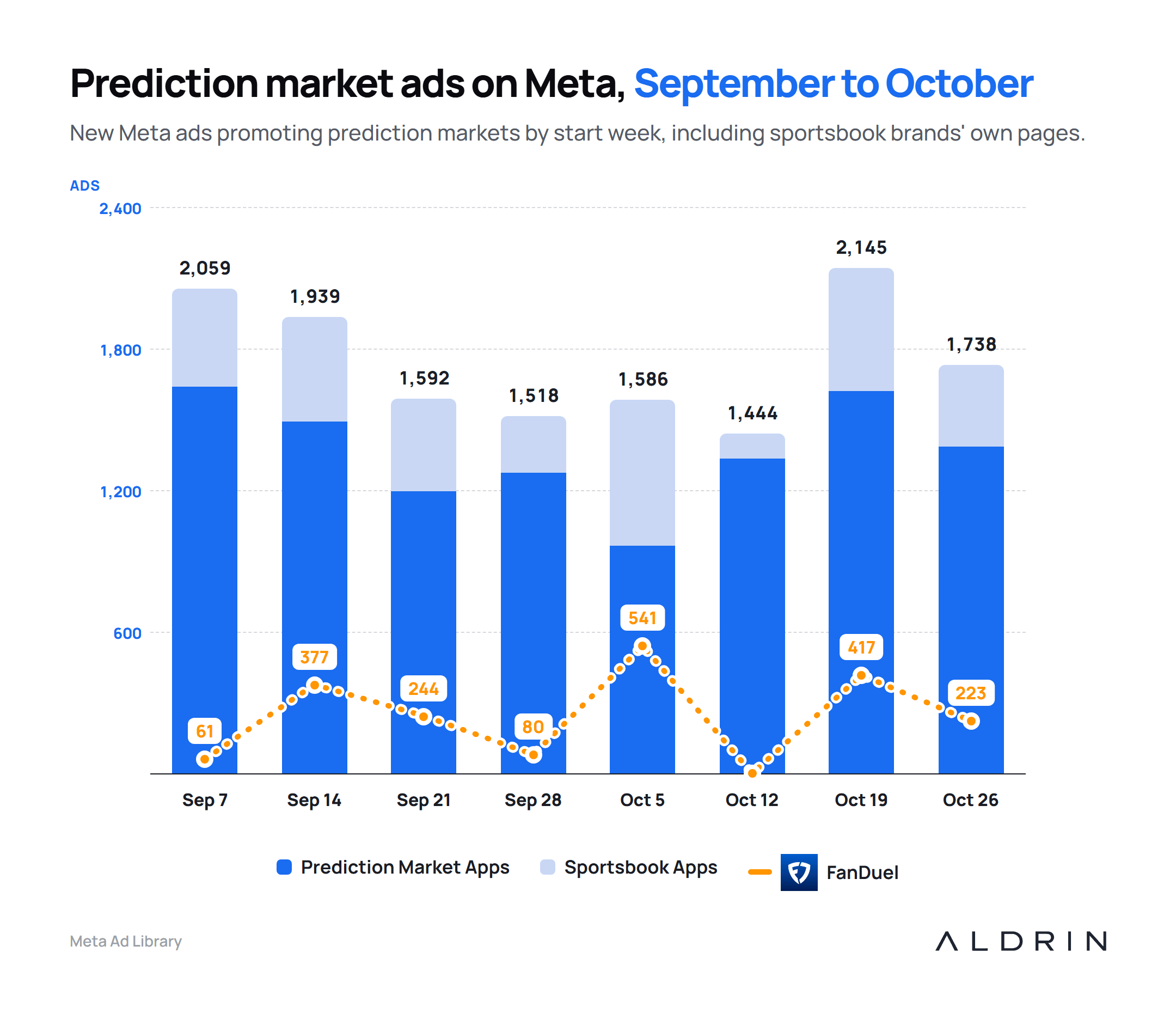
There are hundreds of prediction market ads running on social media, according to Aldrin Research. FanDuel is fighting to stand out from that crowd, and protect its podium position in online gambling.
Nevertheless, prediction markets are providing additional revenue opportunities and future prospects for FanDuel. In the U.S., Flutter said its “other” revenue grew by 20% in the third quarter, to $66 million, which was “primarily driven by our market-making activity” on exchanges.
The company, which has a lot of experience in pricing sporting events, is sticking to its guidance of around $50 million in market-making-related revenue this year.
“We're now trading across multiple exchanges, across multiple sports, and I think our ability on sort of the complex parlays is a real differentiator for us,” Taylor said.
FanDuel Predicts had 66,000 average monthly players (AMPs) in the third quarter, which was up 39% from the second, Flutter said. Taylor added that they had around 140,000 active users on the platform in October as well.
The prediction market platform also saw trading volume of $119 million for the three months that ended Sept. 30, which Flutter said was up 102% from the second quarter. The company added that volume increased 271% in October compared to July.
“FanDuel Predicts revenue was not material during the quarter, however we made significant operational progress through our partnership with Crypto.com and the FanDuel One App delivering a step change in our product offering,” Flutter said. “New features launched since the start of the NFL season included a broader selection of sports markets, variable fees, sub-penny contracts and fractional contracts, alongside a superior promotions experience including our popular refer-a-friend mechanic.”