


Even as prediction markets have become the new hotness, and with state-regulated online sports betting going strong, fantasy sports will not go gentle into that good night.

- Fantasy sports remain popular, with ESPN reaching a record 16 million fantasy football players and a recent survey estimating 56 million Americans played fantasy sports over the past year.
- Fantasy sports also remain popular amid online sports betting's staying power and the prediction market boom, with DFS and season-long participants likely dabbling in both exchange trading and sports betting.
- Prediction market operators are even using fantasy partnerships to expand their trader base (and giving them ways to hedge fantasy lineups).
For proof, look no further than the social media uproar that FanDuel faced over a “site issue” last NFL Sunday. The outcry was enough to jolt FanDuel (which offers both online sports betting and prediction markets) into saying it had "fumbled" and refunded net losses to affected customers.
But FanDuel also had to stomach social media shade from rival DraftKings.
“We’ve noticed other companies just don’t care (about DFS),” DK tweeted.
To our DFS customers - we acknowledge that yesterday's site issue was unacceptable. NFL Week 1 is supposed to be a joyous time, and we fumbled. The team investigated the issue and has now refunded the net losses to our impacted customers. We remain committed to offering you a…
— FanDuel Customer Support (@FanDuel_Support) September 14, 2026
Yes, in the year 2026, with all the attention and money aimed at prediction markets, online sports betting, and internet casino gambling, companies are still trying to dunk on each other over DFS.
It might be about more than just clout, though.
Among other things, somebody who plays fantasy may be more inclined to take their knowledge of players and make a prop bet (or trade). From there, it’s a short hop to placing multi-leg same-game parlays (or combos). There also remains the possibility that sports prediction markets are spiked through the courts, in which case not cutting ties completely with fantasy could be - fittingly - a hedge.
And there are still a ton of fantasy players who just want to draft players and set lineups, who want to play best ball, pick 'ems, or for bragging rights among friends and family. Even amid all the buying and selling of sports event contracts, and all the placing of parlays, same-game and otherwise, fantasy sports are still relevant.
“I think fantasy sports is kind of its own thing, and people who like it like it for different reasons,” said Peter Schoenke, CEO of Fantasy Life and a board member of the Fantasy Sports and Gaming Association (FSGA), in an interview with Covers.
It's been a record-setting season so far for @ESPNFantasy Football 👏
— ESPN PR (@ESPNPR) September 16, 2026
Details: https://t.co/3f7uAv1MEk pic.twitter.com/d37cB2kBlO
People do indeed like it. For example, ESPN announced on Wednesday that its fantasy football game has 16 million players this season, its sixth consecutive all-time high. Last Sunday, ESPN said, “was the highest-trafficked day in the history of the ESPN Fantasy app.”
For its part, the FSGA commissioned a survey by Angus Reid in May and June that found 21% of Americans played fantasy sports in the past 12 months, its highest level in 20 years and up from 20% in 2025. That one percentage point difference also means there were an estimated 56 million fantasy players over the past year, compared to 53 million in 2025.
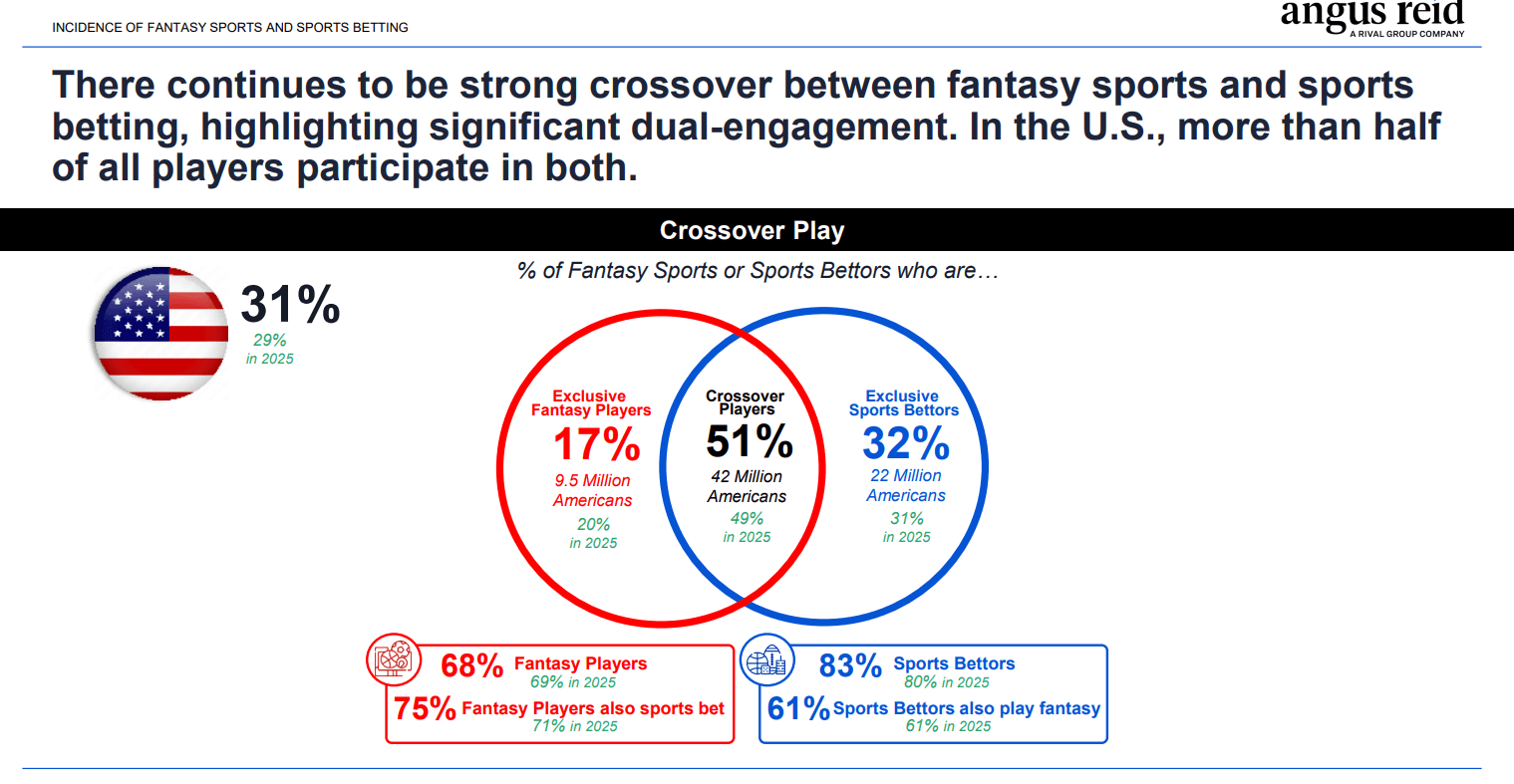
Sports betting participation (which does not include prediction market trading) increased as well, to 26% from 23%. The poll also found 17% of those surveyed considered themselves exclusively fantasy players, 32% exclusively sports bettors, and 51% as “crossover” players who participated in both.
“I just haven't seen a lot of evidence that a large number of people are going to drop fantasy for sports betting,” Schoenke said. “And we’ll see how it plays out, but I'm guessing that it's going to be the same thing with prediction markets.”
There might be some crossover between fantasy and prediction markets, too. On Tuesday, a note from stock analysts at Citizens said Sleeper's app was the fifth-most downloaded real-money gaming app in the U.S. and Canada during the NFL's Week 1.
Sleeper offers both fantasy and prediction markets. Through a partnership with Kalshi, there’s all the usual fare, but there are even contracts related to fantasy available via the Sleeper app, such as who will be the “Top Fantasy QB” this year. And there were approximately 239,000 downloads of the Sleeper app in Week 1, which, granted, was down 9% from a year earlier, according to Citizens.
Kalshi 🤝 @SleeperHQ
— Kalshi (@Kalshi) February 6, 2026
We’ve partnered with Sleeper to bring Kalshi markets to 10 million more people. pic.twitter.com/GcJOTASPsz
The relevance of fantasy could be in the eye of the beholder, however. For some, it may serve as a way to cross-sell users into other products, to make the funnel for acquiring customers just that much wider.
Polymarket notably formed a prediction market partnership with fantasy operator Splash Sports. That partnership also included Polymarket’s sponsorship of a $21-million survivor contest, and that money is at least partly intended to raise consumer awareness of prediction markets.
“We believe that partnering with them for the biggest survivor contest in history is the perfect way to bring prediction markets to NFL fans at scale,” Polymarket CEO Shayne Coplan said in a press release.
Kalshi probably saw a similar distribution play in partnering with Sleeper. Because, while there’s still demand for season-long and daily fantasy games, it’s just not attracting the same kind of buzz and valuations as state-regulated online sports betting and, more recently, prediction markets.
Dollars and sense
And money may be where the rubber meets the road for some operators.
Arizona, for example, recently reported its gaming revenue figures for July. That month, licensed fantasy sports contest operators reported nearly $8 million in in-state fantasy entry fees. That was up from $7.3 million a year earlier but a good deal less than the almost $600 million bet with the state’s sportsbooks in July 2026.
It’s worth noting those figures were for a non-football month. In-state entry fees doubled to $14.1 million when September 2025 rolled around. Yet sportsbook handle was around $850 million that same month.
So fantasy remains a sliver of the overall gambling pie (or real money-being-risked-on-stuff pie). And yet, people are still getting heated about it in 2026, and companies are reluctant to forsake it entirely.
Underdog CEO Jeremy Levine, in announcing a prediction market-related pullback in seven states, said that even though their draft games "don’t get anywhere near the usage of our other offerings, we still care deeply about them."
Drafts community, I have some not fun news to share. Right after kickoff on Wednesday, we will be shutting down Drafts in seven states: MA, MD, MI, MS, NJ, PA and OH. Already entered drafts will continue as normal, but in those states you won’t be able to enter new drafts. If…
— Jeremy Levine (@JerLevine) September 5, 2026
People are also being inspired by it, with new players attracted by newer formats. Schoenke said the FSGA’s summer conference saw “a good number” of purely fantasy sports startups there touting their offerings.
“It's still a very good industry,” Schoenke said. “And if you look at the top-level stuff, it's still very healthy.”
Fantasy sports are no longer in the legislative or regulatory hot seat either. That chair belongs to prediction markets these days, which continue to fight in court with state gambling regulators over the legality of sports event contracts.
Schoenke, who chairs the FSGA's government affairs committee, even pointed to recent legislative successes in Kentucky and Illinois for fantasy operators.
Does that mean those types of battles over legitimacy and regulation are entirely over? No, but the intensity isn’t the same as what’s facing prediction markets.
“We're not the hot topic at the moment,” Schoenke said.
And, in the legislative and regulatory sense, that can be a good thing.















