


You could see it coming, but it was still something to behold.
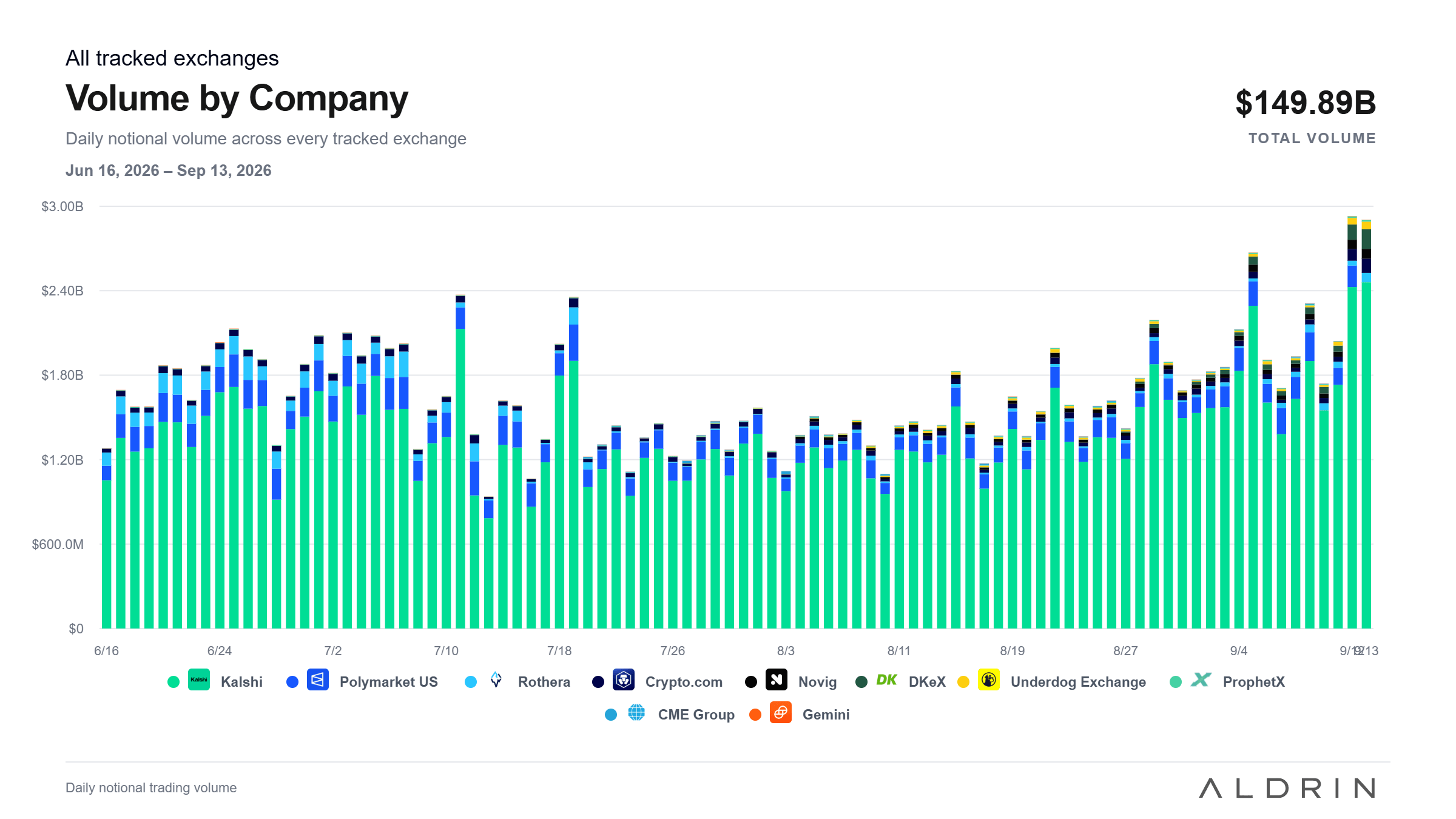
Prediction market trading activity exploded over the weekend, with $2.93 billion in notional volume on Saturday, and what will probably be more than $3 billion on Sunday when all the transactions are accounted for, according to Aldrin Research.
For CFTC-regulated exchanges, it was their two biggest volume days in the past three months. Jefferies, an investment bank, sent a note to clients Monday morning saying that they were "the two highest-volume days in prediction market history."
The bulk of that volume was sports, too: on Sunday, nearly $2.2 billion in Kalshi volume was sports or combos, the latter of which can involve sports. Kalshi's volume for the Super Bowl in February was north of $500 million.

- Prediction market trading activity surged over the weekend (and squares might have done quite well) with the return of the NFL's regular season.
- Regulators are challenging sports prediction markets as illegal gambling, but rising adoption means eliminating them could leave significant unmet demand.
- States could prepare for either outcome by authorizing or improving state-regulated sports betting, and an upcoming hearing in Texas could be a good start.
- Also: FanDuel's market making detailed, Pinnacle reveals a pricing data predicament, and there is carnage in the survivor streets.
A big weekend was expected; the catalyst was obvious. Football is king, and the college and NFL football seasons are now officially underway.
When you combine increased awareness of prediction markets, especially in states that lack state-regulated sports betting, like Texas and California, with a thing people in those states love, like NFL football, the conditions are there for a boom.
Can confirm this is happening. Here’s a live look at inbound RFQs. https://t.co/B1E0ctCXLZ pic.twitter.com/PkD3Ua148Y
— SigmaSquirrel (@SquirrelSigma) September 13, 2026
What’s more, social media grumblings from market makers suggested that the squares were feasting. The trends back that up. Before the Sunday nighter, NFL favorites were 11-3 straight-up for Week 1, meaning a lot of chalky combos (or “parlays”) stuffed full of faves paid out. Oh, and there were a lot of touchdowns, which the recs love.
So, a lot of people were trading, and a lot of people were winning on Sunday. Imagine telling them that they couldn’t do it again next week? What about next month or next year? They’d probably feel a little annoyed.
And yet, prediction markets are very much under a legal siege, and there remains the looming possibility that the frenzy we saw on Sunday is a limited time thing.
Some state gambling regulators and law enforcement officials want to shut down sports prediction markets, which they see as unlicensed, unwanted, and illegal sports betting. Prediction market operators and the CFTC maintain the business is federally governed and protected, so the states can’t stop them. There are now multiple requests for the Supreme Court to opine on the situation.
Where will traders go if prediction markets are taken away?
While the legality of sports prediction markets is being challenged, what is less disputed at this point is that a growing number of people are partaking.
So if one day they’re gone, where will the traders go? Will they give up the habit, or just go looking for the next place to scratch their itch?
In California, Native American tribes are mobilizing for another ballot measure in 2028 that could authorize statewide online sports betting via the tribes. That’s a plan that works in the event of the demise or survival of sports prediction markets. States like Minnesota and Texas could consider similar “break glass in case of [insert prediction market outcome]” plans.
Other states may want to look within, and reassess their state-regulated sports betting markets. While a lot of trading comes from states without legalized sports betting, some is coming from states that have authorized wagering avenues. Now, some people are just choosing not to use them.
Massachusetts is a good example, as it is a state that investigated and then took action on the practice of sports bettor limiting. When your state-regulated sportsbooks are competing against entities that will seemingly take all bets from all comers, not being overly restrictive with bettors may help level the playing field.
Basically what I’m asking is: what happens the morning after? If sports prediction markets go away, the demand they’re meeting won’t just evaporate. Oh, and there’s still a chance they’re here to stay. What then?
ICYMI:
- 1st NFL Sunday of Season 'Champagne-Popping Day for Bettors'
- Jeremiah Smith Springboards Into Heisman Trophy Conversation
- Nebraska's Online Sports Betting Ballot Campaign Pivots to General Election
- Online Gambling, Prediction Markets Become Quebec Election Issues
- Circa Sports Sets Record with $38.7M Football Prize Pool
- FanDuel CEO Sees Sports Prediction Markets as More Opportunity Than Challenge

Other news worth knowing
– Something to watch this coming week: the Texas Senate Committee on State Affairs will meet Tuesday morning in Austin to hear testimony on its interim “charges,” one of which involves prediction markets.
Texas Lt. Gov. Dan Patrick essentially handed out homework assignments earlier this year, asking state lawmakers to study up ahead of the next regular legislative session in January 2027. One assignment for the state affairs committee is to look into “closing gambling loopholes” in Texas.
“Study the sudden inundation of prediction market gambling and the exploitation of federal law to circumvent Texas gambling prohibitions by allowing users to place bets on the outcome of elections and other events,” the charge says. “Examine the relationship between federally regulated derivative markets and state-prohibited gambling. Make recommendations to ensure the integrity of Texas elections and Texas sports.”
Texas is obviously huge for prediction markets and could likewise be huge for state-regulated sportsbooks if that door is ever opened. Tuesday’s meeting should be interesting.
– FanDuel and other online sportsbook operators are market making on Kalshi, according to Barron's reporter Nick Devor.
Now, FanDuel and DraftKings have said already that they're doing this, but this confirms an exchange of choice for FanDuel in carrying out such activity. It makes sense, too, because Kalshi remains the leader in the CFTC-regulated market.
While once upon a time the online sports betting industry was interested in prediction markets for hedging purposes, they clearly see more opportunities for themselves. Those opportunities include running exchanges and facilitating trades, yes, but also putting oddsmaking knowhow to use in making markets. Who knows more about pricing parlays than an online sportsbook?
– Speaking of, Pinnacle has generally been regarded as a sharper sportsbook.
It promotes itself as a place where limits are higher and winners are welcome. In theory, this gives Pinnacle odds and lines that are better-informed than most.
So, if you’re trying to make markets on a federally regulated exchange, Pinny might be a useful reference. How you’re obtaining and using Pinnacle's stuff, however, may not sit right with Pinnacle, which is why it posted the following last week:
A statement on prediction markets & API access from Pinnacle: pic.twitter.com/WSNwthxibR
— Pinnacle (@Pinnacle) September 9, 2026
In short, Pinnacle says sports event contracts have increased the importance of and demand for good pricing data. Pinnacle says it has this, but it claims it is also seeing "an increase in the unauthorized use" of its data, and "in ways that create market confusion, operational disruption, and, in some cases, direct commercial damage."
Enough's enough, Pinnacle says. There are "no authorized resellers" of Pinnacle's data, only Pinnacle. And Pinnacle says it will be "increasing our efforts to enforce our rights against unauthorized resellers."
If you want Pinnacle's data, you can pay Pinnacle. If you're paying someone else for purported Pinnacle data, and then maybe using it as a PM market maker, you've been warned. It's an interesting side plot to the prediction market mayhem, but one Pinnacle is deadly serious about.
Either pay up, or do your own risk-management homework. I'll have more on this later today.
– Pour one out for anyone who had the Chargers in their survivor pool. Indeed, L.A.’s loss to Arizona (as the biggest favorite on the board) caused serious chaos in the survivor streets. For example, it took out nearly a third of contestants in the massive Circa Survivor contest.
Yikes 😩... Carnage already in Week 1 of #CircaSurvivor & #CircaGrandissimo as #Boltup lays an egg 🥚 at home against #BirdCityFootball.
— Circa Sports (@CircaSports) September 13, 2026
Chargers ❌
7,585 Survivor (30.3%) Eliminated
28 Grandissimo (36.4%) Eliminated
Contest season is officially BACK!