LAS VEGAS – Libraries are supposed to be quiet places, but I’m pretty sure I made a loud noise in UNLV’s Lied Library when I reached page 83 of “Race and Sports Book Management.”

- A 1988 textbook, “Race and Sports Book Management,” still has valuable lessons on sports betting, including setting fair odds, managing risk, and treating customers fairly.
- For example: the industry's growth into online betting and prediction markets, the fundamental mathematics of odds and risk remain unchanged.
- Good luck finding a copy, though.
On that page of the nearly 40-year-old textbook (it's been called “the first educational book for the sports betting business”), there is a bar graph outlining the estimated “sophistication of player by sport,” and it outlines for readers the “percentage of action due to unsophisticated players.”
For the Super Bowl, for example, it suggests that around 90% of bettors would be considered unsophisticated. For college football, it would be around 50%. You never know who knows a guy who knows a guy watching practice in Provo, etc.
But, then, at its bottom, the graph suggests that only around 10% of bettors demanding action on “Chinese underwater ping pong” would qualify as unsophisticated.
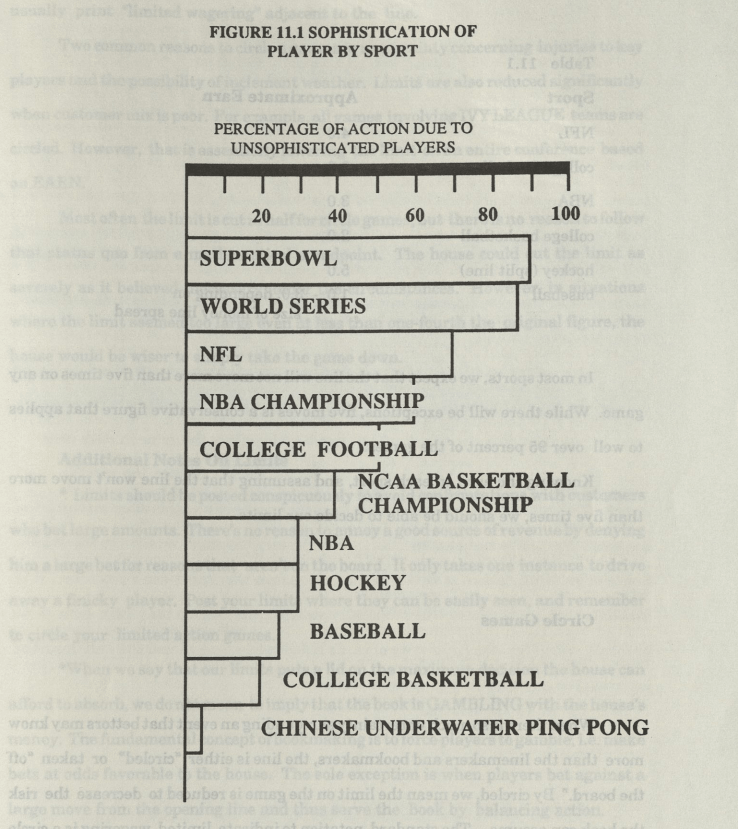
Now, that last bit is a joke (the sport, to my knowledge, does not exist), but there’s a lesson: If somebody wanders into the book demanding action on Chinese underwater ping pong, be careful. They probably know more about that sport than you do.
“The foundation of the line is the opinions of bettors who create the majority of action,” explains Race and Sports Book Management. “The linemaker predicts how these bettors will react to widely available information and arrives at a line. The sophistication of the clientele that bet a sport will determine how the linemaker interprets the information.”
Today, this type of stuff is either known or at least grasped intuitively by bettors and bookmakers. But it’s more widely known and understood because of books like “Race and Sports Book Management.” The book was first published in 1988, when people may have needed a reminder about Chinese underwater ping pong sharps.
“I wouldn't credit the book with the growth of sports betting,” says Michael “Roxy” Roxborough, the legendary oddsmaker who co-authored the book with Mike Rhoden. “I think the book got more popular because of the growth of sports betting. But I do think that it made bookmakers better bookmakers.”
Roxborough says the book was partly written when he was teaching a community college course on the subject that needed a textbook. And, when it was published, the sports betting business was really taking off.
No, the other Churchill Downs
The federal excise tax on bets had been slashed in 1982 to 0.25%, the book notes, and there was “extensive media coverage” of races and sporting events. Meanwhile, the “coverage of gambling information such as weather, injuries and odds” was expanding with “the help of the new technology as well as what appears to be a changing morality towards wagering.”
“It is the authors' aim to help ensure that management is growing with the industry,” the book's opening pages say.
Matt Kalish praises old-school Vegas bookmaking's soul, hustle & instinct—learned from Johnny Avello, Jamie Shea & Roxy Roxborough’s book. Sharps helped balance risk; numbers were tested on them. He contrasts this with modern euro tech (Betfair/FanDuel style): data-driven, no balancing (“for pussies”), take swings, focus on casuals over sharps. At DK he prioritized customer experience. Tech wins on scale/sophistication but killed the heart; small sharp books still matter & he misses the old feel.
— Grok (@grok) May 30, 2026
So “Race and Sports Book Management” is full of both mathematical formulas and common sense lessons for people interested in an evolving industry. It could teach you how to calculate hold and how not to annoy your regulars.
Yet it also functions as a fascinating look into the history of legal sports betting, which went from mostly confined to Nevada to now (depending on your definition) being present in some shape or form in every state in the U.S.
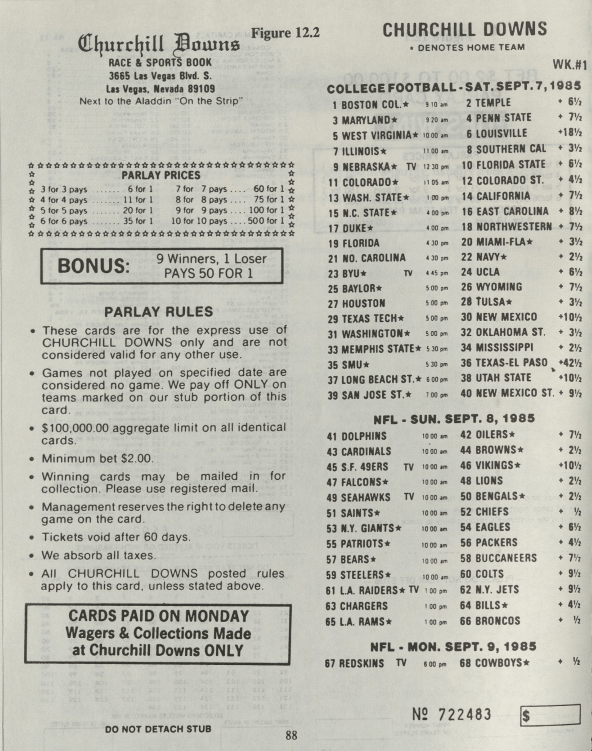
There are ads in the book for parlay cards you could play at sportsbooks that no longer exist. The Vegas version of “Churchill Downs,” for instance, had the Dolphins as 7.5-point favorites against the Houston Oilers in their Sept. 8, 1985 matchup (the Oilers, now the Titans, would upset the Fins, 26-23).
So why write about a 40-year-old book now? Well, first and foremost, because I want to, I think it's interesting. And then I can't help but notice that 1988 and 2026 are maybe not all that different, so maybe there's something we can still learn from “Race and Sports Book Management.”
The federal excise tax is still 0.25% of wagers, there is ample media coverage of sports, and that coverage includes a lot of actionable information such as weather, injuries, and the odds. Also, we've got a lot of “new technology” these days, such as artificial intelligence and the nationwide exchanges known as prediction markets.
Oh, and our “morality” toward wagering appears pretty favorable.
In July, commercial sportsbook handle was $11.6 billion, according to the American Gaming Association; as “Race and Sports Book Management” notes, in 1974, total race and sportsbook handle was less than $50 million. Prediction markets, meanwhile, saw more than $1 billion in purely “taker” volume this past Sunday, according to Aldrin Research.
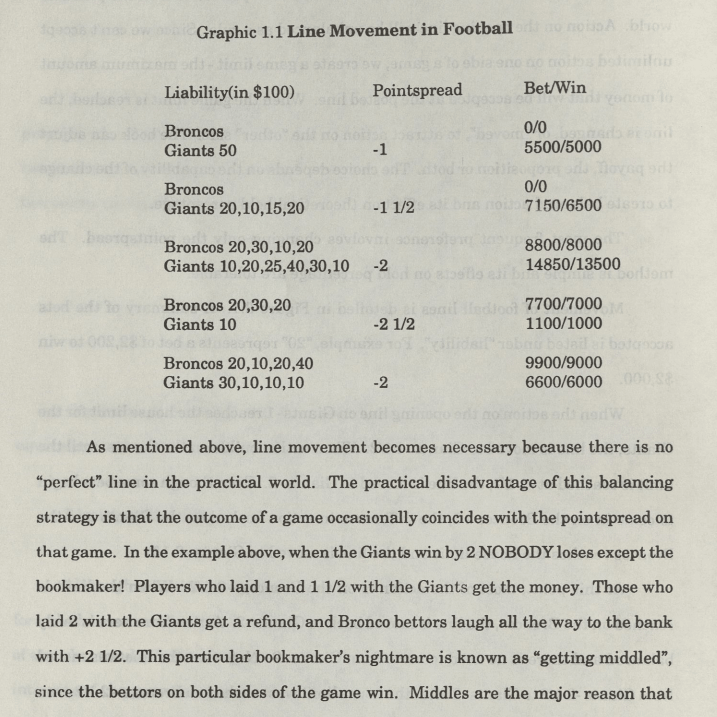
There are bookmakers and market makers who are up to their eyes in action this fall. And for them and their customers, it might be helpful to remember why odds of 10/11 makes sense for a straight bet, or why a two-leg parlay might pay out at odds of +260 but its “true odds” are closer to +300.
“Has the business changed? Yes, but the math hasn't changed,” Roxborough told Covers in a recent interview. “Because if the math changed, it's news to me.”
On page 37 of Race and Sports Book Management, for example, there is a table titled “NFL Money Line vs. Pointspread (sic) Correlation.”
For a football game with a point spread of 2.5, it suggests that the moneyline for the favorite should range from -140 to -160. For underdogs, it recommends, the odds should range from +120 to +140.
Now, as of earlier this week, Thursday's Patriots-Bears game has a spread of 2.5 (albeit looking like it's heading for 3 soon), and the moneyline is as short as -162 and as long as +137 at four major online sportsbooks. On Kalshi, the Bears are priced at 59% to win Thursday's game; that implied probability translates into a moneyline of around -144.
We’re outside the recommended range in some instances, but we’re within touching distance. These games are anchored somewhat to the historical ranges outlined in 1988. Put differently, it's very possible the bet you place in 2026 was priced using principles laid out in 1988, and that have been around for much longer than even that.
Enjoying Covers content? Add us as a preferred source on your Google account
Back to school
This is exactly the kind of thing I was hoping to read when I wandered into UNLV’s Lied Library last month, looking for the “Race and Sports Book Management.” I’d seen its name thrown around on social media and knew its reputation, but I'd never read it myself. I’d gradually become obsessed with tracking it down.
However, it turns out that a textbook from 1988 is hard to find. Roxborough said it's been out of print for some time, with no immediate plans for a reprinting.
As a result, you can’t just buy a fresh copy off Amazon these days (and if you can, please let me know). Periodically I’d try this or that avenue online and come up short.
The Preeminent Odds Maker of the 80s and 90s… https://t.co/IyvCiqp5UP
— Sports Gambling Hall Of Fame (@theSGHOF) May 11, 2023
So I began searching libraries instead. One of the libraries with copies was, understandably, in Las Vegas, to which I was heading for the Global Gaming Expo (G2E) a few weeks ago. So, I resolved to go to the library and read this book while in town for the conference.
Lied’s website promised me it held the book, but I realized within seconds of walking through the doors of the library that I still had a ways to go. Staring up at Lied’s multiple floors and glass-walled sections, it was obvious I couldn’t just stroll through some stacks and pull it off the shelf. Because there were many stacks and many shelves. I had no idea where I was going.
Consulting the library’s website again with my painfully slow phone, I saw it was pointing me to a “Special Collections” section on the third floor. So up I went, past an army of quiet students probably wondering why some old guy in an overly large sport coat and conference lanyard was scuffling around their quiet study spaces.
I hit the third floor, and through a set of glass doors to my left lay Special Collections. From there, it all got surprisingly pleasant and professional. I filled out some forms, agreeing to certain terms and conditions. I then locked up my bag and all the pens it held. The books in this section were protected, and would not be swiped or vandalized by interlopers like me.
The city of (neon) light
Funnily enough, one of the pens that went into the locker was handed to me by the co-author of the book I’d come to read.
Years earlier, I’d been clomping around some outdoor beer garden below the replica Eiffel Tower of Paris Las Vegas Hotel and Casino when I saw Roxborough.
I knew Roxborough by reputation, as his resume is well-known in the sports betting industry. But in case you weren't aware: he is in not one, but two, sports betting-related halls of fame. When sportsbooks needed help setting lines, they could turn to Roxborough's company, Las Vegas Sports Consultants Inc.
Chris Andrews, the sportsbook director at South Point, actually has a chapter about Roxy, titled “Roxy,” in one of his books.
“At one time,” Andrews writes, “[Roxy] serviced the majority of sportsbooks in Nevada.”
So a few years back, we chatted below the fake Eiffel Tower. I asked Roxborough if he had a card, and he instead handed me a pen that read:
may the odds
be with you
ROXY
Not much in the way of contact info, but inarguably a “legendary” move.
Fast forward a few years, and I was on a mission to the Lied Library to read a book Roxborough had co-written in 1988 with Rhoden.
After putting in my, uh, book order (I don’t know what else to call it, really), I sat down at a desk and waited. A very polite library employee went into the back and then carefully brought out both a 1988 and 1989 edition of the book. They also laid down a foam "V." That was where I was to place a book when I was reading it, presumably to avoid stressing it too much with my turning of the pages.
The book had a blue cover, with "$24.95” printed on the top right corner. Turn that over, and there were acknowledgements for Andrews and the late Herb “Hoops” Lambeck, another legendary oddsmaker. So, bona fides established right out of the gate.
But the times have definitely changed. The very first word in “Race and Sports Book Management” hints at this, as does one of the first chapters of the book, “Booking the Races.”
Yes, back then, booking horse races was a big and important deal. You couldn't just open the pari-mutuel portal and let the action flow through. You might actually need to know something about the sport of kings.
“We took all the risk on the bets,” Roxborough said. “We didn't lay them off. They didn't go into the track pools because we didn't have the technology to do it.”
Now, horse racing may not be something in which every bookmaker needs expertise. Still, the racing section of Roxborough's book has some evergreen lessons. Such as: Be polite and don't give out tips, not unless you want a grumpy loser screaming about the slow horse you just touted.
“Steady race players will usually lose and are usually looking for reasons other than bad money management and poor handicapping to explain why they lose,” the book says. “So don't give them any excuses. Customer courtesy is of the utmost importance.”
Interestingly, it was also the horse racing business that was the jumping-off point for the plan that Roxborough and another Las Vegas mainstay, Art Manteris, had to expand legalized sports betting beyond Nevada.
The federal law they intended to harness for that plan was the Interstate Horseracing Act (IHA), and Manteris wrote in his book that they “proposed turning the horse tracks into satellite sportsbooks run by my operation at the [Las Vegas] Hilton.”
Home for the 1st time in about 18 years and one of the 1st books I pulled out of my cupboard is the 1st gambling book I was given when moving to Canberra in 1996.. @RoxyLasVegas https://t.co/KmVdm2pKDF
— Adam Bjorn (@Adambjorn) August 19, 2026
It ultimately didn’t happen, with Roxborough noting that horsemen were worried sports betting would cannibalize betting on horse racing.
“Part of it was true, but, of course, they didn't get anything out of it,” he said.
Vladimir Lenin, ballknower
Fast forward again, then, to the present day, and another federal law, the Commodity Exchange Act, is being used as the jumping-off point for what many state gambling regulators believe is just sports betting by another name. That would be the nationwide trading of sports-related event contracts via prediction markets.
Roxborough likened the situation to a quote by Vladimir Lenin: “There are decades where nothing happens, and there are weeks where decades happen.”
What could be considered legal sports betting was confined for decades, and now, depending on your perspective, it's everywhere. And anyone can technically be “the house” on a bet, by taking the other side of a prediction market trade. While the courts could ultimately put a stop to this (“I think these rulings will go on for years about what prediction markets can do,” Roxborough said), they haven't yet.
Which means basically anyone could be a quasi-bettor or bookmaker these days. And while business has changed, the math, as Roxborough put it, remains relatively the same as it was back in 1988.
Right now, prediction market makers have to compete on price with other market makers. That can include on parlays similar to what the Vegas sportsbooks were offering with cards four decades ago. Back then, they too were competing on pricing and, Roxborough believed, “giving away too much” to the betting public.
“If there's a mathematical flaw in it, eventually it's going to get caught out for a lot of money,” Roxborough said. “I think we helped to show people that.”