Most people buy crypto hoping the line goes up. A sharper-eyed trader ignores the asset entirely and trades volatility instead.
Welcome to the ecosystem of Kalshi Bitcoin Markets, where participants speculate on hyper-short-term price movements using binary event contracts. Let’s explore how to trade Bitcoin event contracts, where you are not buying tokens or worrying about secure wallets.
In these markets, you are trading pure probabilities of price outcomes. So instead of holding coins, you just need to answer a simple question:
“Will Bitcoin be above $75,000 at 3:15 PM?”
Key Takeaways
- You trade probabilities, not the physical Bitcoin asset itself.
- Your maximum loss equals your entry price; the total contract settlement payout is fixed at $1.00.
- Kalshi offers regulated 15-minute markets, while Polymarket focuses on ultra-short intervals at five minutes.
Understanding short-term Bitcoin markets
Ultra-short-term markets
Prediction market apps have compressed the trading window.
You will frequently find rapid cycles dominating the Polymarket Bitcoin five-minute order books. Kalshi tends to see its highest volume in the slightly longer 15-minute brackets.
Why these markets exist
Crypto trades around the clock. That constant volatility creates an ideal environment for rapid contract cycles.
Day traders and momentum traders use these short timeframes because they offer endless opportunities to capitalize on immediate price action without holding overnight exposure.
Example market
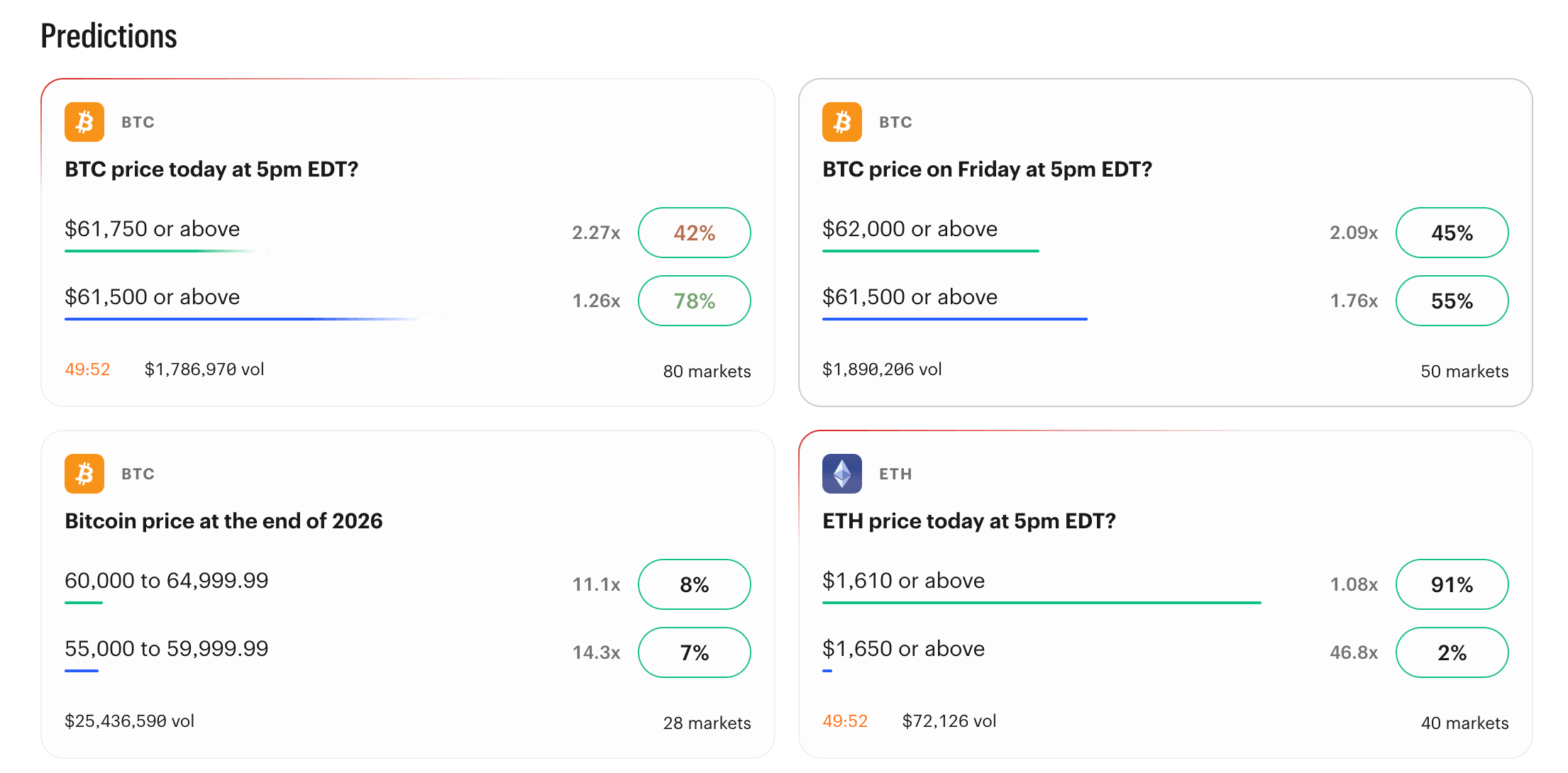
Consider a live scenario. The market asks if BTC will be above $75,200 at exactly 3:15 PM. You examine the current price, assess the immediate momentum, and buy the side of the contract that aligns with your assessment of the next fifteen minutes.
How to Trade Bitcoin Markets
Mastering crypto event contract execution in five simple steps
Choose a Market
Start by selecting your timeframe and price target. Decide whether your strategy for trading Bitcoin event contracts fits better with a frantic five-minute window or a slightly broader 15-minute interval.
Read the Price
Look at the current contract cost and instantly convert it to implied probability. A price of 75¢ means the market thinks there is a 75% chance the event occurs.
Analyze the Trend
Review the underlying asset. Look at recent price movement, current momentum, and any immediate volume spikes that could dictate the next few minutes of market action.
Enter Position
Once you identify an edge, execute your trade. Buy the 'Yes' or 'No' contract that represents your calculated probability threshold.
Manage Trade
You have two choices. You can hold the contract to the final settlement timestamp or exit the position early to safely lock in a partial profit if the market price moves in your favor.
Example Trade: Five-Minute Bitcoin Market
What are Kalshi Bitcoin prediction markets?
A Bitcoin price prediction market is an exchange where users trade contracts based entirely on future price outcomes.
The key difference between this and a traditional crypto exchange is ownership. You never own the underlying asset. You own a contract with a fixed payout of exactly $1 if your prediction is correct.
These markets, offered by many prediction markets, are gaining immense traction for three reasons. They are remarkably simple, they focus entirely on short timeframes, and they eliminate leverage and liquidation risk.
What you need to know before trading event contracts
Binary price contracts
One of the most important things to remember when learning how to trade Bitcoin event contracts is that the core concept is binary.
Every contract asks a straightforward ‘Yes’ or ‘No’ question about the price at a specific time. The price of the contract reflects the market’s perceived probability of that outcome. If a ‘Yes’ contract trades at 60¢, the market implies a 60% probability that the event will happen.
Settlement mechanics
These contracts do not drift indefinitely. They settle at a rigidly defined timestamp. The final resolution is based on real-time price feeds and established exchange indexes to ensure absolute accuracy and prevent manipulation.
Payout structure
The math is absolute. A winning contract pays out exactly $1. A losing contract pays out $0. Your total profit is simply the difference between your entry price and that final dollar payout.
Where to trade Bitcoin event contracts


Why traders use Bitcoin prediction markets
Simplicity vs traditional crypto trading
Traditional crypto trading involves complex order books, funding rates, and margin requirements. Event contracts strip all of that away. You are left with a clear, defined risk and reward ratio on every single trade.
Short-term edge opportunities
Prices on prediction markets often lag slightly behind the asset's spot price.
When momentum and volatility spike simultaneously, sharp traders can exploit these brief inefficiencies before the prediction market catches up.
Defined risk
You cannot blow up your account on a sudden wick. Your maximum possible loss is capped exactly at your entry price. Because there is no leverage, liquidation risk simply does not exist.
Accessibility
The barrier to entry is virtually nonexistent compared to trading complex crypto futures. Anyone who can read a chart and understand basic probabilities can execute a trade.
Finding an edge in Bitcoin event markets
Bitcoin event contracts vs crypto trading
| Feature | Event Contracts | Crypto Trading |
|---|---|---|
| Ownership | No BTC | Own BTC |
| Risk | Fixed | Variable |
| Leverage | None | Often used |
| Complexity | Low | High |
| Market hours | 24/7 | 24/7 |
| Regulatory oversight | CFTC | None/decentralized |
Advanced trading strategies
Arbitrage opportunities
Savvy operators actively hunt discrepancies between platforms. If a specific price target is undervalued on Kalshi but overvalued on Polymarket, you can mathematically lock in a profit by taking opposing sides.
Kalshi vs. Polymarket: A side-by-side comparison
Hedging positions
You can use these contracts to offset exposure in your broader portfolio. If you hold physical Bitcoin but fear an immediate drop, a short-term ‘No’ contract acts as cheap insurance.
Scalping short-term moves
You do not have to wait for settlement. Scalpers buy contracts when they are slightly mispriced and sell them seconds later as the probability adjusts, capturing small inefficiencies repeatedly throughout the day.
Prediction market news
Bitcoin Prediction Markets FAQs
Yes, Bitcoin prediction markets are currently considered fully legal in the United States. Platforms such as Kalshi operate under the direct regulatory oversight of the Commodity Futures Trading Commission (CFTC) as registered designated contract markets. Furthermore, recent federal court rulings have firmly backed this classification, legally confirming that these event contracts are federally regulated financial products rather than unlawful state-level gaming activities.
Kalshi Bitcoin contracts settle as straightforward binary event contracts rather than through the physical delivery of cryptocurrency. Traders take specific positions on direct ‘Yes’ or ‘No’ questions, such as whether Bitcoin will successfully reach a predefined price threshold by a designated expiration date. Upon the contract's expiration, the precise outcome is determined, and all winning positions are settled entirely in cash at the agreed payout.
Yes, you can definitely trade these specific prediction market contracts twenty-four hours a day and seven days a week. This continuous trading schedule explicitly includes all weekends, offering a distinct advantage over many traditional financial markets that strictly close on Fridays. Consequently, active traders can continuously express their market views and actively manage risks during sudden macroeconomic shocks or weekend cryptocurrency price volatility.
Bitcoin event contracts are simple binary options based on direct yes-or-no questions about future price thresholds, without requiring complex margin management. In contrast, cryptocurrency futures are binding agreements to buy or sell the underlying digital asset at a predetermined price, and they entail significant liquidation risk. Ultimately, event contracts focus entirely on determining specific probability outcomes, whereas traditional futures continuously track the ongoing market price of the asset.