Bad news for the broadcast executives who want a unified, patriotic viewing public in 2026.
The American soccer map may be about to splinter.
When the 2026 World Cup kicks off, the primary media narrative will obviously revolve around Team USA. But beneath that surface layer, the United States is quietly hosting a tournament for dozens of other nations that already possess heavily concentrated, built-in fanbases across the country.
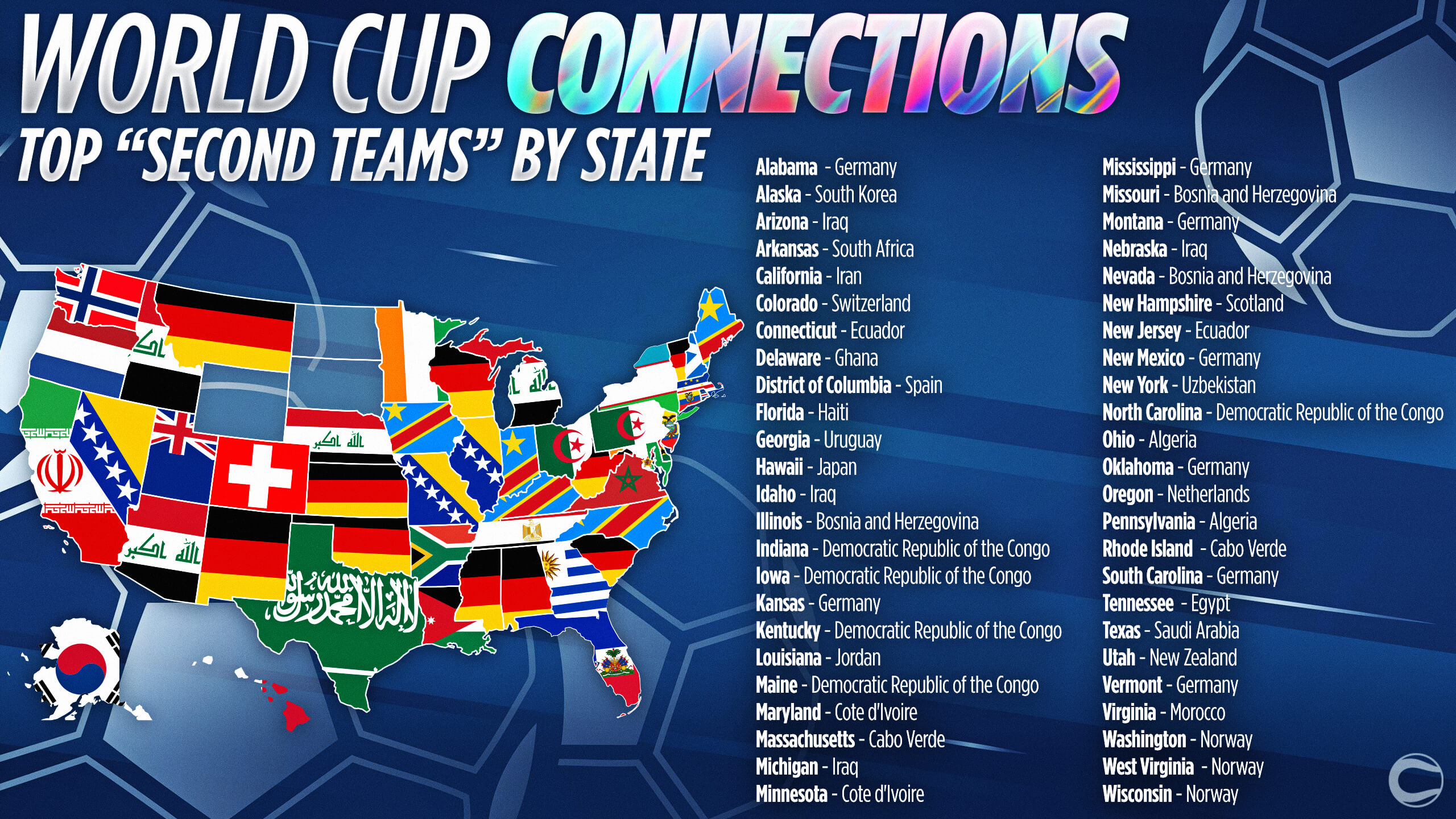
Covers looked at foreign-born population data to map out America's hidden World Cup loyalties. Rather than just counting the total number of residents from a specific country, the goal was to identify over-representation.
Key Takeaways
- America's World Cup support could splinter into highly localized, tribal fanbases supporting other nations.
- Nearly a quarter of U.S. fans pick a second team purely out of spite.
- Rhode Island's Cabo Verde connection is the strongest in the entire country.
- California has a large contingent of supporters backing Iran, while Florida leans heavily toward Haiti.
- DR Congo is the sleeper story, leading five states and ranking nationally.
We wanted to find where a specific national footprint is highly concentrated compared to the national baseline.
The result is a geographic map of "second teams" that looks nothing like a standard demographic chart. The loudest non-U.S. fanbase in one state often has absolutely nothing in common with the state next door.
Enjoying Covers content? Add us as a preferred source on your Google account
The ‘Second Team’ Phenomenon
To fully understand the geography, you have to understand the psychology.
More than a third of American fans are actively looking to support a second country during the tournament.
Family heritage is a major driver here: roughly one in five Americans say ancestry is their primary reason for adopting an alternate squad, while 63 percent are more likely to support a team if they have family links.
But sports fans are petty, and soccer fans are arguably the pettiest of all.
The most revealing data point from our survey is that 23 percent of fans choose their second team purely out of spite. They do not care about the tactical brilliance of a European powerhouse or the underdog narrative of a debut nation. They just want Team USA's rivals to lose.
That tension makes the local support maps highly relevant.
Top State Connections at a Glance
| State | Top "Second Team" Connection | Over-Index Score |
|---|---|---|
| Rhode Island | 🇨🇻 Cabo Verde | 37.28 |
| Iowa | 🇨🇩 DR Congo | 16.34 |
| Massachusetts | 🇨🇻 Cabo Verde | 15.31 |
| Kentucky | 🇨🇩 DR Congo | 12.62 |
| Missouri | 🇧🇦 Bosnia & Herzegovina | 11.86 |
| Michigan | 🇮🇶 Iraq | 11.53 |
| California | 🇮🇷 Iran | 3.35 |
| Florida | 🇭🇹 Haiti | 3.09 |
Florida, California, and the Heavy Hitters
You might assume the biggest states naturally default to traditional soccer superpowers. The data tells a different story.
🇮🇷 California: Iran Leads the Pack
California is the most populous state in the union, yet its strongest World Cup connection is Iran.
With more than 213,000 foreign-born residents, Iran over-indexes heavily in California, followed closely by Portugal, South Korea, Japan, and Sweden.
🇭🇹 Florida: A Caribbean and South American Stronghold
Florida provides a completely different ecosystem. Haiti ranks as the state's strongest secondary connection.
That demographic block holds an over-index score of 3.09, suggesting the Sunshine State will be entirely hostile territory for anyone playing the Caribbean squad. Colombia, Uruguay, Argentina, and Brazil round out the Florida market, guaranteeing a highly partisan atmosphere.
Where the Micro-Markets Dominate
The most striking anomalies happen in smaller states. When a specific immigrant community concentrates in a tight geographic area, you get a localized fan culture that completely ignores broad national trends.
🇨🇻 New England's Cabo Verde Connection
Look at New England. Rhode Island produced the strongest single connection in our entire study. Cabo Verde holds a staggering over-index score of 37.28 in the state. Massachusetts echoes this trend, with Cabo Verde ranking first there as well. If Cabo Verde takes the pitch in 2026, parts of the Northeast will feel like a home fixture.
🇮🇶 The Midwest's Hidden Loyalties
The Midwest map is equally fragmented and highly specific. Michigan could lean heavily toward Iraq, Missouri has a deep connection to Bosnia and Herzegovina.
These are not generic pockets of casual fans. They are established communities ready to rally the moment their squad plays.
Spotting the Demographic Sleepers
If you are looking for a value play on crowd noise, pay attention to DR Congo.
🇨🇩 DR Congo: The Standout Story
The African nation is the true sleeper story of this study. DR Congo leads five separate states in our rankings and appears in the top five in 11 different states. The highest concentrations sit in Iowa, Kentucky, Maine, and Indiana.
This proves that loud international loyalties will emerge in places completely ignored by traditional soccer media.
🇨🇮 Côte d'Ivoire's Quiet Reach
Côte d'Ivoire fits a similar profile. The Elephants rank first in Maryland and Minnesota. They even crack the top five in Texas, proving their relative presence is strong enough to register in sprawling, diverse population centers.
The Local Advantage
The 2026 World Cup is being sold as a giant, unified American event. The reality could be highly localized and heavily tribal.
A Japan match in Hawaii or an Ecuador match in New Jersey will not feel like neutral site games. They will feel like regional rivalries.
Team USA is the headline act, but the actual atmosphere of this tournament could be decided by the neighborhoods, suburbs, and local bars that already belong to the rest of the world.
Watch the odds, but listen to the crowd. The home-field advantage could be severely mispriced.
Methodology: How the Market was Measured
Covers.com analyzed foreign-born population data from the U.S. Census Bureau’s 2024 American Community Survey, using Table B05006: Place of Birth for the Foreign-Born Population in the United States. The Census Bureau defines the foreign-born population as people who were not U.S. citizens at birth, including naturalized citizens. The analysis compared each World Cup country’s share of a state’s foreign-born population with that country’s share of the U.S. foreign-born population overall.
The resulting over-index score shows where each country has a stronger-than-average community presence. A score of 1.00 represents the national average, while a score above 1.00 indicates that a country is over-represented in that state compared with the U.S. overall. Countries included in the analysis were based on the nations competing in the 2026 FIFA World Cup.