


The 2026 FIFA World Cup, hosted across the United States, Canada, and Mexico, will be the most geographically dispersed tournament in football history. With 16 host cities spread across a continent, travel is no longer a background consideration — it becomes an active competitive factor.
To quantify this, we modelled the travel burden for every nation by calculating the distance they would cover if they reached the final, based on their assigned stadiums. These distances were computed using the Haversine formula, producing accurate great-circle estimates; effectively, "as the crow flies" flight distances.
The results reveal massive disparities: some teams are poised for a gruelling, cross-continental odyssey, while others have the luxury of compact, travel-light paths.
✈️ Key Takeaways
⚽ World Cup teams face up to 12,866 km of travel, more than any tournament in history; several teams’ routes stretch across the entire North American continent, making 2026 the most logistically demanding World Cup ever.
⚽ Tournament favourites face wildly different travel burdens – and Spain (+450 ) draw the short straw; it faces the longest travel route of any major contender, with a brutal 12,593 km (7,825 miles) journey even if they win their group.
⚽ Co-hosts experience opposite realities: Mexico have the most compact route to the final of any team at just 5,188 km (3,224 miles) — a major built-in advantage. The USA, however, face a hefty 10,501 km (6,525 miles) total, one of the highest among seeded nations.
⚽ Travel inequality is at record levels, with the toughest routes exceeding the easiest by more than 8,000 km. From Mexico’s 5,188 km cruise to Spain’s 12,593 km slog, the travel burden gap is the largest ever seen at a World Cup. In a tournament this spread out, fatigue may be as decisive as form.

World Cup teams with the most potential travel
| Team | Distance (km) | Distance (mi) | Notes |
|---|---|---|---|
| Cabo Verde | 12,866 | 7,996 | Coast-to-coast zig-zag with repeat long hauls; no geographic rhythm. |
| Uruguay | 12,661 | 7,869 | Heavy continental movement late in the knockout rounds. |
| Spain | 12,593 | 7,827 | Minimal early travel, then heavy late-stage cross-country jumps. |
| Saudi Arabia | 12,454 | 7,740 | Moderate early travel, then repeated cross-country swings late |
| Colombia | 12,225 | 7,598 | Constant cross-region swings with no consistent travel pattern |
| Congo | 12,066 | 7,499 | Chaotic continent-spanning route with repeated long-haul travel swings. |
| Tunisia | 11,105 | 6,902 | Late-tournament eastward grind after minimal early-stage travel. |
| Algeria | 11,079 | 6,886 | Cross-country ping-pong travel with exhausting repeat coast-to-coast jumps. |
| Netherlands | 10,944 | 6,802 | Manageable early route before brutal late-stage eastern travel climb. |
| Portugal | 10,857 | 6,748 | Little early movement before punishing knockout-stage coast-to-coast travel begins. |
The biggest travel burdens aren’t just regional; they come from cross-country zig-zags and poorly aligned routes across the U.S.
World Cup teams with the least potential travel
| Team | Distance (km) | Distance (mi) | Notes |
|---|---|---|---|
| Mexico | 5,188 | 3,224 | Host advantage: extremely clustered match locations |
| Korea Republic | 5,588 | 3,472 | Stable, linear path minimizing large jumps |
| France | 6,087 | 3,782 | One of the most compact journeys of any major contender |
| Norway | 6,090 | 3,784 | Efficient path with low cumulative movement |
| Egypt | 6,148 | 3,820 | Beneficial scheduling reduces overall burden |
| Senegal | 6,348 | 3,945 | Extremely efficient early route with limited long-distance travel requirements. |
| Qatar | 6,524 | 4,055 | West-coast cluster early before major knockout-round cross-country travel spikes. |
| Iraq | 6,760 | 4,201 | Tightly packed early schedule before manageable eastern knockout-stage travel. |
| Argentina | 6,846 | 4,255 | Minimal group-stage travel before heavier knockout-round cross-country movement begins. |
| Ivory Coast | 7,037 | 4,374 | Compact early routing before moderate late-stage eastern travel increases. |
Mexico holds the most favourable travel scenario of any nation — a meaningful edge for a co-host.
Notable World Cup teams: key insights & route maps
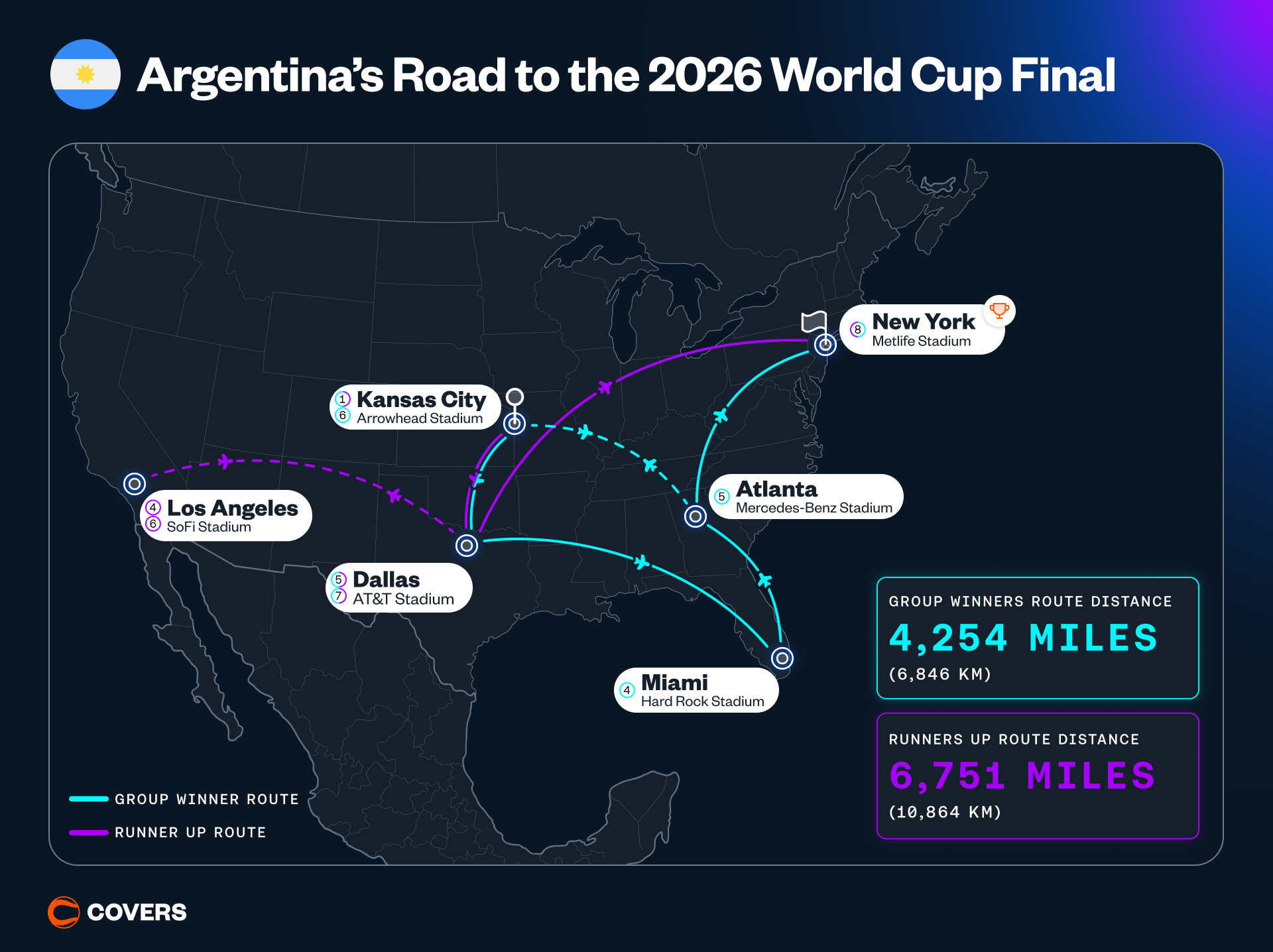
 Argentina
Total distance if 1st: 6,846 km (4,255 miles)
Total distance if 2nd: 10,864 km (6,751 miles)
Total distance if 3rd: 8,934 km (5,552 miles)
Group stage route
- Match 1: Arrowhead Stadium (Kansas City)
- Match 2: AT&T Stadium (Dallas-Arlington)
- Match 3: AT&T Stadium (Dallas-Arlington)
A very efficient group stage: one move from the Midwest to Texas and then they stay put.
Knockout route – if Argentina finish 1st in the group
- Round of 32: Miami
- Round of 16: Atlanta
- Quarterfinal: Kansas City
- Semifinal: Atlanta
- Final: New York/New Jersey
This creates a big sweeping arc, moving from the Southeast up through the central U.S. and finishing in the Northeast.
Knockout route – if Argentina finish 2nd in the group
- Round of 32: Los Angeles
- Round of 16: Dallas
- Quarterfinal: Los Angeles
- Semifinal: Dallas
- Final: New York/New Jersey
This back-and-forth between Los Angeles and Dallas massively increases their travel load.
Knockout route – if Argentina finish 3rd in the group
A potential 3rd-place qualification route pushes Argentina’s total travel distance to 8,934 km.
Their efficient group-stage setup helps soften the blow, keeping this path relatively manageable compared to other contenders.
 Brazil
Total distance if 1st: 9,498 km (5,902 miles)
Total distance if 2nd: 11,695 km (7,267 miles)
Total distance if 3rd: 8,702 km (5,409 miles)
Group stage route
- Match 1: MetLife Stadium (New York/New Jersey)
- Match 2: Lincoln Financial Field (Philadelphia)
- Match 3: Hard Rock Stadium (Miami)
A North-East to South-East run down the U.S. East Coast.
Knockout route – if Brazil finish 1st in the group
- Round of 32: Houston
- Round of 16: New York City
- Quarterfinal: Miami
- Semifinal: Atlanta
- Final: New York/New Jersey
Brazil bounce between East Coast and Southern hubs, with a late move back north to the final.
Knockout route – if Brazil finish 2nd in the group
- Round of 32: Monterrey
- Round of 16: Houston
- Quarterfinal: Boston
- Semifinal: Dallas
- Final: New York/New Jersey
The 2nd-place route introduces Mexico and longer cross-region flights.
Knockout route – if Brazil finish 3rd in the group
A potential 3rd-place qualification route gives Brazil a total travel distance of 8,702 km.
That is one of the more manageable 3rd-place paths among the major contenders, helped by a relatively efficient opening route.
 Canada
Total distance if 1st: 8,166 km (5,074 miles)
Total distance if 2nd: 14,603 km (9,074 miles)
Total distance if 3rd: 12,250 km (7,613 miles)
Group stage route
- Match 1: BMO Field (Toronto)
- Match 2: BC Place (Vancouver)
- Match 3: BC Place (Vancouver)
A big trans-Canada hop, then stability in Vancouver.
Knockout route – if Canada finish 1st in the group
- Round of 32: Vancouver
- Round of 16: Vancouver
- Quarterfinal: Kansas City
- Semifinal: Atlanta
- Final: New York/New Jersey
They enjoy a stationary start to the knockouts before sweeping southeast toward the final.
Knockout route – if Canada finish 2nd in the group
- Round of 32: Los Angeles
- Round of 16: Houston
- Quarterfinal: Boston
- Semifinal: Dallas
- Final: New York/New Jersey
This 2nd-place path drags them through multiple long-haul transitions and nearly doubles their total distance.
Knockout route – if Canada finish 3rd in the group
A potential 3rd-place qualification route keeps Canada under major travel strain, pushing total distance to 12,250 km.
That path wipes away much of the co-host advantage and creates another heavy cross-continent workload.
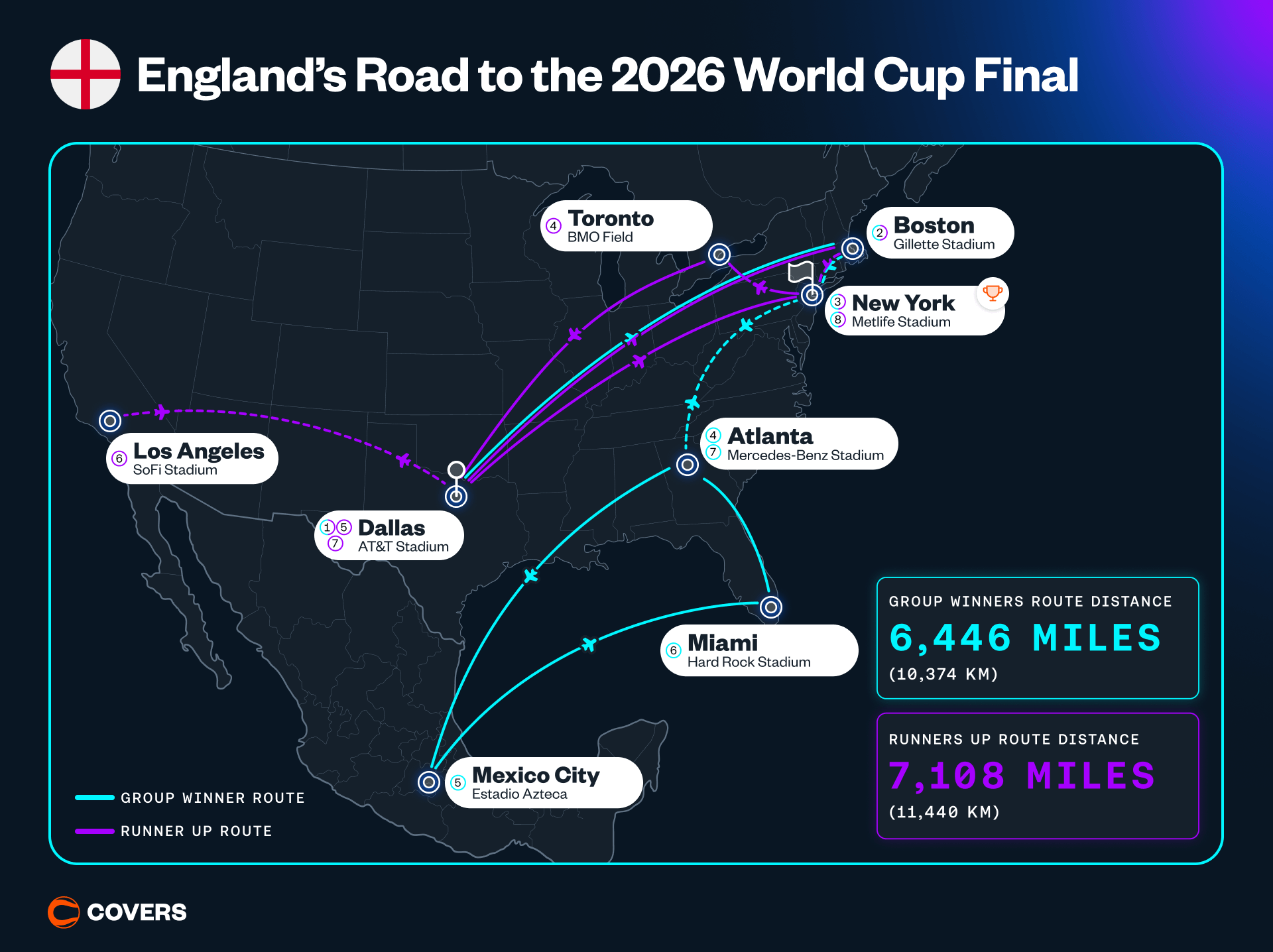
 England
Total distance if 1st: 10,374 km (6,446 miles)
Total distance if 2nd: 11,440 km (7,108 miles)
Total distance if 3rd: 11,856 km (7,367 imles)
Group stage route
- Match 1: AT&T Stadium (Dallas–Arlington)
- Match 2: Gillette Stadium (Boston/Foxborough)
- Match 3: MetLife Stadium (New York/New Jersey)
A significant jump from Texas up to the Northeast corridor.
Knockout route – if England finish 1st in the group
- Round of 32: Atlanta
- Round of 16: Mexico City
- Quarterfinal: Miami
- Semifinal: Atlanta
- Final: New York/New Jersey
This pulls England between the U.S. Southeast, Mexico, and back up to the Northeast.
Knockout route – if England finish 2nd in the group
- Round of 32: Toronto
- Round of 16: Dallas
- Quarterfinal: Los Angeles
- Semifinal: Dallas
- Final: New York/New Jersey
The 2nd-place path adds more long-range zig-zagging between Canada, Texas, and California.
Knockout route – if England finish 3rd in the group
A potential 3rd-place qualification route pushes England's total travel distance to 11,856 km.
The Three Lions already face one of the toughest group-stage travel schedules among contenders, and a 3rd-place finish does little to ease that burden.
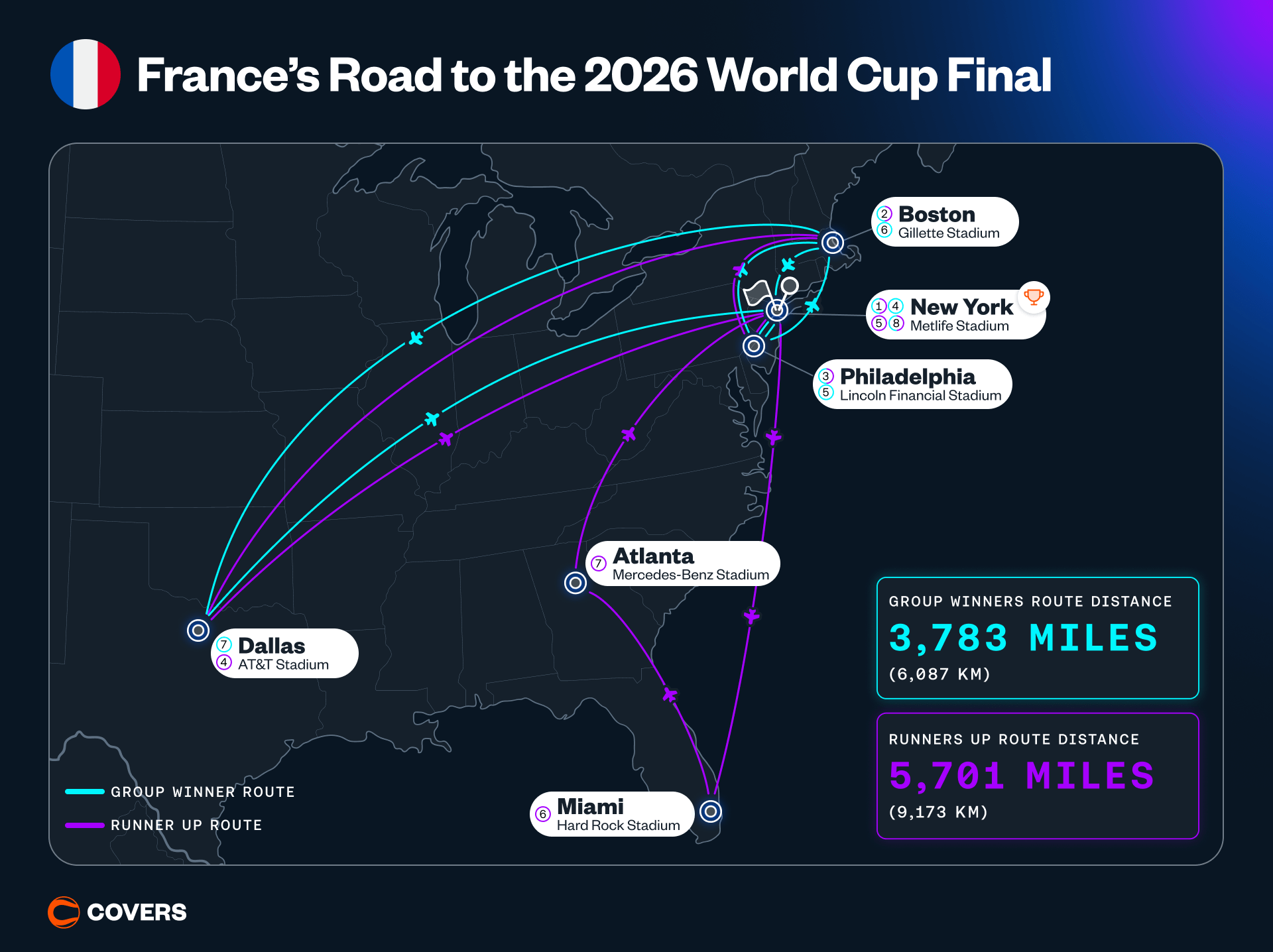
 France
Total distance if 1st: 6,087 km (3,783 miles)
Total distance if 2nd: 9,173 km (5,701 miles)
Total distance if 3rd: 9,692 km (6,024 miles)
Group stage route
- Match 1: MetLife Stadium (New York/New Jersey)
- Match 2: Lincoln Financial Field (Philadelphia)
- Match 3: Gillette Stadium (Boston/Foxborough)
A tight Northeastern cluster, with short hops between cities.
Knockout route – if France finish 1st in the group
- Round of 32: New York City
- Round of 16: Philadelphia
- Quarterfinal: Boston
- Semifinal: Dallas
- Final: New York/New Jersey
France spend most of their time in the Northeast before a single big jump to Dallas and back.
Knockout route – if France finish 2nd in the group
- Round of 32: Dallas
- Round of 16: New York City
- Quarterfinal: Miami
- Semifinal: Atlanta
- Final: New York/New Jersey
This alternative is more sprawling, taking them deep south and then back north again.
Knockout route – if France finish 3rd in the group
A potential 3rd-place qualification route raises France’s travel distance to 9,692 km.
That still leaves them better positioned than many contenders, but it removes some of the efficiency from their ideal route.
 Germany
Total distance if 1st: 8,605 km (5,347 miles)
Total distance if 2nd: 11,155 km (6,931 miles)
Total distance if 3rd: 11,580 km (7,197 miles)
Group stage route
- Match 1: NRG Stadium (Houston)
- Match 2: Arrowhead Stadium (Kansas City)
- Match 3: MetLife Stadium (New York/New Jersey)
A sweep from the South to the Midwest and then to the East Coast.
Knockout route – if Germany finish 1st in the group
- Round of 32: Boston
- Round of 16: Philadelphia
- Quarterfinal: Boston
- Semifinal: Dallas
- Final: New York/New Jersey
Germany oscillate between Boston and Philly before a single long-haul to Dallas and back to the Northeast.
Knockout route – if Germany finish 2nd in the group
- Round of 32: Dallas
- Round of 16: New York City
- Quarterfinal: Miami
- Semifinal: Atlanta
- Final: New York/New Jersey
The 2nd-place track introduces more variation and longer South–North transitions.
Knockout route – if Germany finish 3rd in the group
A potential 3rd-place qualification route pushes Germany’s total travel distance to 11,580 km.
Instead of a cleaner group-winner path, this scenario creates a more scattered route with added long-haul pressure.
 Mexico
Total distance if 1st: 5,188 km (3,224 miles)
Total distance if 2nd: 12,954 km (8,049 miles)
Total distance if 3rd: 10,323 km (6,415 miles)
Group stage route
- Match 1: Estadio Azteca (Mexico City)
- Match 2: Estadio Akron (Guadalajara)
- Match 3: Estadio Azteca (Mexico City)
One of the shortest and most localized group-stage patterns.
Knockout route – if Mexico finish 1st in the group
- Round of 32: Mexico City
- Round of 16: Mexico City (no movement)
- Quarterfinal: Miami
- Semifinal: Atlanta
- Final: New York/New Jersey
Mexico enjoy minimal early movement, then a clean progression along the East Coast.
Knockout route – if Mexico finish 2nd in the group
- Round of 32: Los Angeles
- Round of 16: Houston
- Quarterfinal: Boston
- Semifinal: Dallas
- Final: New York/New Jersey
This alternate path throws in both U.S. coasts and the South, massively increasing distance.
Knockout route – if Mexico finish 3rd in the group
A potential 3rd-place qualification route strips away Mexico’s biggest travel advantage, pushing total distance to 10,323 km.
What begins as a compact host-nation path becomes a far more demanding North American trek.
 Portugal
Total distance if 1st: 10,857 km (6,746 miles)
Total distance if 2nd: 11,646 km (7,236 miles)
Total distance if 3rd: 8,905 km (5,534 miles)
Group stage route
- Match 1: NRG Stadium (Houston)
- Match 2: NRG Stadium (Houston)
- Match 3: Hard Rock Stadium (Miami)
Portugal enjoy two home-base style games in Houston before a move to Miami.
Knockout route – if Portugal finish 1st in the group
- Round of 32: Kansas City
- Round of 16: Vancouver
- Quarterfinal: Kansas City
- Semifinal: Atlanta
- Final: New York/New Jersey
The Vancouver leg in particular adds a huge northward jump from the central U.S.
Knockout route – if Portugal finish 2nd in the group
- Round of 32: Toronto
- Round of 16: Dallas
- Quarterfinal: Los Angeles
- Semifinal: Dallas
- Final: New York/New Jersey
This second path stays more in North America’s mid-belt plus Canada, but still racks up distance.
Knockout route – if Portugal finish 3rd in the group
A potential 3rd-place qualification route lowers Portugal’s total travel distance to 8,905 km.
The Houston-heavy group stage helps, but the knockout path still creates enough movement to prevent a truly compact route.
 Scotland
Total distance if 1st: 9,714 km (6,036 miles)
Total distance if 2nd: 11,911 km (7,401 miles)
Total distance if 3rd: 8,918 km (5,543 miles)
Group stage route
- Match 1: Gillette Stadium (Boston/Foxborough)
- Match 2: Gillette Stadium (Boston/Foxborough)
- Match 3: Hard Rock Stadium (Miami)
Scotland start with a “mini base camp” in Boston before a jump to Florida.
Knockout route – if Scotland finish 1st in the group
- Round of 32: Houston
- Round of 16: New York City
- Quarterfinal: Miami
- Semifinal: Atlanta
- Final: New York/New Jersey
They bounce between major Eastern and Southern hubs, returning twice to the New York area.
Knockout route – if Scotland finish 2nd in the group
- Round of 32: Monterrey
- Round of 16: Houston
- Quarterfinal: Boston
- Semifinal: Dallas
- Final: New York/New Jersey
This alternate path forces an extra Mexico leg and more long-haul cross-region flights.
Knockout route – if Scotland finish 3rd in the group
A potential 3rd-place qualification route brings Scotland’s total travel distance to 8,918 km.
That path remains demanding, but the early Boston base keeps it from becoming one of the tournament’s worst routes.
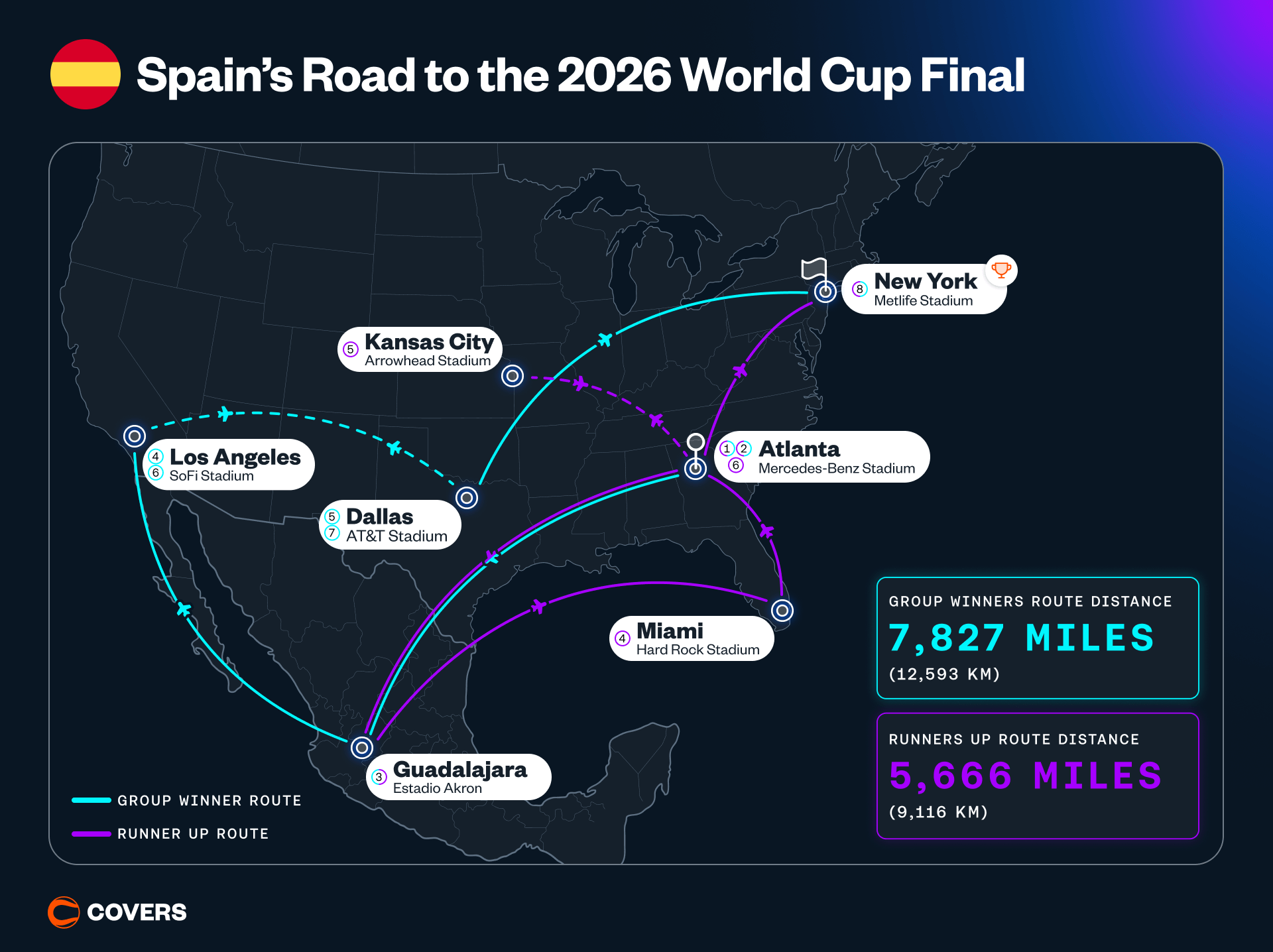
 Spain
Spain
Total distance if 1st: 12,593 km (7,827 miles)
Total distance if 2nd: 9,116 km (5,666 miles)
Total distance if 3rd: 10,248 km (6,369 miles)
Group stage route
- Match 1: Mercedes-Benz Stadium (Atlanta)
- Match 2: Mercedes-Benz Stadium (Atlanta)
- Match 3: Estadio Akron (Guadalajara)
They begin with a stable base in Atlanta before a big cross-border jump to Mexico.
Knockout route – if Spain finish 1st in the group
- Round of 32: Los Angeles
- Round of 16: Dallas
- Quarterfinal: Los Angeles
- Semifinal: Dallas
- Final: New York/New Jersey
This back-and-forth between Los Angeles and Dallas is what drives Spain’s enormous total.
Knockout route – if Spain finish 2nd in the group
- Round of 32: Miami
- Round of 16: Atlanta
- Quarterfinal: Kansas City
- Semifinal: Atlanta
- Final: New York/New Jersey
Ironically, Spain actually travel less if they finish 2nd.
Knockout route – if Spain finish 3rd in the group
A potential 3rd-place qualification route keeps Spain’s travel burden high, pushing total distance to 10,248 km.
Even outside the brutal 1st-place path, Spain would still face a fragmented route with limited geographic rhythm.
 USA
USA
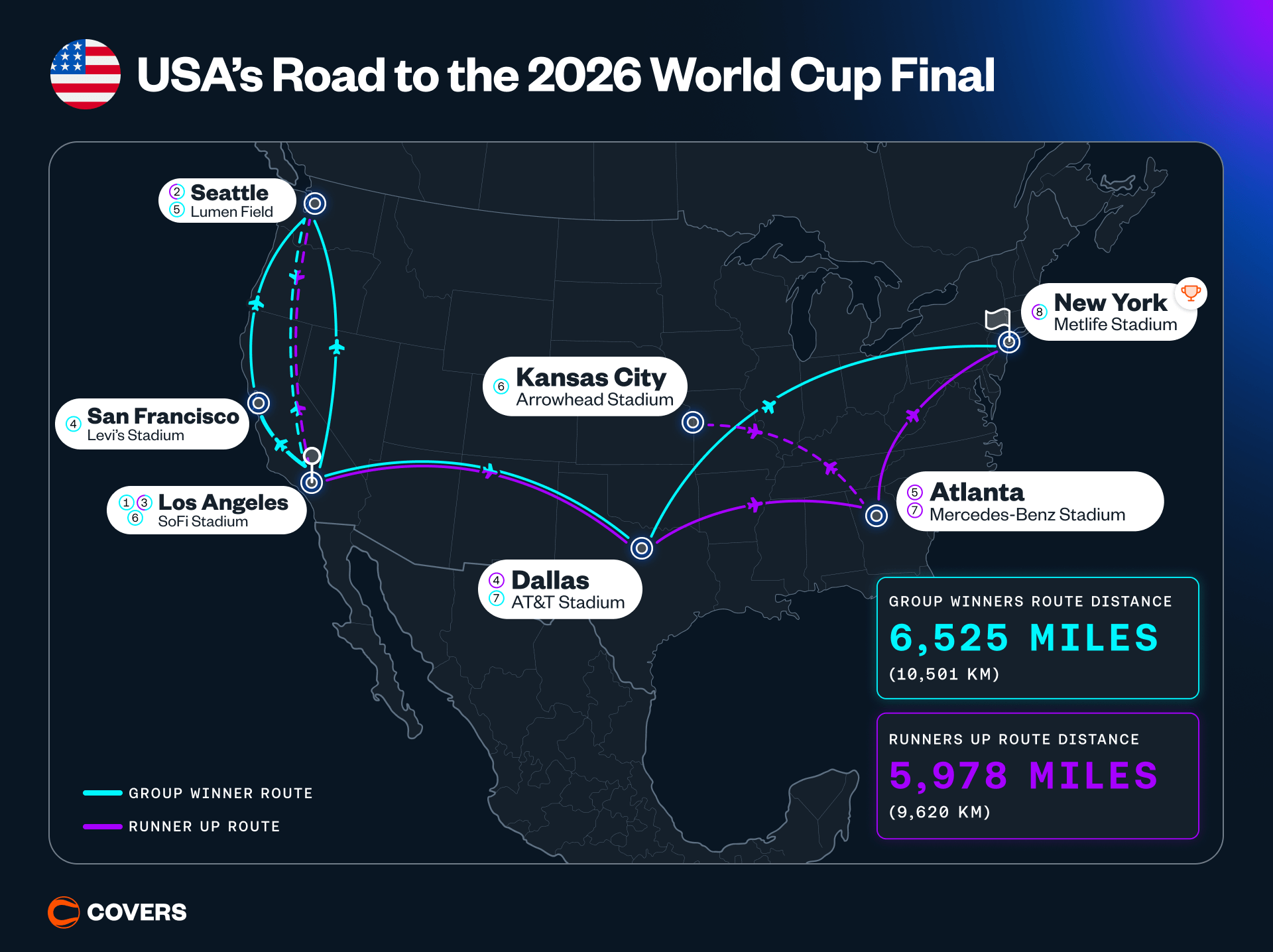
Total distance if 1st: 10,501 km (6,525 miles)
Total distance if 2nd: 9,620 km (5,978 miles)
Total distance if 3rd: 12,595 km (7,828 miles)
Group stage route
- Match 1: SoFi Stadium (Los Angeles)
- Match 2: Lumen Field (Seattle)
- Match 3: SoFi Stadium (Los Angeles)
A long West Coast swing, with a return to LA.
Knockout route – if USA finish 1st in the group
- Round of 32: San Francisco
- Round of 16: Seattle
- Quarterfinal: Los Angeles
- Semifinal: Dallas
- Final: New York/New Jersey
This keeps them on the West Coast for a long time before a major jump inland, then to the East.
Knockout route – if USA finish 2nd in the group
- Round of 32: Dallas
- Round of 16: Atlanta
- Quarterfinal: Kansas City
- Semifinal: Atlanta
- Final: New York/New Jersey
The 2nd-place route leans on more central and eastern venues and is actually shorter overall.
Knockout route – if USA finish 3rd in the group
A potential 3rd-place qualification route dramatically increases the U.S. travel burden, pushing total distance to 12,595 km — one of the heaviest paths among major contenders.
Unlike the more centralized 2nd-place bracket, this scenario introduces multiple long-haul transitions and far less geographic continuity.
🔧 Methodology
Stadium Coordinates
Each World Cup stadium was assigned a latitude and longitude based on official host city locations.
Haversine Formula
Distances between consecutive matches were computed using the great-circle method, which models the shortest possible flight-distance between two Earth coordinates.
Tournament Route Structure
For every team:
Match 1 → Match 2 → Match 3 → R32 → R16 → Quarterfinal → Semifinal → Final
Distance before Match 1 was not counted.
Group Outcome Scenarios
Two parallel models were calculated:
- 1st-place knockout path
- 2nd-place knockout path
Rankings
Travel burden rankings were based on the total kilometres for the 1st-place scenario, ensuring consistent comparison across all nations.