Prediction market combos function similarly to sports betting parlays, in that they allow traders to bundle multiple event contracts into a single position. But there are crucial differences to be aware of, as prediction markets operate differently from sportsbooks.
Combos on prediction markets are built from binary-event contracts, where traders choose ‘Yes’ or ‘No’ for specific outcomes, rather than fixed-odds lines.
Like traditional parlays, they come with the advantage of a significantly increased potential payout. However, in order to win, traders need to be correct on every selection in the combo.
For example, if you bet ‘Yes’ on "BTC above $65K" (at a 50% probability) and 'Yes' on "Rain in NYC" (also at a 50% probability), your combined payout would be priced based on the intersection of those events (approx. 25% probability). If both occur, you win a higher payout than you would have done selecting both individually, but if either fails, you lose both.
In this Kalshi and Polymarket combo guide, we’ll explain what prediction market combos are, how they work, and how traders are using them in all kinds of different strategies.
What are prediction market combos?
Combos are a mechanism for combining multiple independent or correlated market positions into one trade. Instead of managing five separate tickets, a combo lets traders express a single opinion across a group of events. And that opinion can be as complex as traders want it to be.
The two primary methods of creating prediction market combos include:
-
Platform-Native Combo Features: Dedicated interfaces (like Kalshi's combo tool) that automatically handle the math and ticket bundling.
-
Manual Rollover Parlays: A strategy used on platforms without native tools (like Polymarket), where you win one trade and manually reinvest the total proceeds into the next event.
 Key difference vs. sports betting
How prediction market combos work
Manual Combos (Rollover Strategy)
This is the old school approach. You place a trade on Event A. If it resolves correctly, you take the full payout (principal + profit) and immediately invest that entire amount into Event B.
-
Pros: Total control over timing and position sizing. A rollover allows traders to bet on games that start at different times and often yields higher payouts.
-
Cons: You must be present for every event's resolution, and you can’t execute the entire trade in one click.
Native Combo Features
Platforms like Kalshi and Fanatics allow you to select multiple contracts and bundle them into a single combo position, which is a much simpler way of creating combos on prediction markets. The platform groups everything into a single package, so you place a single trade and receive a single payout.
The platform's order book then calculates the combined probability, so traders don’t need to manage liquidity for each individual leg.
Payout Structure
The math works by multiplying the probabilities together. If Event A has a 60% probability and Event B has a 50% probability, the combo's implied probability is $0.60 multiplied by 0.50 = 0.30$ (or 30%). Your payout adjusts accordingly based on the total risk of all legs failing. So as you can see, combos come with a higher level of risk, but the compensation for that is a far higher potential reward.
Where to build prediction market combos
Prediction market combos can be built across all major prediction markets, but each offers slightly different ways to do so. Kalshi, for instance, has its own native tool, whereas Polymarket requires traders to manually build their own combos. Let’s take a closer look.
| Feature | Kalshi Combos | Polymarket (Manual) | Fanatics Markets |
|---|---|---|---|
| Native Tool | Yes | No | Limited |
| UX Style | Trading | Decentralized/Crypto | Sportsbook-like |
| Regulation | CFTC | Decentralized (Niche) | CFTC (via CDNA) |
| Strategy | One-click bundle | Rollover required | Simple flow |
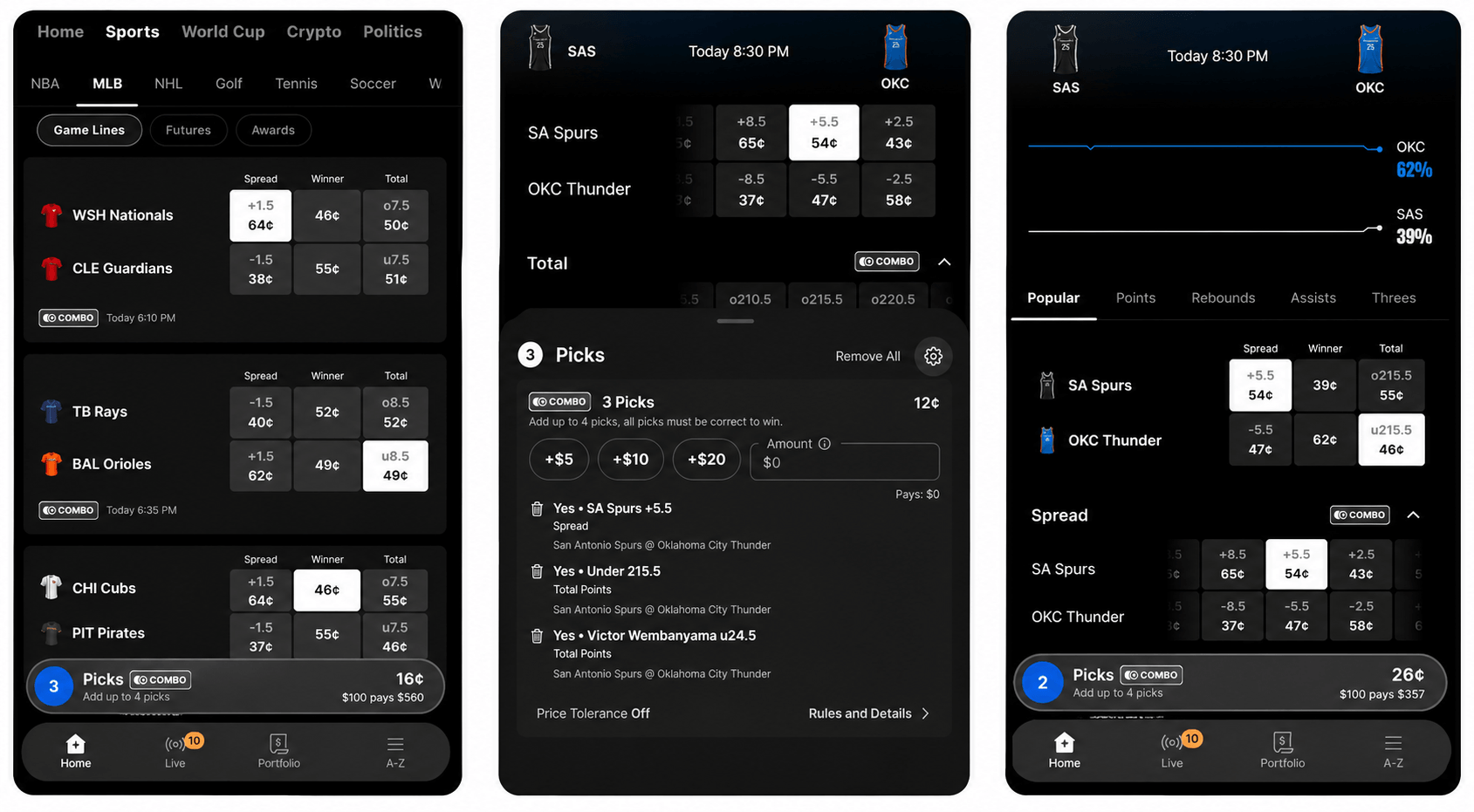
Kalshi app screenshots.
Kalshi Combos
Kalshi offers a recently introduced combo feature that allows you to bundle multiple event contracts into a single position. These are, effectively, Kalshi parlays.
The platform effectively manages your ticket by consolidating your selections. It's a native approach that simplifies execution, automatically calculating combined probabilities and managing the order book for the entire bundle.
Traders on Kalshi get both a structured and a transparent experience, as the platform is regulated by the Commodity Futures Trading Commission (CFTC).
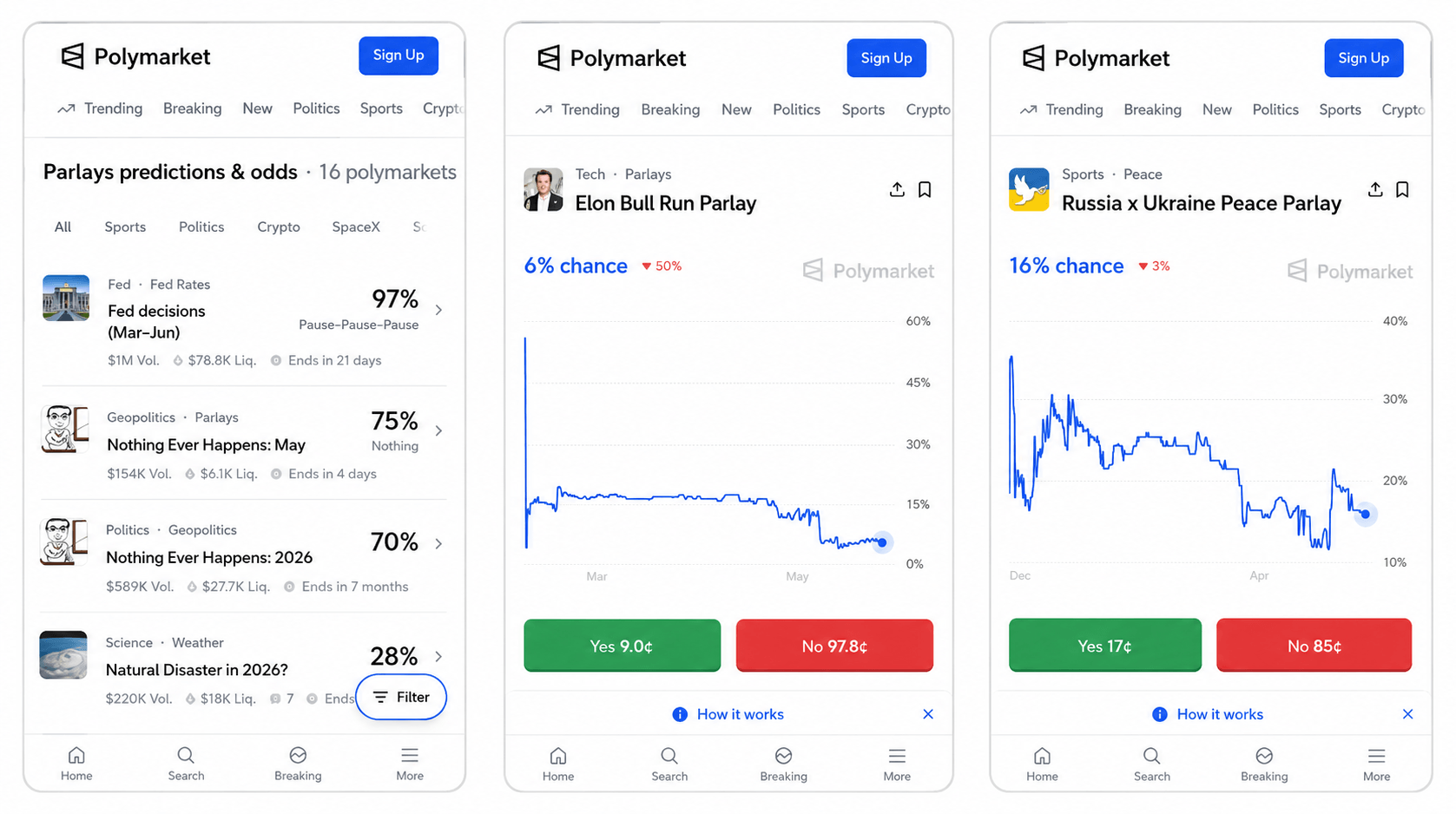
Polymarket app screenshots.
Polymarket (Manual Combos)
Polymarket does not currently offer a native combo builder, so there isn’t a one-click way to bundle predictions on the platform as yet.
Traders can, however, simulate a parlay using a manual rollover strategy, in which they reinvest the proceeds from a successful trade into a subsequent event contract. This requires more active management and manual entry than the combo feature offered on Kalshi, but it also offers better control over timing and position sizing at every step of the sequence.
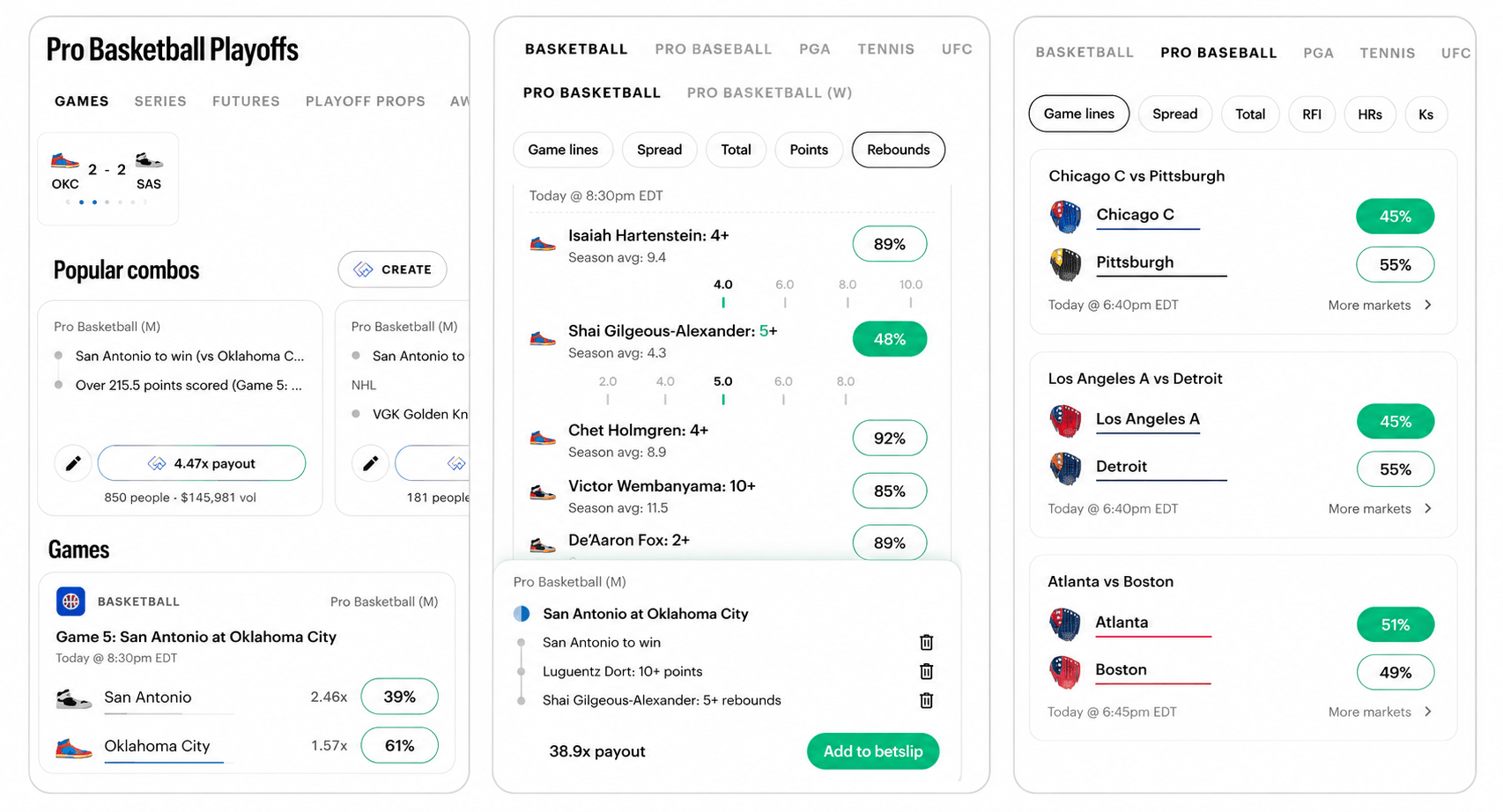
Fanatics Markets app screenshots.
Fanatics Markets Combos
Fanatics Markets offers a sportsbook-style user experience, which helps to make prediction markets accessible to a broader, casual audience.
Designed with a familiar interface that feels intuitive to those accustomed to traditional betting apps, the Fanatics combo offering streamlines trading event contracts across sports, finance, and culture.
It has an easy-to-use, clean, mobile-first design, and really bridges the gap for those who want to engage with event trading but are put off by the complexity of some of the more advanced financial trading platforms.
Prediction market combos vs. sports betting parlays
Prediction market combos are seen as the parlay of the prediction market world, but the mechanics of combos do differ from those found on a standard sports betting site.
On prediction market platforms, combos tend to be more dynamic and reflective of real market sentiment. They’re also less standardized than the pre-packaged parlays found at traditional sportsbooks.
| Feature | Prediction Market Combos | Sports Parlays |
|---|---|---|
| Pricing | Probability-based | Odds-based |
| Flexibility | Trade positions | Locked bets |
| Settlement | Contract-based | Game outcomes |
| Edge | Market inefficiencies | Bookmaker pricing |
Why prediction market combos and traditional parlays feel different
There are three key reasons why prediction market combos feel so different from the traditional parlays you’ve likely seen at sportsbooks. Let’s take a look.
Dynamic vs. Fixed: At a sportsbook, the parlay odds you see are the odds you get. But prediction markets are more complex. In a prediction market, the price of your combo updates in real time as the probability of your chosen events shifts. This allows for a more nuanced strategy, but it also makes combos more complicated (especially for beginners).
Lack of Standardization: Sportsbooks have robust, automated systems that instantly generate same-game parlays for nearly every outcome. Prediction markets, on the other hand, are newer and still maturing. While some platforms offer native combo tools, many still require manual rollover strategies. This can make the user experience less consistent.
The House Factor: When you bet a parlay, you are betting against the bookmaker's math. With prediction combos, you are often participating in a peer-to-peer exchange where the price is dictated by the collective wisdom of other traders. That means you’re navigating market sentiment rather than just a pre-calculated house edge.
How Kalshi Combos Work
Building prediction-market parlays in five simple steps
Select Markets
Navigate the platform and choose your events across diverse categories like Sports, Weather, Crypto, or Economics.
Add to Combo Builder
Use the native "Add to Combo" interface to cleanly group your selected contract positions together.
Review Combined Probability
The system automatically calculates your dynamic implied payout based on the combined likelihood of all selected events, mirroring a traditional sportsbook parlay flow.
Place Trade
Once you review and confirm the trade execution, your risk capital is locked into a single unified combo position.
Track Outcome
If every single leg of your contract settles correctly as 'Yes' or 'No' according to your position, the combo yields a full payout.
The Polymarket Rollover Strategy
How to manually manufacture a prediction market parlay
Place First Trade
Buy your 'Yes' or 'No' contract on the initial event market.
Wait to Settle
You must wait for the current market to completely resolve and clear.
Roll Winnings
Reinvest 100% of your initial stake and accumulated profit into the next trade.
Repeat Process
Continue for as many legs as you want for maximum control over your calculated odds.
Pro Tip: While this strategy is less capital-efficient and more time-consuming than Kalshi's one-click system, it provides meticulous price discovery control at every single step of the layout.
Why traders use prediction market combos
Traders typically opt for prediction market combos to maximize potential returns by linking related outcomes in a single trade. It’s a way of moving beyond basic betting and executing more complex strategies that come with higher risk but higher rewards.
Here are the key reasons why traders might choose prediction market combos.
Higher Payout Potential
The main reason why traders opt for prediction market combos is the increased payout potential they provide. By bundling multiple event contracts into a single position, traders can exponentially increase their potential returns compared to betting on individual outcomes.
The structure of combos creates a multiplicative effect, where the final payout reflects the combined lower probability that all selected events occur simultaneously. Traders often use prediction market combos to turn low-yield, high-certainty bets into high-reward opportunities that would otherwise be unavailable on single contracts.
Correlated Outcomes
Traders sometimes stack related events to exploit the mathematical dependence between them. This strategy allows users to capitalize on scenarios in which the occurrence of one event significantly increases the likelihood of another.
However, this approach requires careful analysis because if the underlying correlation is weaker than anticipated, the risk of the entire combo failing increases significantly.
Strategic Flexibility
Prediction market combos provide a unique level of control that allows users to construct complex positions across diverse categories like economics, weather and politics.
This versatility enables traders to create sophisticated hedging strategies that offset risks in their broader portfolios or target specific, multi-layered market movements. By moving beyond simple binary bets, traders can tailor their exposure to reflect real-world developments.
Familiar UX for Bettors
The design of prediction market combos on platforms like Kalshi effectively bridges the gap between traditional sports betting and modern financial prediction markets.
By mimicking the intuitive parlay layout that sports bettors already understand, these platforms lower the barrier to entry for new users who might otherwise find the jargon of event contracts intimidating.
Prediction market combos offer an immediately familiar user experience, which encourages engagement, particularly among new traders considering prediction markets for the first time.
Example prediction market combo
To illustrate how a combo works, let’s consider a scenario where you combine two independent events into a single ticket. In this example, you take a 'Yes' position on both contracts.
Event A: BTC price is above $65,000 at 3:15 PM ('Yes' position).
Event B: It rains in NYC tomorrow ('Yes' position).
| Metric | Event A (BTC) | Event B (Rain) | Combined Combo |
|---|---|---|---|
| Probability | 60% | 40% | 24% |
| Position | 'Yes' | 'Yes' | 'Yes' on both |
Probability and Payout Breakdown
Prediction market combos are multiplicative, so the platform calculates the combined probability of both independent events occurring simultaneously. Here’s how the math works.
When you see the calculation $0.60 times 0.40 = 0.24$, you are essentially calculating the likelihood of two separate events happening at the same time.
In probability, when you want to know the chance of Event A and Event B both occurring, you multiply their individual probabilities together.
Think of it as a filter process:
Start with the first event: You believe there is a 60% chance BTC will be above $65K. If you were only betting on this, you would be right 60 times out of 100.
Apply the second filter: Now, you add the second requirement: it must also rain in NYC. This only happens 40% of the time.
Calculate the intersection: You are now looking for the times when both are true. You only want the rainy days that occur within the BTC-is-up scenarios. Since you are taking 40% of that original 60%, the math works out to 0.24.
Expected Payout
If you wager $100 on this combo, you would end up with one of the following outcomes:
-
Successful Outcome: If both legs resolve to 'Yes', your total return is approximately $416 (calculated as $100 / 0.24). That results in a profit of $316.
-
Unsuccessful Outcome: If either Event A or Event B resolves to 'No', the entire combo fails, and you lose your full $100 stake.
Summary of Outcomes
The potential outcomes here are as follows:
Both hit ('Yes' and 'Yes'): You receive the full payout, as the combined probability of 24% accurately reflects the lower statistical likelihood of both events occurring. One misses ('Yes' and 'No' or 'No' and 'Yes'): The combo settles at zero, resulting in a full loss of your stake. Both miss ('No' and 'No'): The combo settles at zero, resulting in a full loss of your stake.
Important Math Note
This calculation assumes these events are independent, meaning the price of BTC has no impact on the weather in NYC. If the events are related (e.g., "The President wins the election" and "the stock market goes up"), the math can shift because one event might make the other more or less likely.
Advanced combo strategies
Traders who use data analysis and market discrepancies to maximize profits often opt for more advanced combo strategies. By mastering these techniques, you can move your portfolio from simple speculation to a more calculated approach.
Correlated combos
Correlated combos capitalize on the mathematical relationship between two events, such as a specific candidate winning an election and their party simultaneously securing a majority in the legislature.
By bundling related outcomes, traders can express a more nuanced market thesis that accounts for how one event's result logically increases or decreases the probability of the other.
This strategy works best when the market has not yet fully priced in the correlation, allowing traders to capture a more efficient return on their anticipated market shift.
Hedged combos
Hedged combos use event contracts to offset specific risks in traders’ portfolios. For instance, traders might opt to protect crypto holdings against upcoming regulatory or macroeconomic shocks.
Traders can create hedged combos by selecting 'Yes' or 'No' outcomes that would trigger a payout during periods of market stress. That way, traders can create their own form of insurance for their assets.
This approach requires precise position sizing to ensure the prediction market payout appropriately balances potential losses in the underlying investment, regardless of the broader market's direction.
Arbitrage opportunities
Arbitrage opportunities involve exploiting price discrepancies for the same event across platforms like Kalshi and Polymarket, where differences in liquidity or latency can create temporary pricing imbalances.
Traders look for situations where the combined cost of buying positions across platforms is lower than the guaranteed $1.00 payout, effectively locking in a risk-free return after accounting for transaction fees.
Price gaps often close within seconds, so capitalizing on them usually requires rapid execution or automated tools to identify and enter the trade before the market corrects.
Prediction markets news
Prediction market combos FAQ
In structure, they are similar. But in terms of mechanics, they’re quite different. They are similar in that all legs must succeed for the payout, but prediction combos are based on probability rather than fixed-odds pricing.
Yes, Kalshi offers a combo feature that performs the same function as a parlay.
No, Polymarket does not have a native combo builder. Users must manually rollover to create their own combos on the platforms. Refer to our Polymarket combo guide to find out how to create and manage manual rollovers on the platform.
They can be, but they are high-risk. Because you are multiplying probabilities, the statistical likelihood of winning decreases with every leg added.
Payouts are calculated based on the combined implied probability of all chosen events at the time of the trade. If your prediction is correct, you receive the full value. If it is incorrect, you lose your stake.